
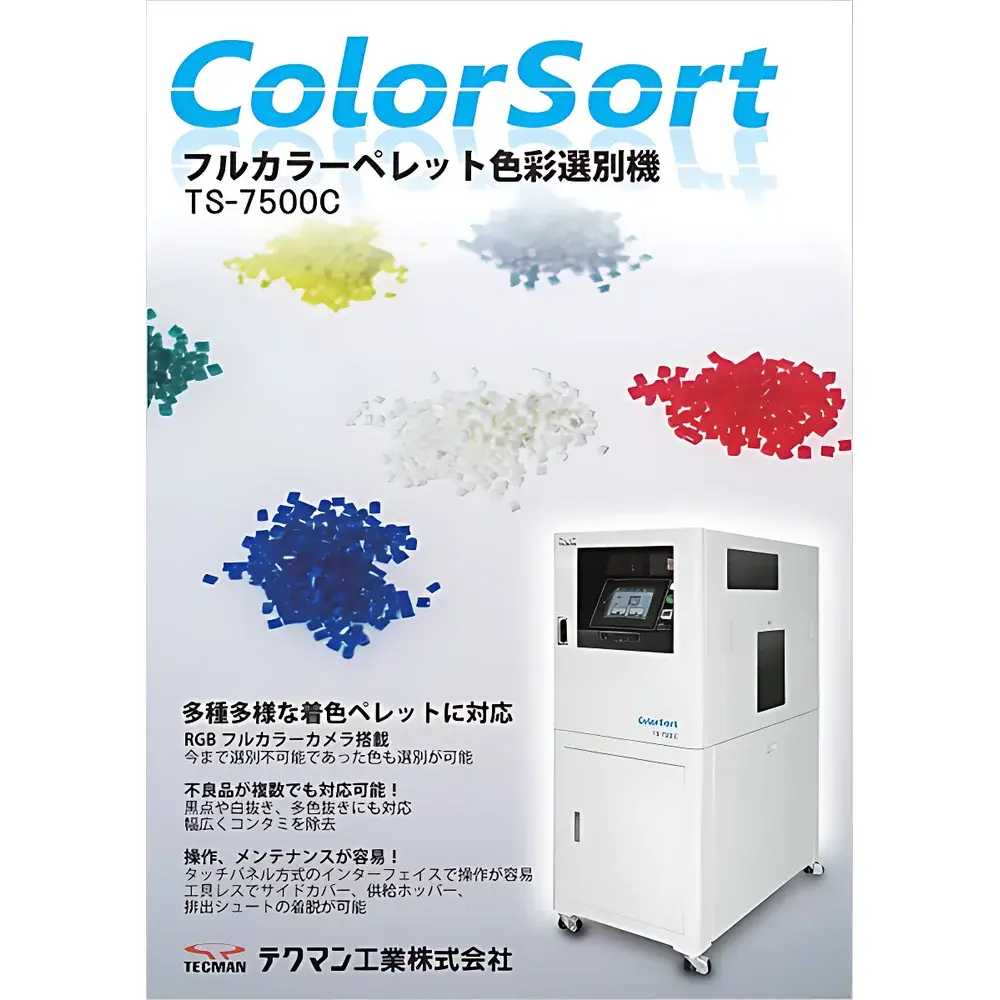
TECMAN TS-7500C Full-Color Pellet Sorting System
| Origin | Japan |
|---|---|
| Manufacturer Type | Authorized Distributor |
| Origin Category | Imported |
| Model | TS-7500C |
| Price Range | USD 42,000 – 70,000 |
| Power Supply | Single-phase AC 200 V |
| Dimensions (W×D×H) | 600 mm × 1120 mm × 1560 mm |
| Weight | 270 kg |
| Throughput | Up to 1000 kg/hr |
| Illumination | Spherical LED lighting |
| Camera Type | Linear CCD full-color RGB camera |
| Effective Resolution | ≤40 µm |
| Feed Mechanism | Vibratory feeder + roller conveyor |
| Particle Separation Principle | Velocity-differential separation between feeder and roller |
| Ejection | 20-channel solenoid valves |
| Human-Machine Interface | 8.4-inch color touch panel |
| Optional | PC-based remote monitoring system |
Overview
The TECMAN TS-7500C Full-Color Pellet Sorting System is an industrial-grade optical sorting instrument engineered for high-precision, real-time color and surface defect discrimination of thermoplastic pellets, granules, and small molded components. Operating on the principle of high-speed linear CCD imaging combined with multi-spectral RGB illumination and pixel-level chromatic analysis, the TS-7500C delivers consistent, repeatable sorting performance across heterogeneous batches. Unlike monochrome or near-infrared systems, its full-color RGB sensor captures true spectral reflectance data—enabling differentiation of subtle hue variations, gloss inconsistencies, contamination traces, and surface oxidation that are invisible to grayscale or narrow-band sensors. Designed for integration into continuous extrusion, compounding, and recycling lines, the system meets the metrological rigor required in polymer quality assurance workflows where visual appearance directly correlates with material homogeneity, thermal history, and end-product compliance.
Key Features
- Linear CCD full-color RGB imaging sensor with ≤40 µm effective spatial resolution, optimized for sub-millimeter pellet inspection (typically 2–12 mm diameter)
- Spherical LED illumination architecture providing uniform, shadow-free, and spectrally stable lighting—critical for minimizing specular reflection artifacts on glossy polymer surfaces
- Velocity-differential particle separation: vibratory feeder and roller conveyor operate at precisely controlled speed differentials to ensure single-layer, non-overlapping presentation to the imaging zone
- 20-channel high-speed solenoid ejection system with programmable timing and pressure control, enabling selective rejection of multiple defect classes in parallel
- 8.4-inch industrial-grade color touch HMI with intuitive parameter configuration, real-time image preview, histogram visualization, and pass/fail statistics logging
- Rugged mechanical construction (270 kg frame) with IP54-rated enclosure, designed for 24/7 operation in ambient factory environments (temperature: 5–40 °C; humidity: <85% RH, non-condensing)
Sample Compatibility & Compliance
The TS-7500C accommodates a broad range of polymeric materials—including PP, PE, PET, ABS, PC, and engineering resins—in pellet, flake, and cylindrical granule form. It supports transparent, translucent, opaque, and metallized particles without hardware modification. Sorting criteria are configurable via user-defined color thresholds (L*a*b*, RGB, or HSV space), brightness masks, and edge-based morphology filters. The system complies with IEC 61000-6-2 (EMC immunity) and IEC 61000-6-4 (EMC emissions) standards. While not certified as medical or pharmaceutical equipment, its architecture supports GLP-aligned documentation practices when paired with optional PC monitoring software—including audit-trail-enabled parameter change logs, image capture timestamps, and batch-level sorting reports exportable in CSV and PDF formats.
Software & Data Management
The embedded firmware provides deterministic real-time image acquisition, pixel binning, and classification at up to 1000 kg/hr throughput. Sorting logic is stored in non-volatile memory with version-controlled configuration files. The optional PC monitoring system extends functionality with remote diagnostics, historical trend analysis, and integration into MES/SCADA environments via Modbus TCP or OPC UA protocols. All image data and decision records are timestamped and retain traceability to individual production lots. When deployed under quality management systems aligned with ISO 9001 or IATF 16949, the system supports documented validation protocols—including repeatability studies (n ≥ 30), inter-operator agreement testing, and sensitivity verification using NIST-traceable color reference standards.
Applications
- Post-extrusion quality control of virgin and recycled polymer pellets to eliminate off-color batches, black specks, gels, and degraded particles
- Recycled PET flake sorting prior to melt filtration, ensuring removal of blue cap fragments, PVC contaminants, and discoloration from thermal degradation
- Color masterbatch verification in compound lines—detecting insufficient dispersion, incorrect pigment ratio, or cross-contamination between color runs
- Pharmaceutical excipient granule inspection (non-sterile ambient processing) for visual consistency prior to tableting or capsule filling
- Electronics-grade plastic component sorting where surface blemishes or inconsistent dye penetration affect downstream coating adhesion or ESD performance
FAQ
What types of materials can the TS-7500C sort?
It is validated for thermoplastic pellets (2–12 mm), flakes, and small injection-molded parts made from common polymers including PP, PE, PET, ABS, PC, PA, and POM. Transparent and semi-crystalline materials are supported via optimized illumination and contrast algorithms.
Does the system require calibration with physical standards?
Yes—initial setup includes white balance calibration using a certified diffuse reflectance tile and optional color target verification (e.g., X-Rite ColorChecker). Recalibration is recommended after major environmental shifts or lamp replacement.
Can sorting parameters be changed without stopping production?
Yes—thresholds, ROI definitions, and rejection logic can be modified dynamically via the touch HMI or remote PC interface while maintaining continuous feed; no mechanical reconfiguration is needed.
Is FDA 21 CFR Part 11 compliance available?
The base system does not include electronic signature or audit trail features required for Part 11. However, the optional PC monitoring package supports configurable user roles, password-protected parameter changes, and immutable log exports—providing a foundation for internal validation against Part 11 requirements.
What maintenance is required for long-term stability?
Routine tasks include weekly lens cleaning with optical-grade solvent, quarterly verification of LED intensity uniformity, and annual verification of solenoid valve response time and ejection accuracy using test pellets with known defect signatures.






