
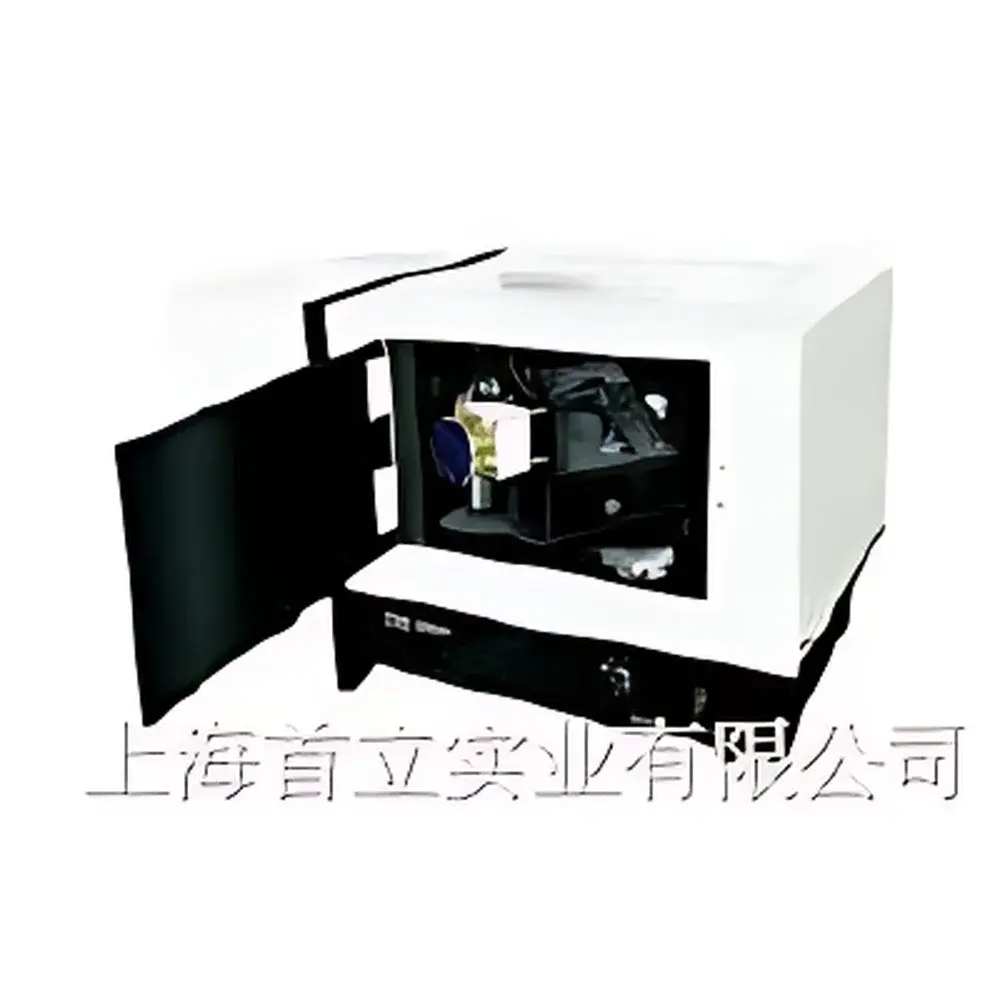
DDS-5000 Three-Dimensional Spectrogoniophotometer with Variable-Angle Colorimetry Capability
| Origin | Japan |
|---|---|
| Manufacturer Type | Authorized Distributor |
| Origin Category | Imported |
| Model | DDS-5000 |
| Pricing | Available Upon Request |
Overview
The DDS-5000 is a precision-engineered spectrogoniophotometer designed for angular-resolved spectral reflectance characterization of spatially and directionally anisotropic materials. It operates on the principle of goniophotometric spectral measurement—capturing wavelength-dependent reflectance as a function of both incident and viewing angles—enabling quantitative analysis of goniochromatic, retroreflective, and multidirectional scattering behaviors. Unlike conventional colorimeters or spectrophotometers limited to fixed 45°/0° or d/8° geometries, the DDS-5000 implements true three-axis articulation: independent motorized control of illumination angle (0°–70° in 5° increments), bidirectional detection angle (–70° to +70°, excluding ±10° blind zones relative to specular), and sample oscillation (–70° to +70°) coupled with automated rotational stage (1°–5° step resolution). This architecture supports measurement of BRDF (Bidirectional Reflectance Distribution Function) components under controlled CIE-standard illuminants, making it suitable for R&D and QC applications where appearance consistency under varying viewing conditions is critical.
Key Features
- Triple-axis goniometric platform: independently programmable illumination, detection, and sample oscillation axes with sub-degree repeatability
- Full-spectrum spectral acquisition from 400 nm to 700 nm using interference filters with 20 nm bandwidth and silicon photodiode array detection
- Halogen broadband source (12 V / 50 W) providing stable, continuous spectral output traceable to NIST-calibrated reference standards
- Automated angular scanning sequences compliant with ISO 18346:2015 (gonio-spectral measurement of reflective materials) and ASTM E308-22 (computing tristimulus values from spectral data)
- Four-level sensitivity adjustment (Standard, ×0.1, ×0.02, ×0.002) to accommodate highly reflective metals, low-reflectance matte finishes, and semi-transparent diffusers without saturation or noise floor limitations
- Compact benchtop footprint (622 × 440 × 421 mm) with rigid aluminum alloy frame minimizing thermal drift and mechanical hysteresis during long-duration angular sweeps
Sample Compatibility & Compliance
The DDS-5000 accommodates planar specimens ranging from 30 mm × 30 mm minimum to 150 mm × 150 mm maximum, supporting flat, slightly curved, or textured surfaces typical of automotive trim, injection-molded plastic housings, vacuum-metallized films, and LCD backlight diffuser plates. Its optical design excludes ±10° around the specular reflection vector to mitigate stray light interference—a configuration aligned with ISO/CIE recommendations for non-specular BRDF sampling. All firmware and measurement protocols are structured to support audit-ready documentation per GLP and ISO/IEC 17025 requirements. While the instrument itself does not carry FDA certification, its data export structure (ASCII tab-delimited spectral tables with metadata headers) is compatible with systems operating under 21 CFR Part 11-compliant environments when integrated with validated laboratory information management systems (LIMS).
Software & Data Management
The DDS-5000 is operated via dedicated Windows-based control software supporting script-driven measurement sequences, real-time spectral visualization, and BRDF matrix export in standard .csv and .spc formats. The software enables user-defined angular grids, automatic normalization against certified ceramic tile standards, and calculation of CIE 1931 xy chromaticity coordinates, CIELAB ΔE₀₀, and directional gloss indices at multiple angles. Raw spectral data includes timestamp, instrument ID, calibration epoch, and environmental condition tags (ambient temperature/humidity if external sensors are connected). Exported datasets contain full traceability metadata required for internal QA reporting and third-party technical review. RS-232C serial interface ensures deterministic communication timing and error-checked packet transmission—critical for integration into automated test cells requiring synchronized trigger inputs.
Applications
- Automotive interior and exterior component validation: measuring angular color shift in painted body panels, brushed aluminum trim, and pearlescent coatings
- Display technology development: characterizing viewing-angle dependency of LCD backlight units, quantum dot enhancement films, and micro-lens arrays
- Security and anti-counterfeiting material analysis: quantifying goniochromic response of optically variable pigments (OVPs) and diffractive security foils
- Industrial coating QC: verifying batch-to-batch consistency of metallic, mica-based, or flake-aligned finishes used in consumer electronics housings
- Lighting design support: generating BRDF look-up tables for ray-tracing simulations in optical modeling software (e.g., LightTools, TracePro)
- Academic research in appearance science: experimental validation of BRDF models including Cook-Torrance, Ward, and SVBRDF parameterizations
FAQ
Is the DDS-5000 capable of measuring transmittance or fluorescence?
No. The DDS-5000 is configured exclusively for reflectance-mode goniophotometry. It lacks excitation sources in UV or near-UV ranges and has no transmittance port or integrating sphere attachment.
Does the system include factory calibration certificates?
Yes—each unit ships with a NIST-traceable spectral irradiance calibration certificate for the halogen source and angular position verification report for all three motorized axes.
Can measurement data be imported directly into MATLAB or Python?
Yes. ASCII-formatted spectral and angular data files are fully parseable using standard I/O libraries (e.g., pandas.read_csv, numpy.loadtxt) without proprietary codecs or license dependencies.
What maintenance is required for long-term angular accuracy?
Annual recalibration of encoder zero points and optical axis alignment is recommended; this service is available through authorized regional service centers with certified metrology labs.
Is remote operation supported over Ethernet or USB?
No. Communication is strictly via RS-232C serial interface. USB-to-serial adapters may be used, but network-based control requires external hardware gateways not supplied with the base system.





