
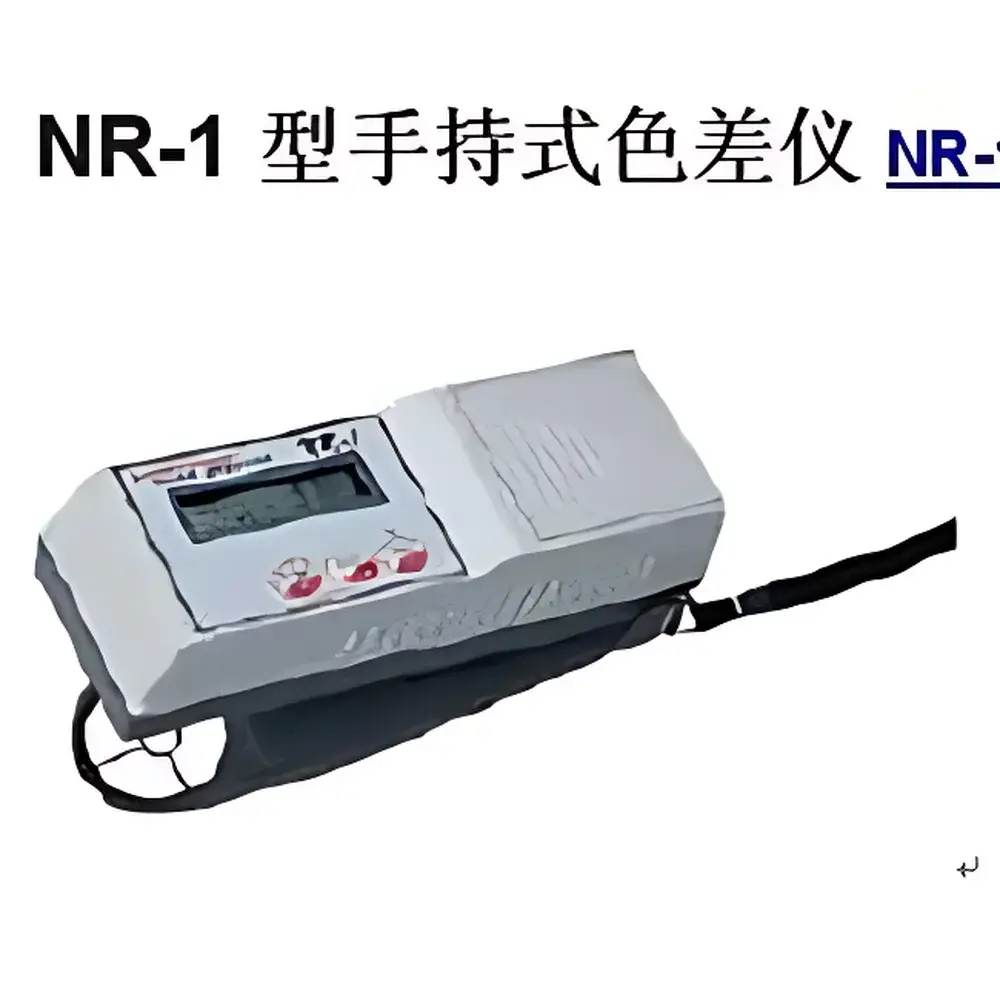
Konica Minolta NR-1 Handheld Color Difference Meter
| Origin | Japan |
|---|---|
| Manufacturer Type | Authorized Distributor |
| Origin Category | Imported |
| Model | NR-1 |
| Pricing | Upon Request |
| Measurement Geometry | 0°/45° (JIS Z 8722 compliant) |
| Measured Color Spaces | CIELAB (ΔL* a* b*), CIELCH (ΔL* C* H*), ΔE*ab, ΔEab, ΔLab |
| Pass/Fail Threshold Evaluation | User-definable ΔE*ab or ΔEab |
| Aperture Size | Φ10 mm |
| Illuminant | Tungsten Halogen Lamp (3 V / 1.5 A) |
| Repeatability (ΔE*ab) | ≤0.1 (based on SD of 20 measurements on certified white reference tile) |
| Dimensions (W × D × H) | 200 × 70 × 68 mm |
| Weight | 0.6 kg |
| Power Supply | AC adapter (400 mW) |
| Optional Accessories | Windows-compatible data acquisition & analysis software, RS-232C interface cable, thermal printer |
Overview
The Konica Minolta NR-1 Handheld Color Difference Meter is an industrial-grade, portable spectrophotometric instrument engineered for rapid, repeatable color difference evaluation in production environments. It operates on the 0°/45° illumination/viewing geometry specified in JIS Z 8722, ensuring compatibility with standardized visual assessment conditions used across automotive, plastics, paint, textile, and packaging industries. Unlike integrating sphere-based instruments, the NR-1 employs a fixed-angle optical path optimized for surface reflectance measurement under controlled directional lighting—minimizing gloss interference and enabling stable comparison against master standards. Its core functionality centers on CIE 1976 L*a*b* color space computation, delivering quantitative ΔL*, Δa*, Δb*, and total color difference values (ΔE*ab and ΔEab), with real-time pass/fail judgment based on user-defined tolerance thresholds. Designed for integration into QC workflows requiring immediate go/no-go decisions, the NR-1 requires no warm-up time, zero calibration prior to use, and delivers results within one second per measurement.
Key Features
- True plug-and-play operation: No pre-heating or daily calibration required; powered via AC adapter for continuous benchtop or inline station use.
- Intuitive single-button interface: One-touch reference setting, averaging of up to 9 sequential readings, and instant pass/fail status display via dual-color LED indicators (green = pass, red = fail).
- Precision targeting system: Integrated optical viewfinder with crosshair reticle enables accurate positioning over small or irregularly shaped test areas (Φ10 mm measurement spot).
- Environmental compensation: Built-in temperature sensor monitors ambient conditions and triggers audible/visual alerts if operational limits are exceeded—ensuring measurement integrity under variable factory conditions.
- Energy-efficient architecture: Automatic power-down after 3 minutes of inactivity; low standby current draw (<5 mA) extends operational readiness between maintenance cycles.
- Robust mechanical design: Compact housing (200 × 70 × 68 mm), ABS+PC polymer construction, and IP52-rated ingress protection for dust resistance and limited moisture exposure.
Sample Compatibility & Compliance
The NR-1 is validated for non-destructive reflectance measurement of opaque, matte-to-semi-gloss planar surfaces—including painted metal panels, injection-molded plastic parts, coated paper, and dyed fabrics. It conforms to multiple international colorimetric standards: JIS Z 8722 (Japanese Industrial Standard for color measurement geometry), ASTM E 308 (computing tristimulus values from spectral data), ASTM E 313 (yellowness index), and ASTM D 1925 (yellowness index for plastics). While not designed for transparent or translucent samples, its 0°/45° configuration inherently suppresses specular reflection artifacts common in high-gloss materials—making it suitable for production-line verification where absolute spectral fidelity is secondary to comparative consistency. The instrument’s repeatability specification (ΔE*ab ≤ 0.1 SD on white reference tile) meets internal QC requirements aligned with ISO 13655:2017 (spectral measurement practices) and supports GLP-compliant documentation when paired with optional software.
Software & Data Management
Optional Windows-compatible software enables full traceability and statistical process control (SPC) integration. The application supports bidirectional RS-232C communication for automated data logging, batch export to CSV/Excel, and generation of compliance reports including measurement timestamp, operator ID, reference ID, sample ID, and pass/fail verdict. Audit trail functionality records all parameter changes and threshold adjustments, satisfying basic FDA 21 CFR Part 11 requirements for electronic records when deployed with appropriate organizational controls (e.g., user authentication, change logs). Raw spectral reflectance data is not captured—the device computes and transmits only CIE-compliant color coordinates and derived metrics—reducing storage overhead and streamlining data review in regulated manufacturing settings.
Applications
- Automotive component color matching: Verifying consistency of interior trim, dashboards, and exterior body panels against master standards.
- Plastics manufacturing: Monitoring batch-to-batch color stability during extrusion and injection molding processes.
- Printing & packaging QA: Ensuring label and carton color alignment across press runs and substrate changes.
- Coatings & paints: Validating spray booth output before shipment; detecting pigment dispersion anomalies or curing inconsistencies.
- Textile dyeing: Performing final inspection of fabric lots for shade deviation in garment assembly lines.
FAQ
Does the NR-1 require annual recalibration?
No. The NR-1 is factory-calibrated using NIST-traceable reference tiles and does not require scheduled recalibration. Users should perform daily verification using the supplied white calibration standard to confirm optical stability.
Can the NR-1 measure metallic or pearlescent finishes?
It is not recommended. The 0°/45° geometry cannot resolve goniochromatic effects; for effect pigments, a multi-angle spectrophotometer (e.g., Konica Minolta CM-700d) is required.
Is battery operation supported?
The standard configuration uses an AC adapter. An optional rechargeable Li-ion battery pack is available as an accessory, providing ~4 hours of continuous use.
What is the minimum sample size for reliable measurement?
The Φ10 mm aperture requires a uniformly colored area ≥12 mm in diameter; smaller features may yield inaccurate results due to edge diffraction and background influence.
Does the software support SPC charting (e.g., X-bar/R charts)?
Yes. The optional software includes built-in SPC tools for real-time control chart generation, capability analysis (Cp/Cpk), and alarm thresholds tied to user-defined ΔE limits.





