
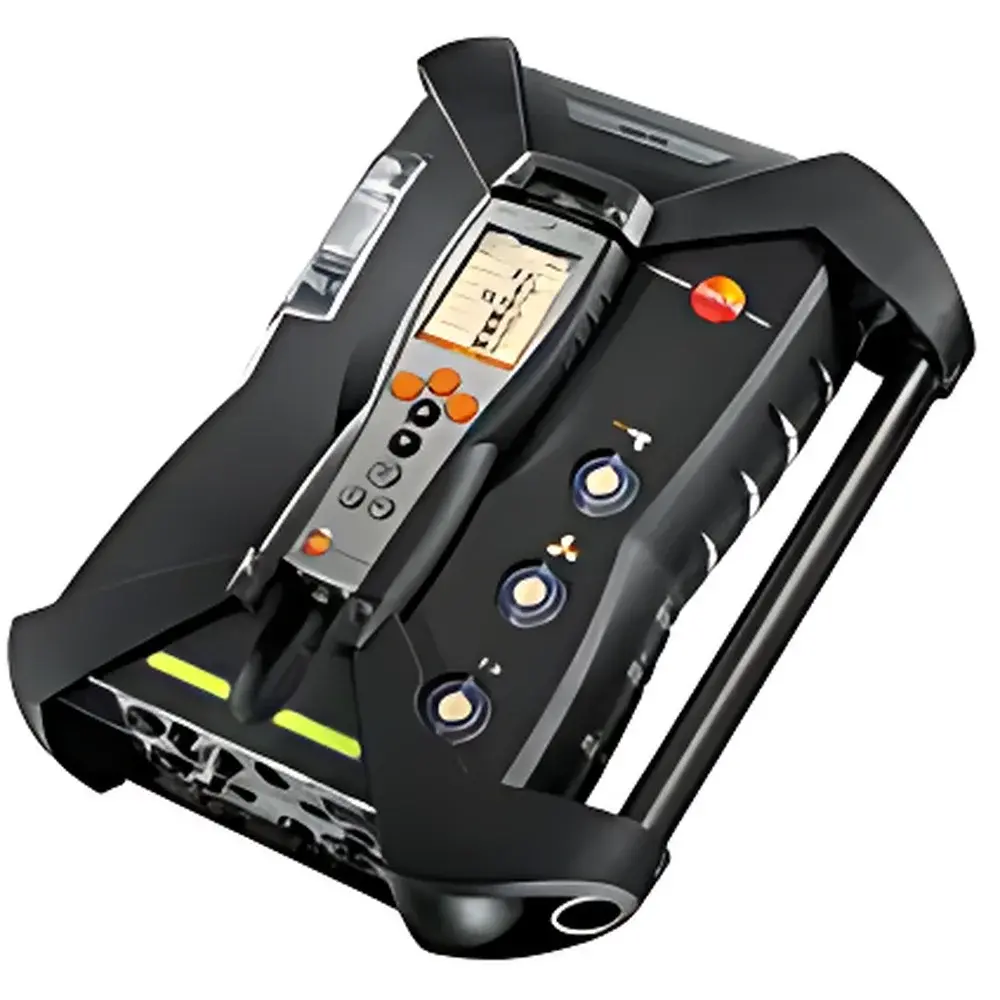
testo 350 Flue Gas Analyzer
| Origin | Germany |
|---|---|
| Manufacturer Type | Authorized Distributor |
| Origin Category | Imported |
| Model | testo 350 |
| Pricing | Upon Request |
Overview
The testo 350 Flue Gas Analyzer is a professional-grade, portable emissions measurement system engineered for precision, reliability, and regulatory compliance in industrial combustion diagnostics and environmental monitoring. Designed and manufactured in Germany by testo AG—a globally recognized leader in metrology—the instrument employs a hybrid sensor architecture combining electrochemical (EC), non-dispersive infrared (NDIR), and catalytic bead (CxHy) detection technologies to deliver simultaneous, real-time quantification of up to 12 flue gas components. Its core measurement principle relies on selective gas absorption spectroscopy (for CO₂ via NDIR), diffusion-controlled electrochemical redox reactions (for O₂, CO, NO, NO₂, SO₂, H₂S), and thermal conductivity-based hydrocarbon detection (for CxHy). The testo 350 is purpose-built for stack testing, boiler efficiency optimization, emission compliance verification (e.g., EU Directive 2010/75/EU, U.S. EPA Method 6C, 7E, and 10), and preventive maintenance of stationary combustion sources including gas turbines, industrial burners, steam generators, and waste incineration units.
Key Features
- Modular, field-serviceable analyzer housing with IP40-rated hand-held controller and rugged industrial-standard analysis box featuring thermally isolated sensor chambers and integrated Peltier-based gas conditioning (optional)
- Pre-configured application profiles—including burner, gas turbine, diesel engine, and industrial furnace—automatically load fuel-specific stoichiometric tables and priority parameter sets to minimize setup time and operator dependency
- High-resolution color graphical display with intuitive menu navigation, dynamic trend plots, and real-time process visualization (e.g., O₂ vs. CO, lambda vs. temperature)
- Dual communication interface: USB-C for direct PC connection and Bluetooth® 5.0 for wireless data transfer to laptops, tablets, or printers—enabling remote diagnostics up to 10 m line-of-sight
- Integrated condensate management with auto-monitored water trap and self-diagnostic pump status indicators to ensure long-term measurement stability under high-moisture conditions
- Hot-swappable gas sensors with plug-and-play calibration ID chips; no manual coefficient entry required during replacement
- On-board data logging capacity of 250,000 measurement values (2 MB internal memory) with timestamp, GPS tagging (via optional external module), and user-defined annotation fields
Sample Compatibility & Compliance
The testo 350 is validated for use across diverse flue gas matrices—including natural gas, LPG, light fuel oil, heavy fuel oil, biomass, and biogas combustion exhaust—with operating temperature ranges from −5 °C to +45 °C (hand controller) and up to +180 °C at probe inlet (with appropriate thermocouple selection). It meets EN 50379-1:2012 (portable flue gas analyzers), DIN EN 15548-1:2019 (performance requirements), and conforms to the essential requirements of the EU Measuring Instruments Directive (MID) for portable emission testers. While not certified as a Class I explosion-proof device, its design supports safe operation in non-hazardous zones per IEC 60079-0. All electrochemical sensors are factory-calibrated traceable to NIST and PTB standards, and the system supports GLP-compliant audit trails when paired with testo’s certified software suite.
Software & Data Management
Data acquisition, reporting, and instrument configuration are managed through testo’s proprietary testo EasyHeat and testo IRSoft software platforms—both compliant with FDA 21 CFR Part 11 for electronic records and signatures (when configured with user access controls, audit logging, and digital signature modules). Raw measurement files (.tdf) export seamlessly to CSV, PDF, or XML formats and support automated generation of DIN EN 12952-15–compliant boiler efficiency reports, ISO 5167–aligned flow calculations, and EPA-aligned stack test summaries. Firmware updates are delivered via secure HTTPS portal with SHA-256 integrity verification, and all calibration events—including sensor zero/span, linearity checks, and cross-sensitivity compensation—are logged with operator ID, timestamp, and environmental metadata.
Applications
- Combustion optimization and excess air ratio (λ) control for fossil-fueled boilers and furnaces
- Emission compliance monitoring per local TA Luft, MCERTS, or Clean Air Act Title V requirements
- Pre- and post-SCR/SNCR system performance evaluation (NOₓ reduction efficiency)
- Fuel switching validation (e.g., natural gas → hydrogen blends) with multi-component CxHy detection
- Leak detection and safety assessment in biogas upgrading facilities (H₂S, CH₄, CO)
- Thermal efficiency audits per ASTM D2845 and ISO 16889
- Commissioning and periodic inspection of CHP units, district heating plants, and cement kilns
FAQ
What gas parameters can the testo 350 measure simultaneously?
The standard configuration measures O₂, CO (H₂-compensated), NO, NO₂, SO₂, CO₂ (NDIR), H₂S, and flue gas temperature. Optional modules add CxHy (CH₄, C₃H₈, C₄H₁₀), low-range CO/NO, differential pressure, and ambient humidity.
Is the testo 350 suitable for high-moisture flue gases?
Yes—the integrated Peltier-cooled condensate separator (optional) maintains dew point control down to +2 °C, and the auto-monitoring water trap prevents sensor saturation during extended sampling of saturated exhaust streams.
How often does the system require calibration?
Electrochemical sensors typically retain accuracy for 6–12 months under normal use; annual full-system calibration is recommended. NDIR CO₂ and CxHy sensors require biannual verification against certified span gases.
Can measurement data be exported for regulatory submission?
Yes—testo IRSoft generates audit-ready PDF reports with embedded digital signatures, calibration certificates, and metadata required by EPA, EA, or local environmental agencies.
Does the testo 350 support third-party integration via API or Modbus?
No native Modbus or REST API is provided; however, real-time streaming over Bluetooth or USB is supported via testo’s SDK for custom SCADA or CMMS integration.







