
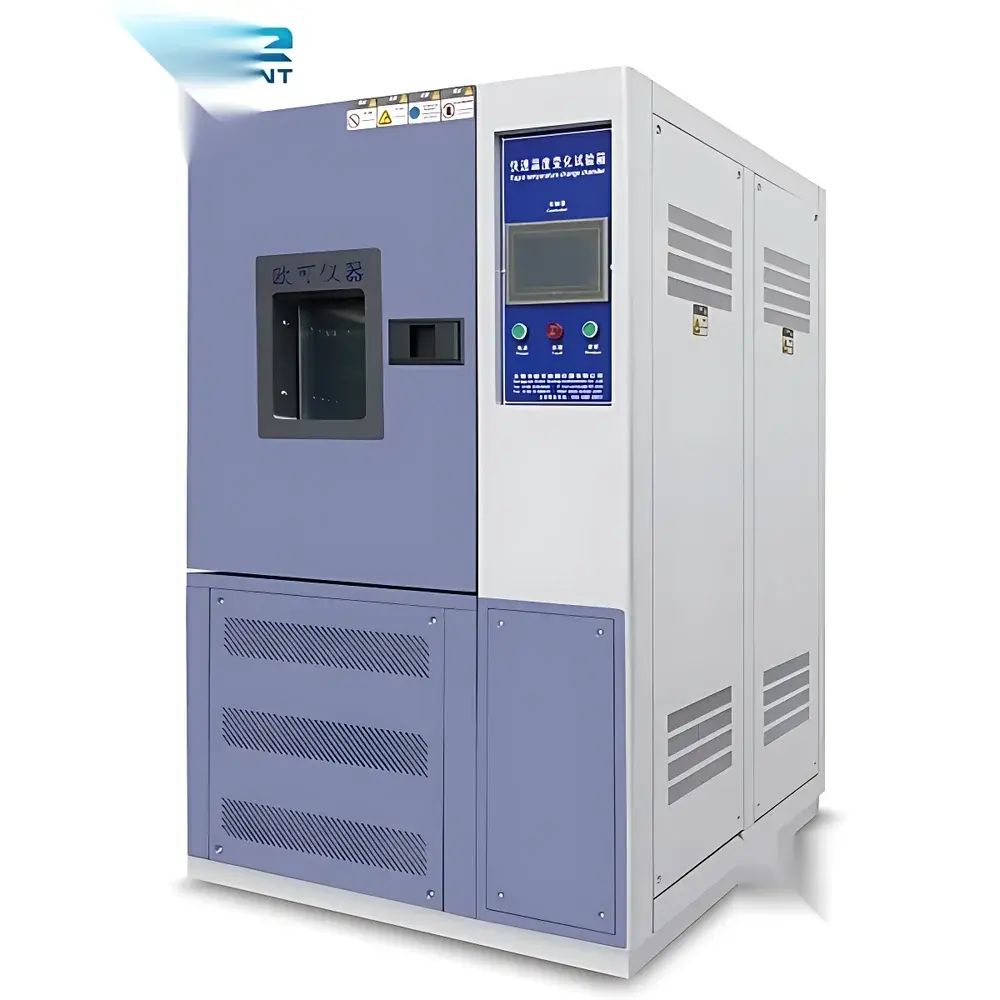
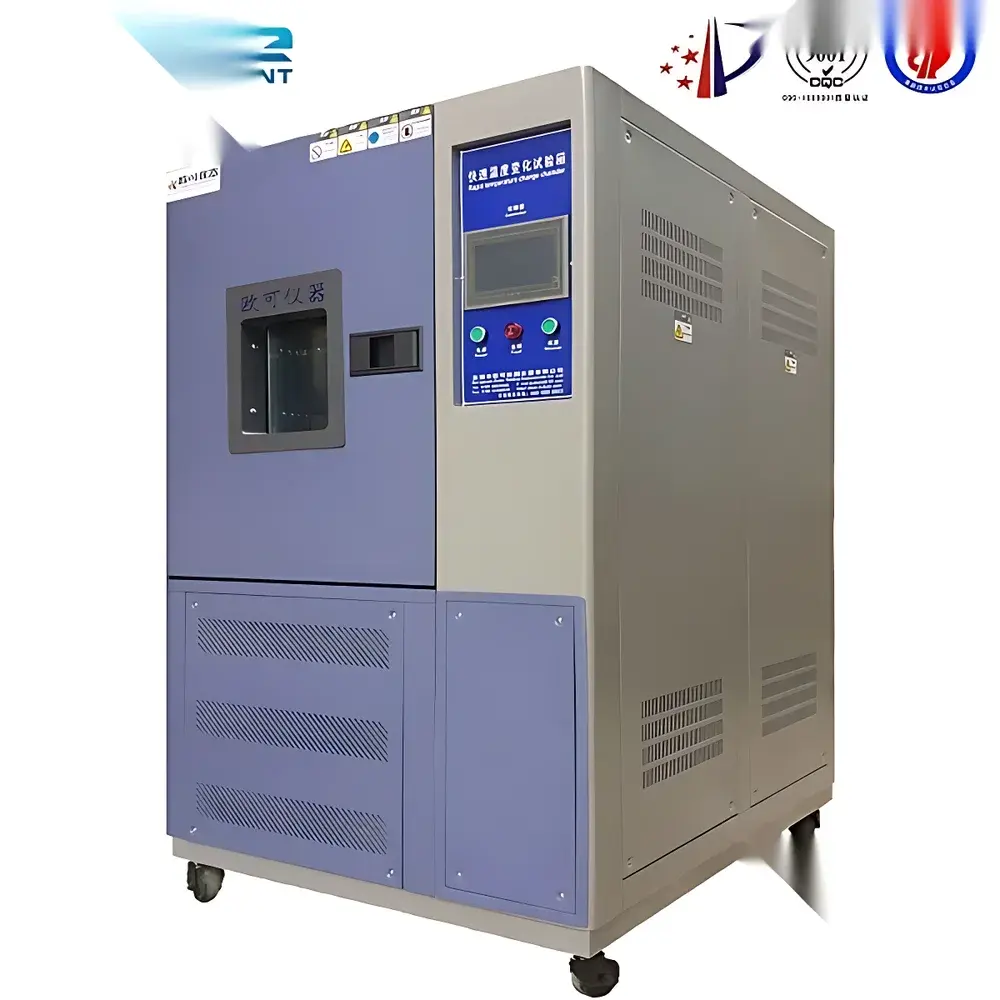
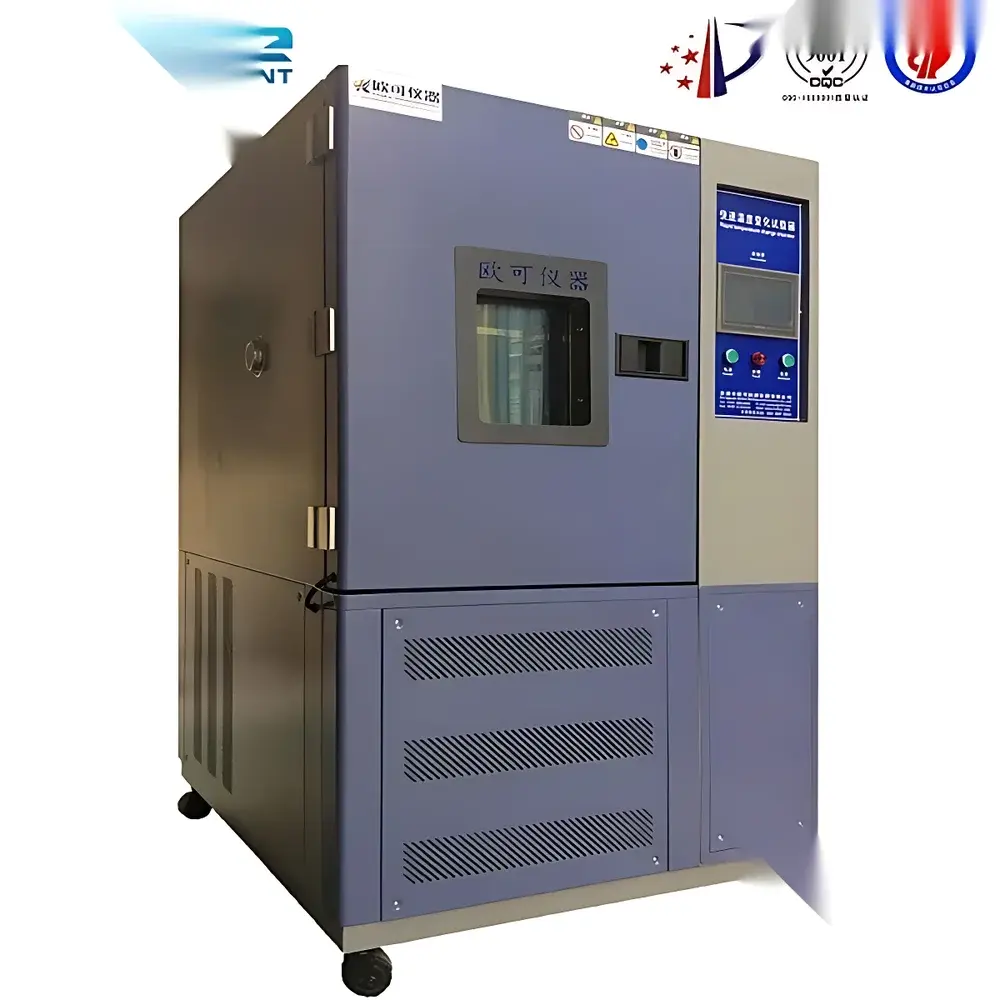
High-Low Temperature Rapid Thermal Cycling Chamber
| Key | Brand: Other Brands |
|---|---|
| Origin | Imported |
| Manufacturer Type | General Distributor |
| Temperature Range | -70°C to +150°C (configurable variants: -20/-40/-60°C to +150°C) |
| Humidity Range | 30–98% RH |
| Temperature Uniformity | ±2.0°C (ambient, unloaded) |
| Temperature Stability | ±0.5°C (ambient, unloaded) |
| Temperature Deviation | ±3.0°C (ambient, unloaded) |
| Heating Rate | 1.0–3.0°C/min (unloaded) |
| Cooling Rate | 0.7–1.0°C/min (unloaded) |
| Pressure Range | Ambient to 0.5 kPa |
| Pressure Accuracy | ±1.8 kPa (ambient–40 kPa), ±4.5% (40–4 kPa), ±0.1 kPa (4–0.5 kPa) |
| Depressurization Time | ≤45 min (ambient → 0.5 kPa) |
| Compliance Standards | GB/T 2423.1–2001, GB/T 2423.2–2001, GB/T 2423.3–1993, GB 10586–2006, GB 10589–2006, GB 10592–2006, GB 11158–2006, GB/T 5170.2–1996, GB/T 5170.5–1996 |
Overview
The High-Low Temperature Rapid Thermal Cycling Chamber is an engineered environmental test system designed to subject materials, components, and finished products to precisely controlled, accelerated thermal transitions under defined atmospheric conditions. It operates on a dual-mode thermodynamic architecture—integrating independent heating and refrigeration circuits—to enable rapid, repeatable temperature ramping across wide operational envelopes. The chamber employs a cascade or single-stage low-temperature refrigeration loop, utilizing hermetically sealed Copeland or Tecumseh compressors (equivalent to French “Tecumseh” units per original specification) for stable cryogenic performance down to –70°C. Air circulation is maintained via multi-blade centrifugal blowers with optimized duct geometry, ensuring uniform thermal distribution (±2.0°C uniformity) and minimal thermal lag during door opening events. This design conforms to the functional requirements of IEC 60068-2-14 (Test N: Change of Temperature) and supports both linear and stepwise thermal profile execution.
Key Features
- Independent dual-circuit thermal control system: Separated heating and cooling paths minimize cross-interference, improve energy efficiency, and extend component service life.
- Multi-wing centrifugal air circulation: Ensures laminar, high-velocity airflow with negligible dead zones; maintains specified temperature uniformity and stability even during dynamic transitions.
- Configurable temperature range: Standard variants include –20°C, –40°C, –60°C, and –70°C to +150°C; custom low-temperature extensions available upon request.
- Integrated humidity control (30–98% RH): Achieved via steam injection and precision dew-point regulation, compliant with GB/T 2423.3–1993 (Test Ca) and IEC 60068-2-78.
- Vacuum-capable configuration: Optional pressure control module enables operation from ambient down to 0.5 kPa, with calibrated accuracy across three pressure sub-ranges per GB/T 5170.2–1996.
- Robust structural insulation: High-density polyurethane foam (≥100 mm thickness) with vapor barrier layer minimizes thermal leakage and condensation risk.
Sample Compatibility & Compliance
This chamber accommodates standard test specimens up to 500 mm × 500 mm × 500 mm (W×D×H), with customizable interior dimensions and port configurations for sensor feedthroughs, power cabling, or real-time monitoring interfaces. All thermal and humidity profiles are traceable to national metrological standards via internal Class A PT100 sensors (IEC 60751) and calibrated hygrometers (capacitive polymer type, ISO 4618). The system meets essential requirements for GLP-compliant testing environments—including audit-ready calibration records, sensor drift monitoring, and configurable alarm thresholds for over-temperature, under-humidity, and pressure deviation. Full compliance documentation aligns with GB series standards referenced in the original specification, as well as harmonized equivalents: IEC 60068-2-1 (cold), IEC 60068-2-2 (dry heat), and ISO 16750-4 (road vehicles—environmental conditions).
Software & Data Management
Equipped with an embedded industrial controller running real-time Linux OS, the chamber supports programmable multi-step thermal/humidity/vacuum profiles with ramp/soak/hold logic, user-defined rate limits, and conditional branching. Data logging occurs at 1-second intervals, stored internally (≥30 days retention) and exportable via USB or Ethernet (Modbus TCP, optional OPC UA). The software interface provides full audit trail functionality—including operator login, parameter modification history, and event-triggered annotations—meeting the electronic record integrity criteria of FDA 21 CFR Part 11 when paired with appropriate access controls and digital signature modules. Calibration certificates and uncertainty budgets are generated per ISO/IEC 17025 guidelines and may be integrated into LIMS workflows.
Applications
- Electronics reliability validation: Solder joint fatigue assessment, PCB delamination screening, and semiconductor package stress testing per JESD22-A104 and MIL-STD-810H Method 503.5.
- Aerospace component qualification: Composite material thermal shock resistance, avionics enclosure integrity, and seal performance evaluation under combined thermal-vacuum cycling.
- Automotive ECU and battery module testing: Simulating under-hood thermal transients and cold-start conditions aligned with ISO 16750-4 and UN ECE R100.
- Pharmaceutical packaging stability: Accelerated aging studies for blister packs and primary containers under controlled humidity-temperature gradients.
- Materials science research: Polymer crystallinity analysis, elastomer hysteresis characterization, and phase-change behavior mapping across extreme thermal boundaries.
FAQ
What is the maximum achievable temperature transition rate between extremes?
The system achieves 1.0–3.0°C/min heating and 0.7–1.0°C/min cooling rates under unloaded, ambient-conditioned operation—rates that scale predictably with thermal mass and load configuration.
Can this chamber operate under vacuum while maintaining humidity control?
No—humidity and vacuum modes are mutually exclusive due to physical constraints of water vapor partial pressure; however, sequential humidity → depressurization profiles are fully supported.
Is third-party calibration certification included with delivery?
Yes—each unit ships with a factory-issued calibration report covering temperature, humidity, and pressure sensors, traceable to NIM (China National Institute of Metrology) or equivalent national standards.
Are non-standard chamber dimensions or custom thermal profiles supported?
Yes—engineering services include bespoke chamber sizing, specialized door mechanisms, extended low-temperature capability (e.g., –85°C), and profile scripting for complex thermal shock protocols.
Does the controller support remote monitoring and alarm notification?
Yes—via Ethernet interface with SMTP-based email alerts, SNMP traps, and optional integration into SCADA or cloud-based predictive maintenance platforms.



