
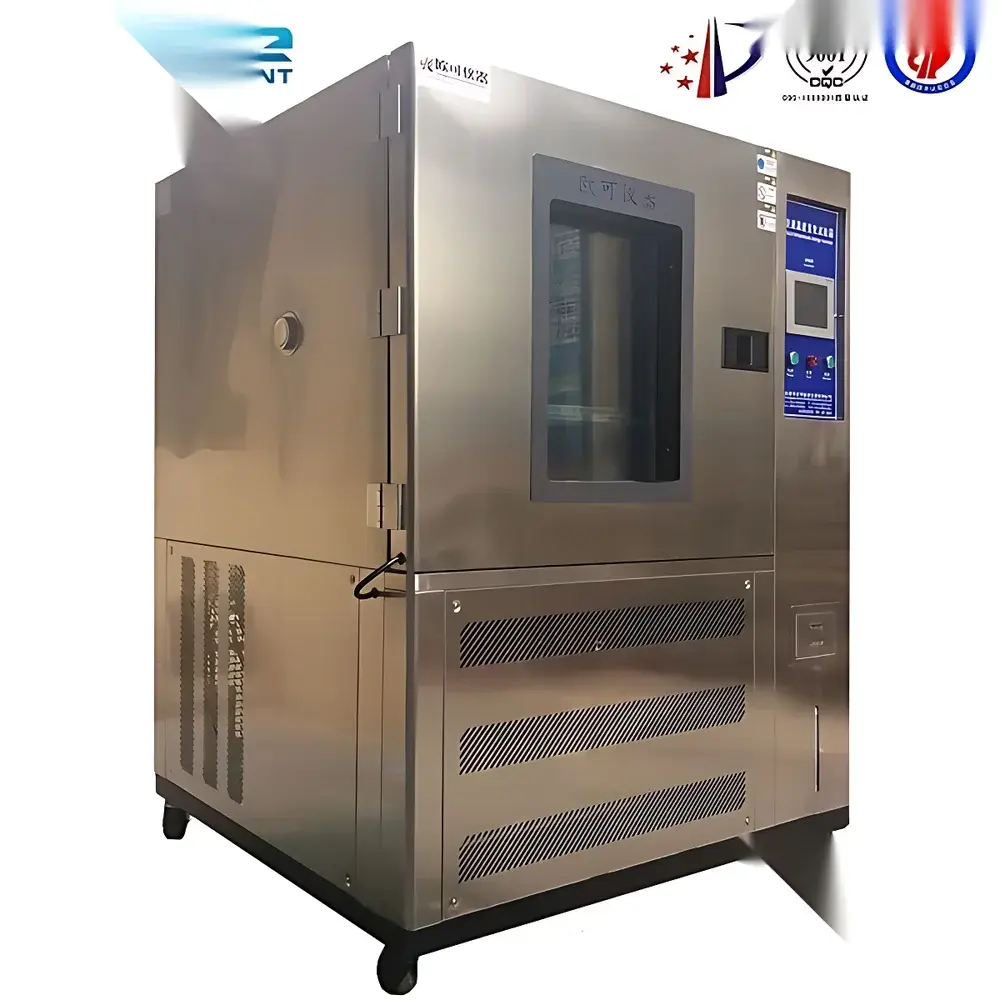
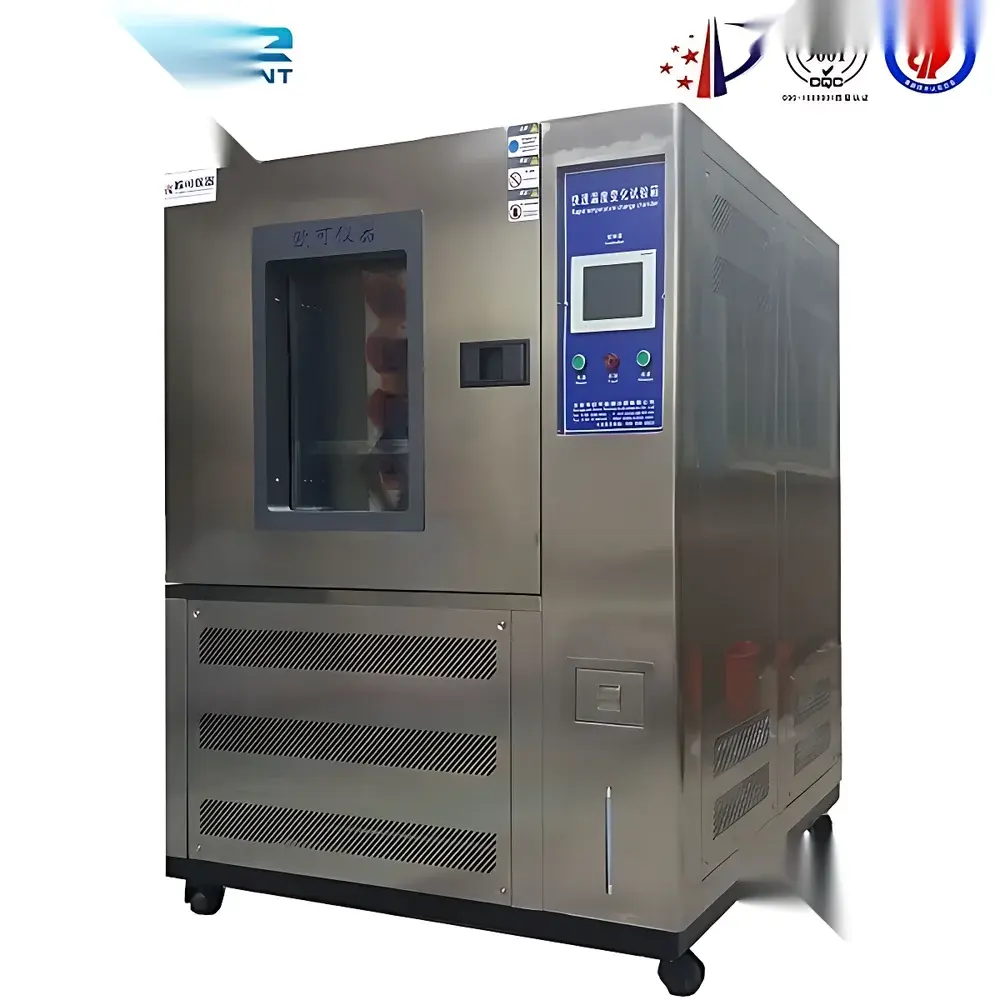
Generic Brand QTVT Series Rapid Temperature Change Environmental Test Chamber
| Brand | Other Brands |
|---|---|
| Origin | Imported |
| Manufacturer Type | Authorized Distributor |
| Temperature Range | -70 °C to +100 °C |
| Humidity Range | 20–98 % RH |
| Temperature Uniformity | ≤ ±2 °C |
| Temperature Fluctuation | ≤ ±0.5 °C |
| Humidity Deviation | +2 / −3 % RH |
| Cooling Rate | 0.7–1.2 °C/min |
| Heating Rate | 1.0–3.0 °C/min |
| Internal Chamber Dimensions (W×H×D) | 500 × 750 × 600 mm |
| Insulation Thickness | 80 mm High-Density Glass Fiber |
| Power Supply | 380 V, 50 Hz |
| Control System | PID-Based Digital Touchscreen Controller with PT100 Sensors |
| Display Resolution | 0.1 °C |
| Temperature Accuracy | ±0.1 °C (display range) |
Overview
The Generic Brand QTVT Series Rapid Temperature Change Environmental Test Chamber is an engineered thermal stress testing system designed for accelerated reliability assessment of industrial components and finished products under dynamically varying temperature and humidity conditions. Based on the principle of controlled thermal convection and vapor pressure regulation, the chamber employs a balanced heating/cooling architecture—combining high-efficiency refrigeration circuits, precision resistive heating elements, and saturated steam humidification—to achieve repeatable, traceable environmental profiles. It supports standardized thermal cycling protocols per IEC 60068-2-14 (Change of Temperature), MIL-STD-810H Method 503.5 (Temperature Shock), and JESD22-A104 (Temperature Cycling), enabling laboratories to evaluate material integrity, solder joint fatigue, seal performance, and condensation resistance across extended operational lifetimes.
Key Features
- Robust dual-wall construction: 1 mm cold-rolled A3 steel outer shell with electrostatic powder coating; mirror-finish SUS304 stainless steel inner chamber for corrosion resistance and ease of cleaning
- 80 mm thick high-density glass fiber insulation, minimizing thermal leakage and improving energy efficiency during rapid ramp cycles
- High-torque, low-vibration axial fan motor with multi-blade stainless steel impeller, ensuring uniform vertical airflow distribution and compliance with temperature uniformity requirements (≤ ±2 °C)
- Dual-layer high-tensile silicone rubber door gasket, rated for continuous operation from −70 °C to +150 °C, maintaining chamber integrity across extreme transitions
- Multi-layer tempered safety observation window with embedded conductive film heater to prevent fogging and enable real-time visual monitoring without thermal distortion
- Standard left-side test port (Φ50 mm) with removable blanking plug; optional configurations available for multiple feedthroughs or custom diameters upon request
- Heavy-duty locking PU casters (two fixed, two swivel) for stable positioning and safe relocation within controlled lab environments
Sample Compatibility & Compliance
The QTVT chamber accommodates samples up to 150 L in volume (500 × 750 × 600 mm internal dimensions), supporting standard test specimens used in electronics (PCBAs, connectors, sensors), automotive modules (ECUs, lighting assemblies), medical devices (diagnostic housings, infusion pump casings), aerospace components (avionics enclosures, composite fasteners), and polymer-based consumer goods. Its control architecture meets GLP and GMP-aligned operational traceability standards, including configurable audit trails, user-level access control, and password-protected parameter locking. While not pre-certified to specific regulatory marks, the system’s design aligns with foundational requirements of ISO/IEC 17025 accredited laboratories and supports validation documentation per ASTM E2709 and USP for analytical instrument qualification.
Software & Data Management
The integrated PID touchscreen controller provides intuitive profile programming—including step, ramp-soak, and cyclic modes—with up to 100 programmable segments and 999 cycle repetitions. Real-time data logging records temperature, humidity, setpoint, and alarm status at user-defined intervals (1–600 seconds); logs are exportable via USB to CSV format for post-test analysis in Excel or statistical software (e.g., Minitab, JMP). Optional Ethernet or RS485 interfaces support integration into centralized facility monitoring systems (SCADA/BMS) and enable remote supervision via secure web client. All firmware updates are delivered via signed firmware packages to maintain system integrity and version control in regulated environments.
Applications
This chamber is routinely deployed in QA/QC labs for HALT (Highly Accelerated Life Testing) screening, pre-compliance thermal stress validation, and failure mode identification prior to formal certification. Typical use cases include evaluating thermal expansion mismatch in multi-material assemblies, verifying moisture barrier performance of conformal coatings, assessing cold-start functionality of battery-powered instrumentation, and qualifying packaging integrity under tropical storage conditions (40 °C / 93 % RH). Its controlled ramp rates (0.7–3.0 °C/min) make it suitable for both gradual aging simulations and abrupt thermal shock evaluation—particularly where product geometry or thermal mass prohibits immersion-based shock methods.
FAQ
What is the maximum allowable sample mass for thermal stability during rapid ramping?
Thermal load capacity depends on total thermal mass and surface emissivity; for optimal control fidelity, we recommend limiting net sample weight to ≤ 30 kg when operating at full ramp rate specifications.
Can the chamber be validated for IQ/OQ/PQ protocols?
Yes—the system includes calibration-ready sensor ports, documented uncertainty budgets for PT100 sensors, and a comprehensive vendor-provided validation support package (URS template, FAT/SAT checklists, traceable calibration certificates).
Is humidity control maintained during sub-zero temperature operation?
Humidity is not actively controlled below 0 °C; the chamber operates in dry-cold mode per IEC 60068-2-1, with dehumidification achieved via refrigerant coil condensation and desiccant-assisted purge.
Does the controller support automated report generation?
The base unit does not generate formatted PDF reports; however, exported CSV logs can be imported into third-party reporting tools or scripted using Python/Pandas for automated summary dashboards compliant with internal SOPs.
What maintenance intervals are recommended for long-term reliability?
Compressor oil and refrigerant levels should be verified annually; condenser coils require bi-monthly vacuum cleaning; door gaskets and observation window heaters should be inspected quarterly for adhesion and continuity.



