
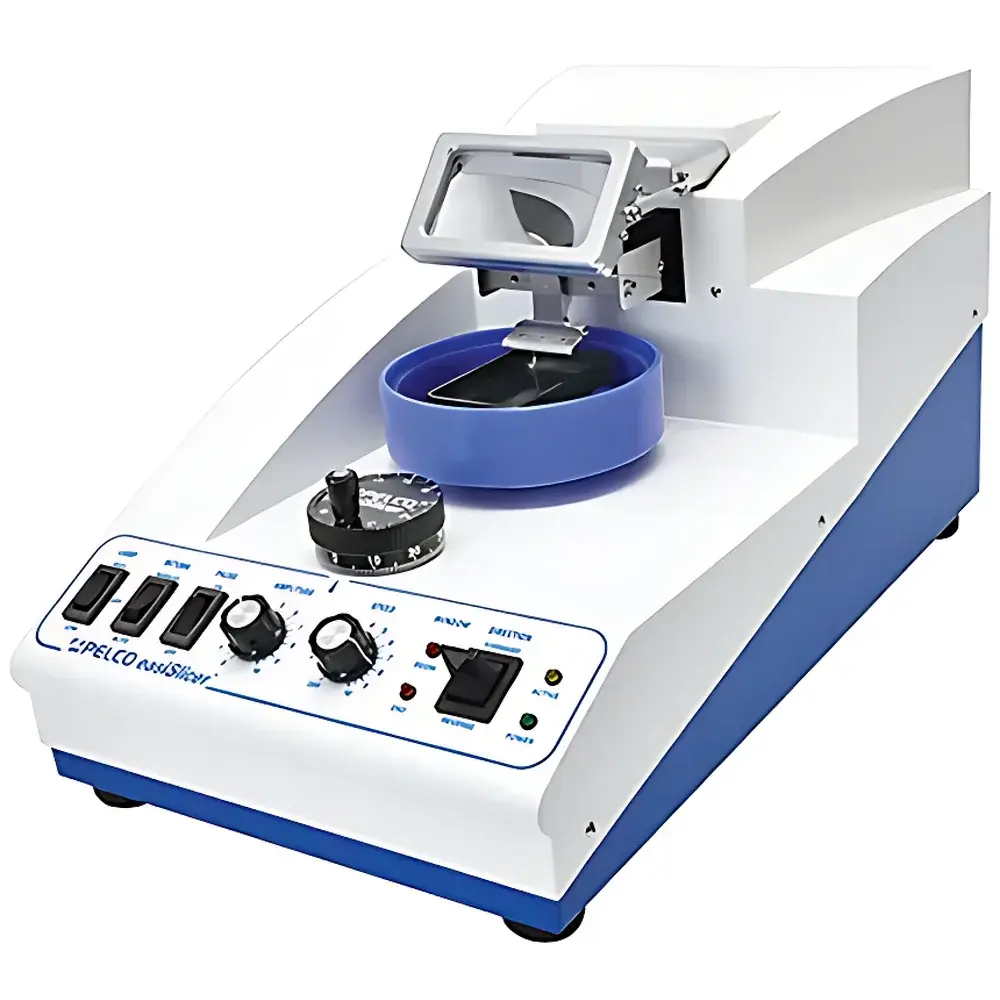
Ted Pella easiSlice Vibrating Microtome
| Brand | Ted Pella |
|---|---|
| Origin | USA |
| Manufacturer Type | Authorized Distributor |
| Product Origin | Imported |
| Model | easiSlice |
| Price Range | USD 6,800–13,600 (est.) |
| Max Sample Dimensions | 40 × 40 mm |
| Section Thickness Increment | 1 µm |
| Section Thickness Range | 40–1000 µm |
| Max Sample Height | 15 mm |
| Cutting Window | 10–40 mm |
| Z-Axis Adjustment Range | 0–15 mm (1 µm resolution) |
| Y-Axis Translation Speed | 0–2.0 mm/sec (forward), 5 mm/sec (return) |
| X-Axis Vibration Amplitude | 0–1.00 mm (continuously adjustable) |
| Vibration Frequency | 50–60 Hz |
| Magnification | 2× |
| Illumination | Dual-intensity white LED |
| Dimensions | 535 × 300 × 290 mm |
| Weight | 16.8 kg |
| Power Supply | 100–240 VAC, 50/60 Hz, 345 VA |
Overview
The Ted Pella easiSlice Vibrating Microtome is an engineered solution for high-fidelity sectioning of soft, hydrated, or lightly fixed biological tissues—including fresh, cryoprotected, or paraformaldehyde-fixed mammalian brain, spinal cord, plant meristems, and embryonic specimens. Unlike rotary or sliding microtomes, the easiSlice operates on the principle of controlled harmonic vibration: a precisely tuned electromagnetic drive induces lateral oscillation (X-axis) of the blade while the specimen advances vertically (Z-axis) at micron-level increments. This decoupled motion minimizes shear stress and compressive deformation, preserving ultrastructural integrity in sections as thin as 40 µm—critical for subsequent immunohistochemistry, live-cell imaging, electrophysiology, or serial block-face reconstruction. Its rigid monolithic frame and optimized mass distribution suppress parasitic Z-axis resonances, achieving mechanical stability comparable to premium-tier vibrating microtomes—without requiring active damping or external vibration isolation tables.
Key Features
- Rigid aluminum chassis with precision-ground linear rails ensures repeatable, drift-free vertical (Z-axis) advancement across the full 15 mm travel range, calibrated in 1 µm increments via a central micrometer-style knob featuring tactile detents every 5 µm.
- Modular polypropylene sample chamber with spring-loaded side-locking mechanism enables tool-free installation and removal; eliminates fluid leakage pathways and obviates external tubing or funnels.
- Magnetized square specimen stage provides secure, non-slip adhesion to the chamber floor—compatible with standard agarose, gelatin, or OCT-embedded samples—while remaining fully demagnetizable for easy cleaning.
- Interchangeable blade holders pre-set at 15°, 18°, and 21° bevel angles (15° supplied standard); each holder features a rigid stainless-steel clamping interface that prevents blade flexure or slippage during high-frequency vibration—eliminating calibration drift common in spring-loaded systems.
- Dual-intensity white LED illumination integrated into a pivoting 2× magnifier assembly delivers shadow-free, low-heat visualization of the cutting window and tissue surface; the lens can be swung out of the optical path when not required.
- Programmable return function allows user-selectable auto-return or manual stop at end-of-stroke, enabling precise retraction of the specimen prior to blade reversal—preventing compression artifacts and edge curling.
Sample Compatibility & Compliance
The easiSlice accommodates specimens up to 40 × 40 mm in planar dimension and 15 mm in height, supporting both free-floating and chamber-mounted protocols. It is routinely validated for use with rodent and primate neural tissue, zebrafish larvae, Arabidopsis root tips, and fungal hyphae. All wetted components are chemically resistant to 70% ethanol, PBS, sucrose solutions, and common cryoprotectants. The instrument complies with IEC 61010-1:2010 for laboratory electrical safety and meets CE marking requirements for EMC (EN 61326-1) and low-voltage directives. While not FDA-cleared as a medical device, its design supports GLP-compliant histology workflows—including audit-ready documentation of section thickness settings, vibration parameters, and operator-defined return logic—facilitating alignment with ISO/IEC 17025 quality management frameworks.
Software & Data Management
The easiSlice operates as a stand-alone electromechanical system with no embedded firmware or proprietary software dependencies. All operational parameters—including Z-step increment, forward speed, vibration amplitude, and frequency—are set manually via front-panel controls with tactile feedback and LED status indicators. This analog-digital hybrid architecture ensures deterministic behavior, eliminates cybersecurity vulnerabilities associated with networked instruments, and guarantees long-term serviceability without software obsolescence. For laboratories requiring traceability, parameter settings can be logged manually or integrated into LIMS via optional digital caliper interfaces or third-party motion controllers (e.g., Thorlabs KDC101) using standard USB/RS-232 protocols.
Applications
- Preparation of free-floating vibratome sections for fluorescence immunolabeling and confocal 3D reconstruction.
- Routine slicing of acute brain slices for patch-clamp electrophysiology and calcium imaging.
- Sectioning of delicate plant tissues (e.g., vascular bundles, stomatal complexes) without collapse or tearing.
- Serial sectioning of large-volume specimens for electron microscopy volume reconstruction (SBF-SEM, ATUM).
- High-throughput generation of standardized tissue sections for spatial transcriptomics and proteomics profiling.
FAQ
Is the easiSlice compatible with Feather® disposable blades only?
No—the blade holder accepts standard Feather® S35, but also accommodates other 35 mm-length, 0.5 mm-thick disposable blades (e.g., Ted Pella #11000, Electron Microscopy Sciences #72020) provided they meet ISO 8549-2 dimensional tolerances.
Can the vibration frequency be adjusted outside the 50–60 Hz range?
No—the unit is hardwired to line frequency (50 Hz or 60 Hz depending on regional mains supply) to ensure stable, jitter-free oscillation; this eliminates phase drift and maintains consistent harmonic coupling between blade and specimen.
Does the instrument require water cooling or external air supply?
No—all thermal management is passive; the electromagnetic actuator and power electronics are rated for continuous operation at ambient temperatures up to 35°C without derating.
How is calibration verified for section thickness accuracy?
Users may validate Z-axis linearity using NIST-traceable gauge blocks or interferometric stage calibrators; the micrometer knob’s 100 µm/revolution ratio and engraved scale provide direct mechanical traceability to SI units.
Is the sample chamber autoclavable?
The polypropylene chamber is autoclavable at 121°C for 20 minutes (max. 3 cycles); however, repeated sterilization may reduce magnet strength in the specimen stage—replacement stages are available as consumables.



