
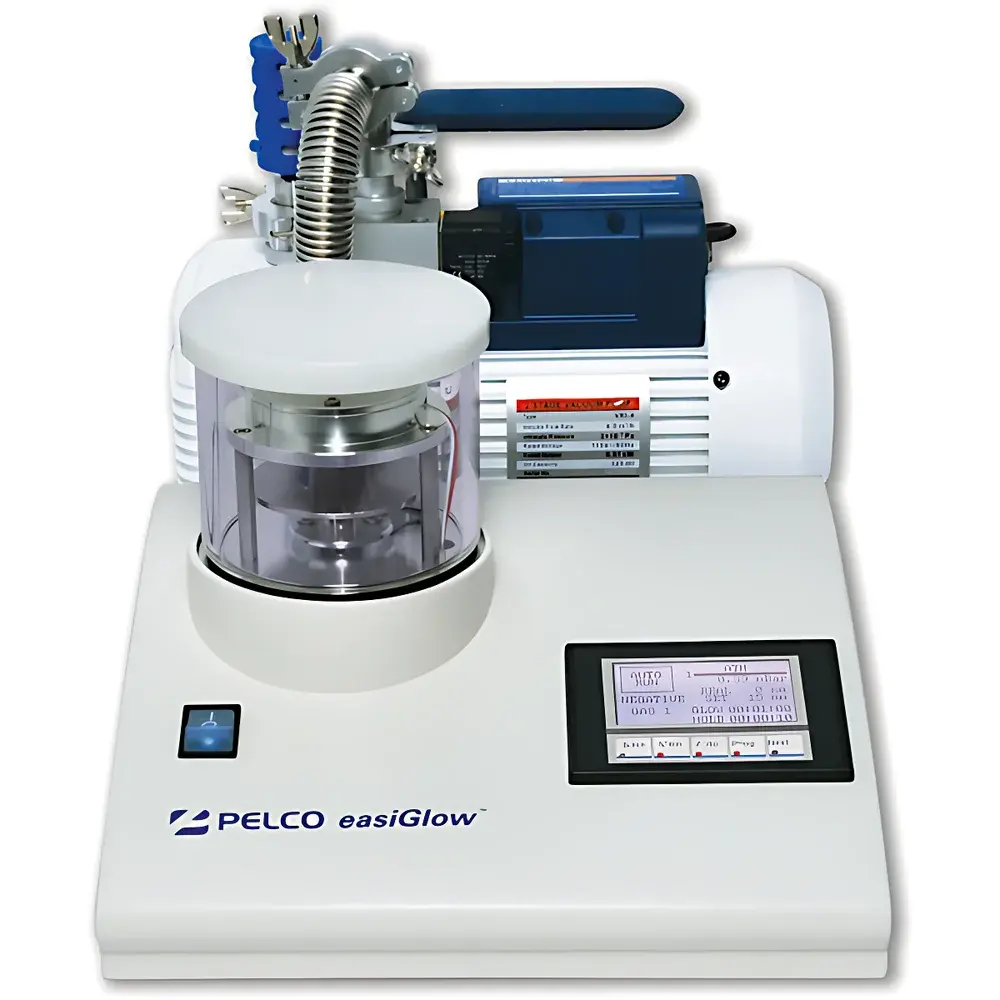
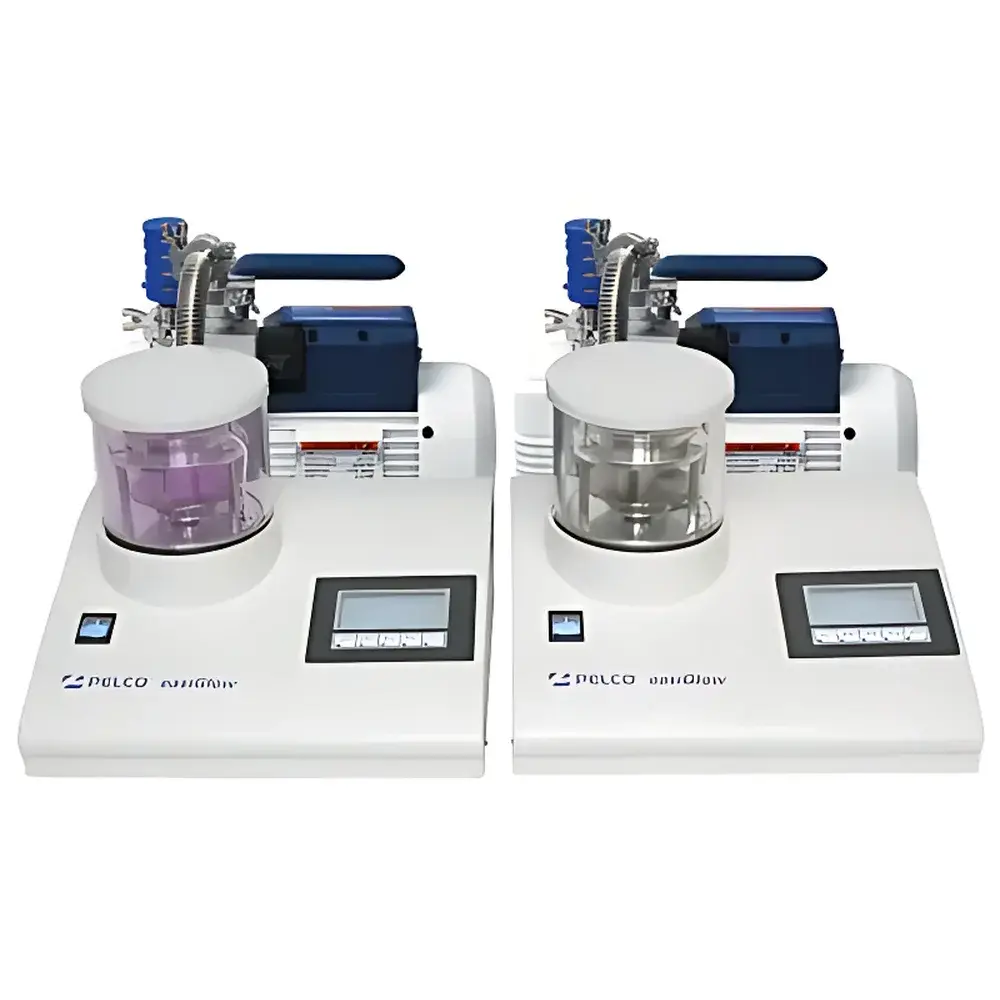
PELCO easiGlow™ Glow Discharge System 91000
| Brand | Ted Pella |
|---|---|
| Origin | USA |
| Manufacturer Type | Authorized Distributor |
| Product Origin | Imported |
| Model | PELCO easiGlow™ 91000 |
| Plasma Current | 0–30 mA |
| Power | 30 W |
| Electrode Polarity | Reversible (Positive/Negative) |
| Sample Stage Diameter | 75 mm |
| Stage Height Adjustment | 1–25 mm |
| Delay Time | 0–14,400 s |
| Treatment Time | 0–900 s |
| Chamber Dimensions | 120 × 100 mm |
| Gas Inlets | Two 6 mm ports |
| Vacuum Control | Electromechanical proportional valve with Pirani gauge |
| Operating Vacuum Range | 1.1–0.20 mbar |
| Ultimate Vacuum (with optional GD4 pump) | 0.03 mbar |
| Pump Speed (GD4) | 2.5 m³/hr |
| Display | 3″ LED-backlit touchscreen with five dedicated function keys |
| Control Modes | Auto-programmable (up to 4 user-defined protocols) + Manual mode |
| Safety | Dual hardware/software vacuum interlock |
| Dimensions (unit) | 305 × 292 × 230 mm (L×W×H) |
| Weight (unit) | 6.26 kg |
| Optional GD4 Pump Dimensions | 337 × 138 × 244 mm |
| GD4 Weight | 11 kg |
| Electrical Requirement | 230 V, 50 Hz, 10 A |
Overview
The PELCO easiGlow™ Glow Discharge System 91000 is a compact, benchtop plasma treatment instrument engineered for precise surface functionalization of transmission electron microscopy (TEM) support films and copper grids. It operates on the principle of low-pressure DC glow discharge plasma generation—ionizing inert or reactive gases (e.g., air, argon, oxygen, or ammonia) at controlled pressures between 1.1 and 0.20 mbar. Under this regime, energetic electrons collide with gas molecules, producing reactive species (ions, radicals, UV photons) that modify surface chemistry without thermal damage. This process enables reproducible conversion of hydrophobic carbon films into hydrophilic, negatively charged surfaces—critical for uniform aqueous sample spreading, reduced charging artifacts, and improved grid-to-grid consistency in high-resolution TEM workflows.
Key Features
- Reversible electrode polarity control (positive/negative) to tailor surface charge and wettability—enabling both hydrophilic and hydrophobic treatments within a single chamber.
- Electronically regulated proportional vacuum valve replaces manual needle valves, ensuring repeatable pressure setpoints and eliminating operator-induced variability.
- Stepwise venting protocol prevents mechanical stress on delicate TEM grids during atmospheric re-entry, preserving structural integrity of ultra-thin support films.
- Intuitive 3-inch LED-backlit touchscreen interface with five dedicated soft keys supports rapid parameter entry, real-time status monitoring, and seamless transition between auto-programmed and manual operation modes.
- Dual independent gas inlets allow sequential or simultaneous introduction of different gases—essential for multi-step surface engineering (e.g., Ar sputtering followed by O₂ activation).
- Modular sample stage accommodates standard 25 × 75 mm glass slides, individual TEM grids, or custom fixtures; optional dual-clamp holders enable batch processing of up to 20 grids per cycle.
- Integrated dual-safety interlock system—hardware-based vacuum cutoff and software-enforced pressure validation—ensures compliance with laboratory electrical safety standards and prevents accidental operation outside defined operational envelopes.
Sample Compatibility & Compliance
The easiGlow™ 91000 is validated for use with standard 200–400 mesh copper, nickel, and gold TEM grids; continuous carbon, Formvar, and ultrathin graphene oxide support films; and silicon nitride electron-transparent windows. Its treatment parameters align with widely adopted TEM preparation protocols described in ASTM E1558 (Standard Guide for Preparation of Transmission Electron Microscopy Specimens) and ISO/IEC 17025–2017 requirements for equipment calibration traceability. When operated with optional GD4 rotary vane pump (ultimate vacuum: 0.03 mbar), the system meets vacuum stability criteria required for GLP-compliant documentation workflows. All firmware logs—including pressure curves, current draw, treatment duration, and user ID—are timestamped and exportable for audit trail generation under FDA 21 CFR Part 11–aligned data governance frameworks.
Software & Data Management
The embedded microcontroller stores up to four fully customizable treatment protocols, each defining pressure setpoint, polarity, delay time, treatment duration, and gas selection. Each protocol retains full execution history—including date/time stamp, operator ID (if network-authenticated), vacuum ramp profile, and final plasma current—accessible via USB export in CSV format. No proprietary drivers or cloud dependencies are required; raw log files are compatible with common LIMS platforms and Excel-based QA review pipelines. Firmware updates are delivered via secure HTTPS download and verified using SHA-256 checksums to ensure integrity and version control traceability.
Applications
- Routine hydrophilization of carbon-coated TEM grids prior to negative staining or cryo-EM grid preparation.
- Controlled oxidation of graphene or MoS₂ monolayers to introduce oxygen-containing functional groups for targeted biomolecule anchoring.
- Surface activation of PDMS microfluidic channels to enhance bonding strength with glass substrates in TEM-compatible microchips.
- Pre-treatment of silicon nitride windows to reduce electron beam-induced charging during in situ liquid-phase TEM experiments.
- Reproducible reversal of surface polarity on polymer-based supports for alternating hydrophobic/hydrophilic patterning in correlative light-electron microscopy (CLEM) workflows.
FAQ
What gases are compatible with the easiGlow™ 91000?
Air, argon, oxygen, nitrogen, and ammonia are routinely used. Reactive gases require appropriate gas handling certification and compatible tubing (e.g., stainless steel or fluoropolymer-lined).
Can the system be integrated into an automated TEM sample prep line?
Yes—RS-232 and TTL trigger I/O ports enable synchronization with robotic grid handlers and environmental chambers.
Is vacuum pump included in the base configuration?
No—the GD4 vacuum pump is optional but recommended for stable operation below 0.5 mbar; the unit includes a standard KF-16 vacuum flange for third-party pump integration.
How is calibration maintained over time?
The Pirani gauge is factory-calibrated against NIST-traceable standards; users may perform zero-point verification at atmospheric pressure using the built-in self-test routine.
Does the system support IQ/OQ documentation packages?
Yes—Ted Pella provides GxP-compliant Installation Qualification (IQ) and Operational Qualification (OQ) templates upon request, aligned with ISO 9001:2015 and ASTM E2500 guidelines.



