
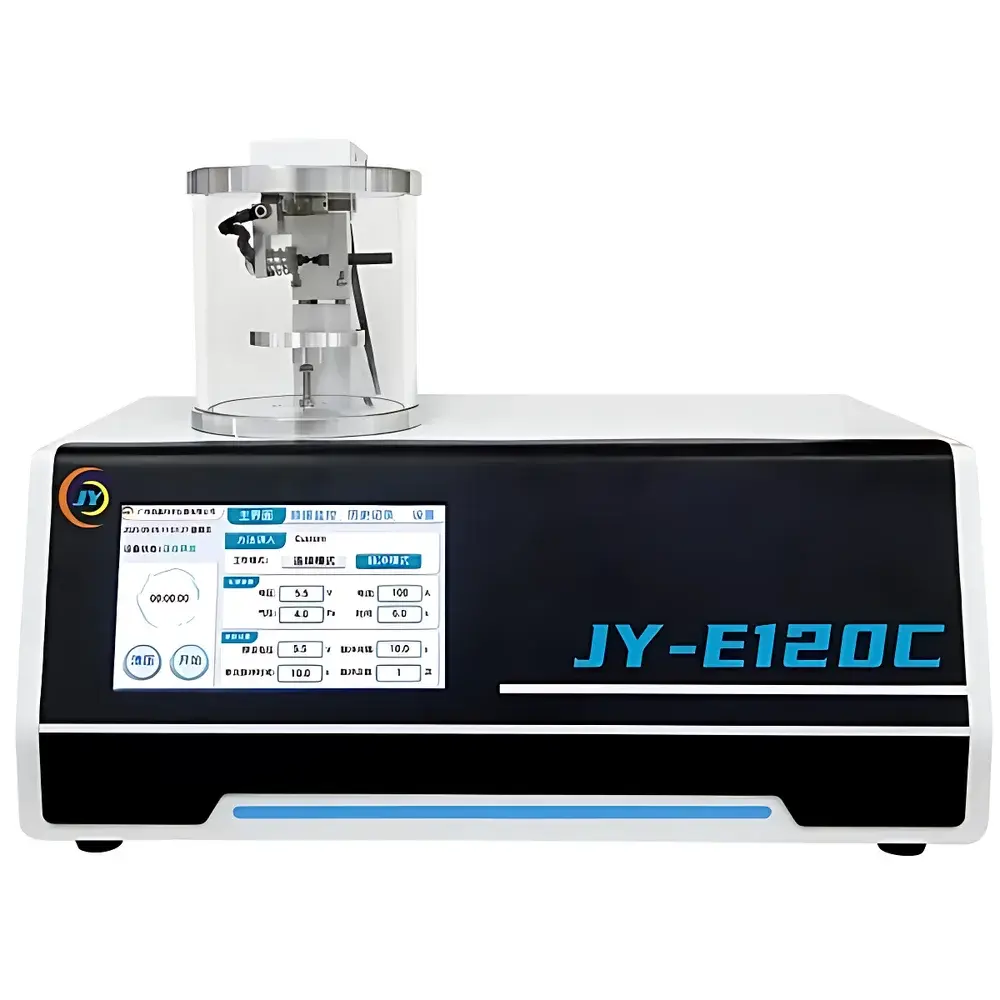
English Product Name
| Brand | Jingying (Guangzhou Jingying Scientific Instrument Co., Ltd.) |
|---|---|
| Origin | Guangdong, China |
| Manufacturer Type | OEM Manufacturer |
| Country of Origin | China |
| Model | JY-E120C |
| Price | USD 7,000 (approx.) |
| Dimensions | 450 × 310 × 340 mm |
| Touchscreen | 7-inch IPS color LCD |
| Evaporation Source | Graphite rod (carbon rope optional) |
| Operating Modes | Continuous mode & pulsed mode |
| Vacuum Pump Speed | 133 L/min |
| Ultimate Vacuum | ≤0.05 Pa |
| Working Vacuum | ≤5 Pa |
| Sample Chamber | 120 × 120 mm |
| Language Support | English / Chinese interface toggle |
Overview
The Jingying JY-E120C Carbon Coater is a benchtop thermal evaporation system engineered for high-precision conductive coating of non-conductive or semi-conductive specimens prior to scanning electron microscopy (SEM) and energy-dispersive X-ray spectroscopy (EDS) analysis. It operates on the principle of resistive heating under high vacuum: graphite rods (or optional carbon ropes) are electrically heated to sublimation temperature (~3,600 °C), generating a directional flux of carbon atoms that condense uniformly onto cooled sample surfaces. This process forms a continuous, amorphous carbon film—typically 5–20 nm thick—with low intrinsic stress, minimal grain structure, and excellent electrical conductivity. Such coatings mitigate charge accumulation during electron beam irradiation, thereby eliminating image distortion, streaking, and EDS quantification drift. The JY-E120C is designed to meet the reproducibility and traceability requirements of academic laboratories, materials science core facilities, and industrial QA/QC labs performing routine SEM sample preparation under GLP-aligned workflows.
Key Features
- 7-inch IPS full-color capacitive touchscreen with intuitive icon-based navigation and real-time vacuum monitoring.
- True one-button automation: integrated sequence control for pump-down, venting, evaporation initiation, and cooldown—reducing operator dependency and inter-user variability.
- Dual evaporation modes: continuous mode delivers stable deposition rates for uniform films >10 nm; pulsed mode enables microsecond-level current modulation for sub-nanometer thickness control and reduced thermal load on beam-sensitive biological or polymeric samples.
- Five user-programmable methods per mode—each storing vacuum setpoint, evaporation current ramp profile, pulse width/frequency (for pulsed mode), and dwell time—supporting method validation and SOP compliance.
- Bi-directional pressure release: automatic solenoid-controlled venting post-evaporation or manual bleed valve operation for rapid chamber access when handling air-sensitive samples.
- Modular evaporation source design accommodating standard 0.5–1.0 mm diameter graphite rods; carbon rope compatibility (via adapter kit) extends operational lifetime and improves deposition rate consistency across extended runs.
Sample Compatibility & Compliance
The JY-E120C accommodates standard 120 × 120 mm specimen stubs—including aluminum, copper, and stainless-steel holders—and supports multi-sample trays for batch processing of TEM grids, filter membranes, or fractured ceramic cross-sections. Its vacuum architecture achieves ≤0.05 Pa base pressure via a two-stage rotary vane pump, ensuring low residual hydrocarbon partial pressure (<1 × 10⁻⁵ mbar) critical for minimizing organic contamination during carbon film formation. The system conforms to ISO 14644-1 Class 8 cleanroom-compatible operation when installed in controlled environments. While not certified to IEC 61000-6-3 or UL 61010-1 out-of-box, its electrical safety design meets GB 4793.1–2019 (equivalent to IEC 61010-1:2010) for laboratory equipment. Method parameters are fully loggable for audit readiness under ISO/IEC 17025 or FDA 21 CFR Part 11–aligned data governance frameworks.
Software & Data Management
No external PC software is required—the embedded controller stores up to 200 operation logs with timestamp, vacuum curve snapshot, current waveform trace, and final film thickness estimate (calculated from empirical current–time–thickness correlation curves). Logs export via USB-C to CSV for integration into LIMS or ELN platforms. Interface language switching (English/Chinese) is retained across power cycles. All parameter changes trigger an audit trail entry including operator ID (if configured via optional RFID badge reader), date/time stamp, and pre/post values—supporting ALCOA+ data integrity principles.
Applications
- Coating insulating geological thin sections (e.g., silicates, clays) for high-resolution backscattered electron (BSE) imaging and quantitative mineral mapping.
- Preparing polymer nanocomposites for EDS line scans without edge charging artifacts.
- Depositing ultra-thin carbon films (<8 nm) on cryo-SEM specimens to preserve native hydration state while enabling stable beam exposure.
- Creating conductive underlayers for subsequent metal sputter coating (e.g., Au/Pd), improving adhesion and reducing island formation.
- Routine QC coating of reference materials (e.g., NIST SRM 2053) in metrology labs verifying SEM spatial resolution and detector efficiency.
FAQ
What vacuum level is required before initiating carbon evaporation?
Evaporation must commence only after achieving ≤5 Pa working vacuum—verified automatically by the integrated Pirani gauge. Base vacuum (≤0.05 Pa) is recommended for optimal film purity but not mandatory for standard applications.
Can the JY-E120C deposit materials other than carbon?
No. The system is optimized exclusively for graphite-based sources. Its power supply, thermal management, and chamber geometry are not rated for metals (e.g., Au, Pt) or oxides requiring higher evaporation temperatures or reactive gas environments.
Is calibration of the thickness estimation function possible?
Yes—users may perform empirical calibration using a quartz crystal microbalance (QCM) sensor (not included) mounted in the chamber. Calibration coefficients are stored per method and applied during subsequent runs.
How often should the graphite rod be replaced?
Typical service life is 15–25 coating cycles at 80–120 A, depending on rod diameter and evaporation duration. Visual inspection for tip erosion >30% is the primary replacement criterion.
Does the system support remote monitoring or network connectivity?
Not natively. However, the USB-C port enables passive data extraction; third-party integration via RS-232 (optional module) supports basic status polling in automated lab environments.







