
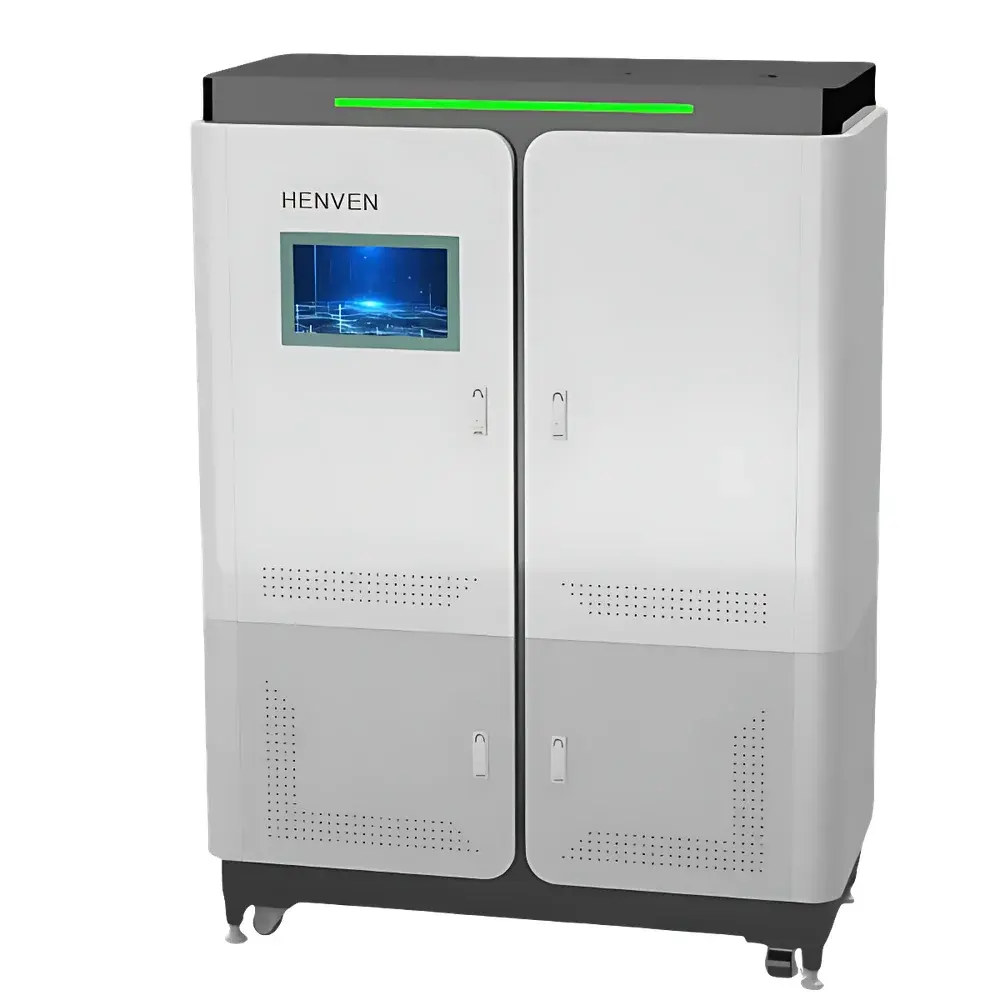
Henven HTF-50 High-Pressure Thermogravimetric Analyzer
| Brand | Henven |
|---|---|
| Origin | Beijing, China |
| Manufacturer Type | Direct Manufacturer |
| Regional Category | Domestic (China) |
| Model | HTF-50 |
| Price Range | USD 70,000–112,000 (FOB Beijing) |
| Test Environment | High-Pressure Atmosphere |
| Sample Capacity | Single-sample configuration |
| Instrument Type | Dedicated TGA platform |
| Temperature Range | Ambient to 950 °C |
| Temperature Precision | ±0.1 °C |
| Temperature Accuracy | ±0.1 K |
| Dynamic Weighing Range | 1 mg–200 mg or 0–5 g (user-selectable) |
| Balance Sensitivity | 10 µg |
| Mass Accuracy | 0.1 µg |
| Heating/Cooling Rate | 0.1–30 K/min |
| Maximum Sample Mass Capacity | 500 g |
| Baseline Drift | ≤0.01% (full-scale) |
Overview
The Henven HTF-50 High-Pressure Thermogravimetric Analyzer is an engineered solution for quantitative thermal stability and decomposition behavior assessment under controlled elevated pressure conditions. It operates on the fundamental principle of thermogravimetry—measuring mass change as a function of temperature or time—while integrating a precision-controlled pressurized gas environment (0.11–5 MPa). Unlike conventional ambient-pressure TGA systems, the HTF-50 enables investigation of reaction kinetics, phase transitions, volatilization equilibria, and catalytic deactivation mechanisms where partial pressure of reactive or condensable species (e.g., H2O, CO2, H2) critically influences sample behavior. Its design conforms to ASTM E1131, ISO 11358, and USP <467> guidelines for thermogravimetric characterization, supporting method development in materials science, petrochemical research, pharmaceutical excipient screening, and energy storage material evaluation.
Key Features
- Integrated high-pressure gas delivery system with dual-stage regulation: stainless-steel back-pressure valve and precision needle valve for stable pressure maintenance within ±0.01 MPa across 0.11–5 MPa range
- Dual-mode furnace architecture: hermetically sealed heating chamber with internal resistive heating elements and redundant Pt100 RTD sensors for uniform thermal distribution over a 50 mm active zone
- Modular vapor generation subsystem: factory-integrated steam generator with closed-loop control of temperature, flow rate, pressure, and vapor concentration—compatible with inert, oxidizing, reducing, vacuum, and humidified atmospheres
- Suspended mechanical microbalance: high-stability torsion-based transducer with 10 µg sensitivity, <0.1 µg repeatability, and <0.01% full-scale accuracy over 0–5 g range
- Three independent gas inlets + dedicated steam port, each equipped with calibrated mass flow controllers (MFCs) and solenoid isolation valves
- Active tail-gas management: inline condenser and liquid–vapor separator for safe handling of condensable byproducts during pyrolysis or hydrothermal decomposition studies
- Programmable heating/cooling profiles: linear, stepwise, or isothermal modes with ramp rates from 0.1 to 30 K/min; cooling from 1100 °C to 50 °C in ≤30 min via forced-air assist
Sample Compatibility & Compliance
The HTF-50 accommodates standard alumina, platinum, or quartz crucibles (0.1–2 mL volume), enabling analysis of powders, granules, thin films, and monolithic ceramics. It supports both static (isobaric/isothermal) and dynamic (TGA/DTG) measurement protocols per ISO 11358-1 and ASTM E1641. Pressure-rated components meet ASME B31.3 process piping standards; all wetted surfaces are electropolished 316L stainless steel or high-purity quartz. The system is designed for GLP-compliant operation with audit-trail-enabled software (see Software & Data Management), and its pressure control architecture satisfies requirements for ICH Q5C stability protocol validation under variable humidity and partial pressure conditions.
Software & Data Management
Control and data acquisition are managed through Henven’s proprietary TGA Control Suite v4.x—a Windows-based application compliant with FDA 21 CFR Part 11 (electronic signatures, role-based access, and immutable audit logs). Real-time visualization includes synchronized plots of mass %, derivative mass loss (DTG), temperature, pressure, and gas flow rates. Raw data export supports ASCII, CSV, and universal .tdf formats compatible with OriginLab, MATLAB, and Thermo Scientific™ OMNIC. Calibration routines include multi-point mass verification (using NIST-traceable weights) and temperature calibration against certified metal standards (In, Sn, Zn, Al). All method parameters—including pressure setpoints, ramp sequences, and gas switching logic—are fully scriptable and recallable.
Applications
- Coal and biomass devolatilization kinetics under simulated gasification pressure
- Thermal degradation profiling of polymer composites in humidified N2/O2 environments
- Catalyst coking resistance evaluation under hydrocarbon partial pressure
- Hydration/dehydration equilibria of pharmaceutical hydrates at controlled water vapor activity
- Oxidation onset temperature determination for battery cathode materials under elevated O2 pressure
- Decomposition enthalpy estimation via coupling with differential scanning calorimetry (DSC) in hybrid modules
FAQ
What pressure ranges can the HTF-50 maintain, and how is pressure stability ensured?
The system delivers continuous pressure control from 0.11 to 5 MPa (1.1–50 bar) using a feedback-regulated back-pressure valve with integrated pressure transducer monitoring. Stability is maintained within ±0.01 MPa across all operating temperatures.
Is the instrument compatible with corrosive or reactive gases such as H2S or Cl2?
Standard configuration supports inert (N2, Ar), oxidizing (O2, air), reducing (H2, CO), and steam atmospheres. For aggressive chemistries, optional Hastelloy C-276 furnace liners and fluoropolymer-sealed valves are available upon request.
Can DTG curves be generated in real time during acquisition?
Yes—numerical differentiation is performed on-the-fly using Savitzky–Golay smoothing algorithms; DTG is displayed and saved simultaneously with raw mass and temperature data.
Does the system support automated multi-step pressure–temperature programs?
Absolutely. Users may define up to 99 sequential segments combining independent pressure holds, ramped pressure transitions, and temperature ramps—all synchronized and logged with timestamped event markers.
What documentation is provided for regulatory submissions?
Factory-issued IQ/OQ documentation, NIST-traceable calibration certificates (mass, temperature, pressure), and a complete 21 CFR Part 11 compliance package—including electronic signature workflow diagrams and audit log structure specifications—are included with each shipment.



