
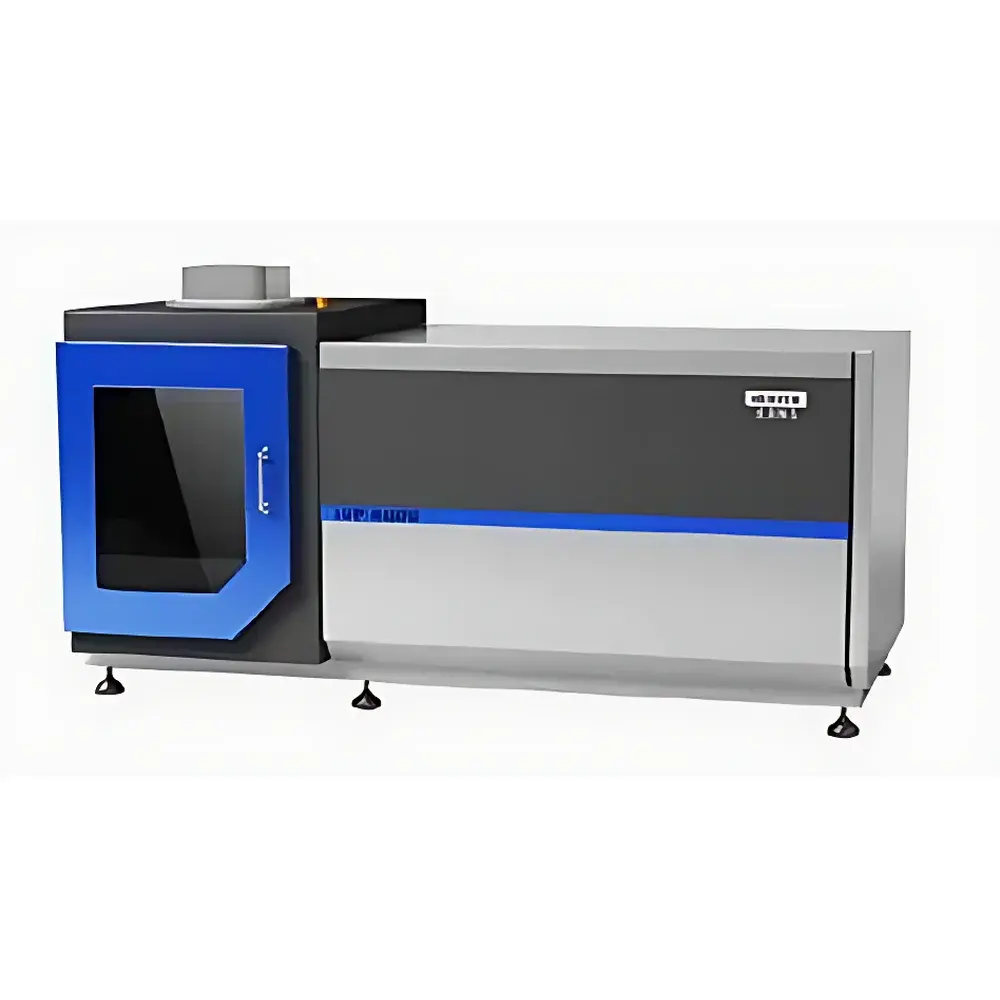
Henven ICP8000 Inductively Coupled Plasma Optical Emission Spectrometer
| Brand | Henven |
|---|---|
| Origin | Jiangsu, China |
| Manufacturer Type | Direct Manufacturer |
| Instrument Type | Simultaneous (Multi-Channel) ICP-OES |
| Wavelength Range | 195–500 nm (with 3600 L/mm grating) |
| Repeatability (Short-Term Stability) | RSD ≤ 1.5% |
| Long-Term Stability | RSD ≤ 2.0% |
| Optical Configuration | Czerny-Turner with 1000 mm Focal Length |
| Grating | Ion-Etched Holographic Grating |
| Detector | Imported Photomultiplier Tube (PMT) |
| RF Generator Power Output | 800–1500 W |
| Frequency Stability | ±0.1% |
| EMI Emission | Electric Field Strength E < 2 V/m at 30 cm distance |
| Cooling | Integrated Chiller System |
| Gas Flow Control | Digital Mass Flow Controller |
Overview
The Henven ICP8000 is a high-performance simultaneous inductively coupled plasma optical emission spectrometer (ICP-OES) engineered for precise, multi-element quantitative and qualitative analysis in environmental, geological, metallurgical, pharmaceutical, and regulatory laboratory settings. It operates on the fundamental principle of inductively coupled plasma excitation: liquid or dissolved solid samples are nebulized into an argon plasma at ~6,000–10,000 K, where atoms and ions are thermally excited and emit element-specific photons upon relaxation. These emissions are dispersed via a high-resolution Czerny-Turner optical system (1000 mm focal length) and detected by imported photomultiplier tubes (PMTs), enabling real-time spectral acquisition across the ultraviolet–visible range (195–500 nm with 3600 L/mm grating). The instrument’s rigid mechanical design, temperature-stabilized optical bench, and digital mass flow control ensure consistent plasma conditions—critical for analytical reproducibility and long-term method robustness.
Key Features
- Simultaneous multi-element detection: Up to 70+ elements quantified in a single 60-second integration, eliminating sequential scanning delays and maximizing throughput.
- High optical resolution: Ion-etched holographic grating delivers spectral resolving power >45,000 (measured at Mn 257.610 nm), supporting accurate separation of adjacent lines (e.g., As 193.696 nm and Al 193.696 nm).
- Thermal and mechanical stability: Optomechanical assembly mounted on low-expansion material; internal temperature regulation maintains wavelength calibration drift <0.5 pm/h under continuous operation.
- Robust plasma management: Solid-state RF generator with active frequency feedback ensures plasma impedance matching stability within ±0.1%, minimizing signal flicker and background drift.
- Low electromagnetic interference (EMI) architecture: Fully shielded RF compartment and grounded optical enclosure limit radiated electric field strength to <2 V/m at 30 cm—compliant with IEC 61326-1 for laboratory electromagnetic compatibility.
- Integrated chiller and digital gas control: Closed-loop cooling sustains detector and optics at 15 ± 0.3 °C; mass flow controllers regulate argon sheath, auxiliary, and nebulizer flows with ±0.2% full-scale accuracy.
Sample Compatibility & Compliance
The ICP8000 accepts aqueous solutions (0.1–5% v/v acid matrix), digested solids (EPA Method 3050B/3052), organic solvents (with oxygen ashing interface), and slurry suspensions (<5 µm particle size). It supports direct analysis of drinking water (EPA 200.7), soil extracts (ISO 11047), and pharmaceutical catalyst residues (ICH Q2(R2)). All operational parameters—including integration time, viewing height, and RF power—are configurable per element to optimize sensitivity and minimize polyatomic interferences (e.g., ArO⁺ on Fe 56). Data acquisition and reporting comply with GLP audit trails and support 21 CFR Part 11–ready electronic signatures when paired with validated LIMS integration modules.
Software & Data Management
The instrument is controlled via Henven SpectraSuite™ v4.x, a Windows-based platform supporting method development, calibration curve fitting (linear, quadratic, weighted least-squares), interference correction (internal standardization, background correction, inter-element correction), and automated QC checks (continual calibration verification, drift monitoring). Raw spectral data are stored in vendor-neutral .csv and .spc formats; audit logs record user actions, parameter changes, and instrument status timestamps. Optional add-ons include ASTM E1779-compliant uncertainty propagation modules and ISO/IEC 17025 traceability templates for accredited laboratories.
Applications
- Environmental monitoring: Quantification of heavy metals (Pb, Cd, As, Hg) in wastewater per ISO 17294-2 and EPA 200.7.
- Geochemical exploration: Multi-element profiling (Li, Rb, Sr, Ba, REEs) in rock digests using internal standard normalization (Sc, Y, In).
- Metallurgical QA/QC: Alloy grade verification (Al, Mg, Si, Cu, Zn) with precision ≤1.2% RSD across 10-day runs.
- Pharmaceutical elemental impurities: USP / compliance testing for catalyst residues (Pd, Pt, Rh) at sub-ppb levels.
- Fertilizer and agrochemical analysis: P, K, Ca, Mg, S, B, Zn, Mn quantification in complex matrices with matrix-matched calibration.
FAQ
What plasma gas configuration does the ICP8000 support?
It uses a three-gas system: nebulizer gas (Ar), auxiliary gas (Ar), and coolant gas (Ar), all regulated by independent digital mass flow controllers.
Is the instrument compatible with organic solvent introduction?
Yes—with optional oxygen addition module and modified torch configuration, it supports methanol, ethanol, and xylene-based samples up to 30% v/v.
Can the ICP8000 perform isotope ratio measurements?
No—it is a polychromator-based OES system optimized for concentration analysis, not high-mass-resolution isotope detection (requires magnetic sector or multi-collector ICP-MS).
What maintenance intervals are recommended for routine operation?
Nebulizer and torch cleaning every 8 hours of plasma runtime; PMT voltage recalibration quarterly; optical alignment verification semiannually or after transport.
Does the system meet ISO/IEC 17025 requirements for accredited testing?
Yes—when operated with documented SOPs, calibrated standards (NIST SRM traceable), and enabled audit trail logging, it fulfills technical competence criteria for elemental analysis scope accreditation.





