
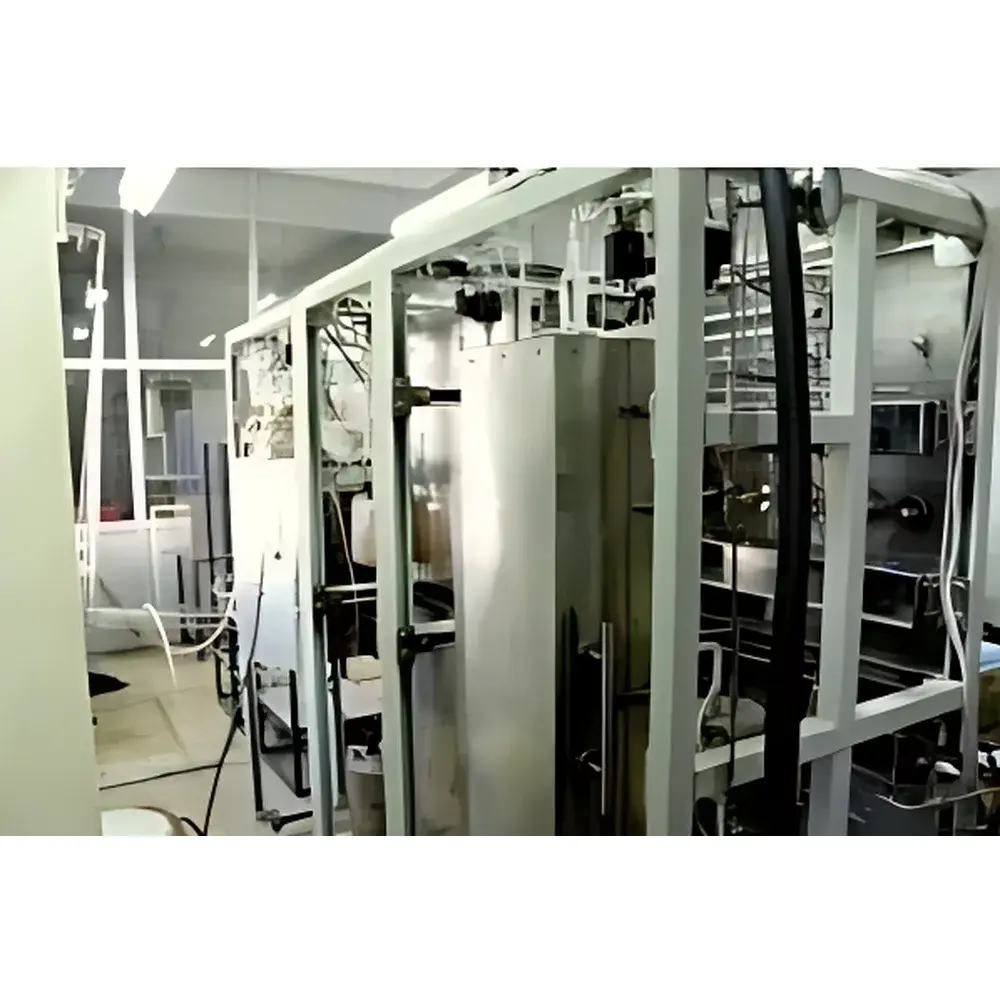
Hengjiu HJ-13 Multi-Channel Fixed-Bed Catalytic Evaluation System
| Brand | Hengjiu (Henven) |
|---|---|
| Origin | Beijing, China |
| Manufacturer | Yes |
| Type | Domestic |
| Model | HJ-13 |
| Price | Upon Request |
| Reactor Temperature Range | Up to 650 °C |
| Linear Ramp Rate | 0.1–40 °C/min |
| Isothermal Stability | ±0.1 °C |
| Operating Pressure Range | 0.1–6 MPa |
| Gas Flow Range | 0–300 mL/min |
| Gas Flow Accuracy | ±0.1% FS |
| Liquid Flow Range | 0–5 mL/min |
| Liquid Flow Accuracy | ±0.1% FS |
| Catalyst Loading Capacity | 0–5 mL |
Overview
The Hengjiu HJ-13 Multi-Channel Fixed-Bed Catalytic Evaluation System is an engineered platform for parallel, high-fidelity catalytic performance assessment under controlled thermodynamic and kinetic conditions. Designed for laboratory-scale catalyst screening, kinetics studies, and process optimization in heterogeneous catalysis, the system integrates four independent fixed-bed reactors within a single robust stainless-steel frame. Each reactor operates with full thermal and pressure autonomy—enabling comparative testing across varied catalyst formulations, feed compositions, or operating protocols without cross-contamination. The core measurement principle relies on precise mass flow control (gas and liquid), real-time temperature profiling along axial reactor zones, and dynamic pressure regulation via servo-controlled back-pressure regulators. All operational parameters are governed by a deterministic control architecture rooted in closed-loop feedback from calibrated platinum RTD sensors (Class A, IEC 60751), piezoresistive pressure transducers (0.05% FS accuracy), and Coriolis-based liquid flow meters. This architecture ensures traceable, repeatable data acquisition aligned with fundamental requirements of catalytic reaction engineering.
Key Features
- Four fully isolated fixed-bed reactors with individual PID-controlled heating zones and axial temperature monitoring (up to 3 thermocouple positions per reactor)
- Integrated fluid delivery subsystem: dual-channel mass flow controllers (MFCs) for gases (0–300 mL/min, N₂-equivalent), plus precision syringe pumps for liquid feeds (0–5 mL/min, pulseless operation)
- Liquid crystal touch interface (10.1″ capacitive screen) with intuitive configuration wizard for ramp/soak temperature programs, pressure setpoints, and flow sequencing
- Renmai Fluidized-Bed Control Module (optional firmware extension) enabling automatic bed expansion ratio calculation, minimum fluidization velocity estimation, and gas velocity modulation based on real-time ΔP signals
- Dedicated fault-safety layer: independent hardware watchdog monitors critical T/P nodes; triggers audible/visual alarm, flow shutoff, and heater de-energization upon deviation beyond user-defined thresholds
- Structural integrity: all-welded 316L stainless-steel frame (IP54-rated enclosure), electropolished 304SS front panel, vibration-damped mounting feet for long-duration stability
Sample Compatibility & Compliance
The HJ-13 accommodates standard catalyst forms—including pellets, extrudates, powders, and monoliths—with reactor tubes (ID: 8 mm, L: 300 mm) designed for easy loading/unloading and minimal dead volume. Catalyst beds are confined using quartz wool and sintered metal frits to ensure uniform flow distribution and prevent particle migration. The system complies with mechanical safety standards per GB/T 150.1–2011 (Chinese pressure vessel code) and incorporates pressure relief mechanisms certified to ASME B31.3 process piping guidelines. For regulated environments, optional audit-trail logging (timestamped parameter changes, operator ID, event flags) supports GLP and GMP-aligned workflows. While not pre-certified to ISO/IEC 17025, raw sensor outputs (4–20 mA, RS485 Modbus RTU) are compatible with third-party LIMS integration for method validation and data archiving.
Software & Data Management
The embedded control firmware records all primary variables—temperature (°C), pressure (MPa), flow rates (mL/min), and time—at configurable intervals (100 ms–5 min). Data export is supported via USB 2.0 (CSV, Excel-compatible) or Ethernet (TCP/IP socket streaming to SCADA or MATLAB). Optional Hengjiu CatalystLab™ desktop software provides advanced post-processing: Arrhenius plot generation, space-time yield (STY) calculation, deactivation rate modeling, and comparative activity mapping across channels. All data files include embedded metadata (operator name, experiment ID, calibration dates) and support digital signature verification for regulatory submissions. Audit trail logs meet FDA 21 CFR Part 11 requirements when paired with network-authenticated user accounts and electronic signature modules.
Applications
- Screening of Fischer–Tropsch, hydrodesulfurization (HDS), methanol synthesis, and ammonia oxidation catalysts under industrially relevant P–T–space velocity conditions
- Long-term stability testing (≥500 h) with automated regeneration cycles and periodic activity sampling
- Reaction kinetics derivation (e.g., Langmuir–Hinshelwood modeling) using transient response analysis and steady-state rate measurements
- Validation of computational fluid dynamics (CFD) simulations through experimental benchmarking of radial temperature gradients and pressure drop profiles
- Educational use in chemical engineering laboratories for teaching catalytic reactor design, heat/mass transfer limitations, and process safety fundamentals
FAQ
What reactor tube materials are compatible with the HJ-13?
Standard reactors use fused quartz or Inconel 600 tubes; custom Hastelloy C-276 or alumina ceramic liners are available upon request.
Can the system operate under vacuum or inert atmosphere?
Yes—the integrated vacuum pump module (ultimate pressure: 5×10⁻² mbar) and purge sequences support inert start-up, leak-checking, and oxygen-free operation.
Is remote monitoring supported?
Ethernet connectivity enables secure remote access via VNC or browser-based dashboard (HTTPS/TLS encrypted); firewall-configurable port mapping required.
How is catalyst bed temperature uniformity verified?
Each reactor includes three axial RTD positions; uniformity is validated during factory calibration using NIST-traceable dry-block calibrators at 200 °C, 400 °C, and 600 °C.
Does the system support liquid-phase reactions with vapor–liquid equilibrium considerations?
Yes—combined liquid feed + pre-heater + flash separator configuration allows partial vaporization studies; optional online GC integration supports phase composition tracking.



