
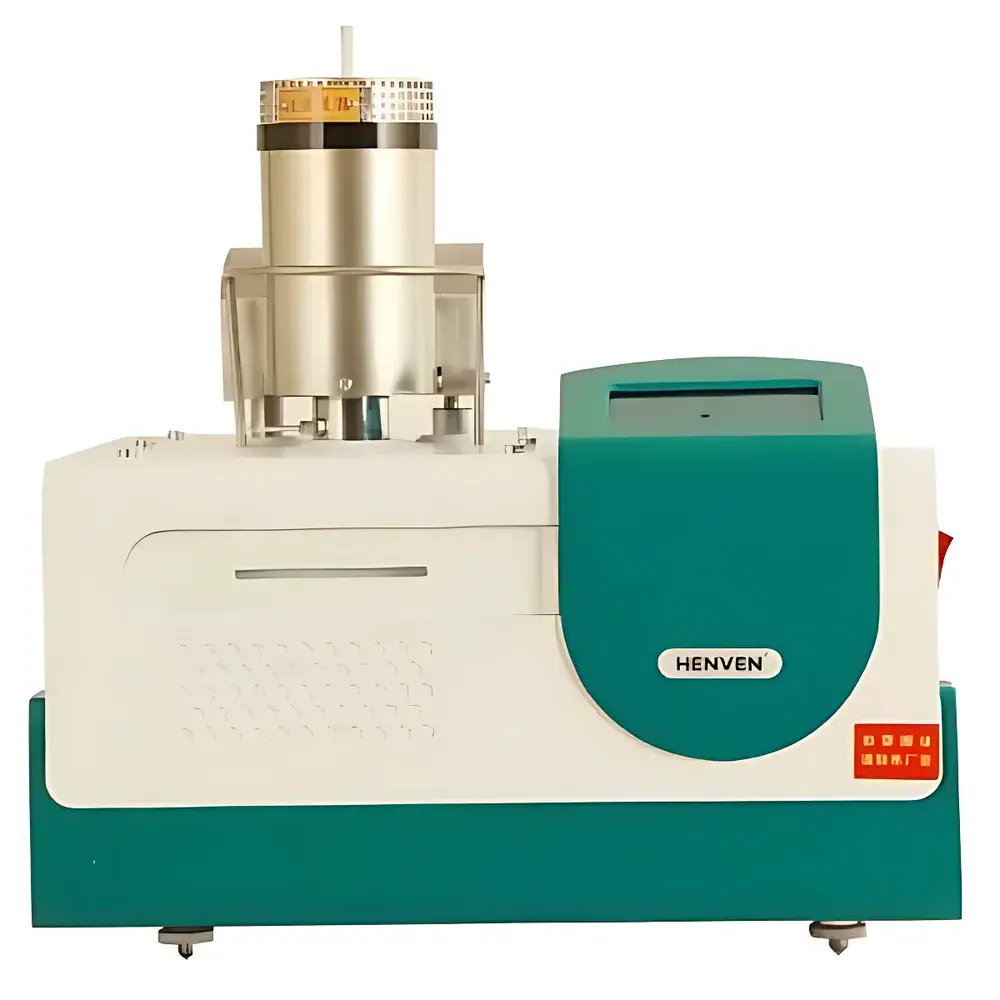
Henven HTG-1 Thermogravimetric Analyzer
| Brand | Henven |
|---|---|
| Origin | Beijing, China |
| Manufacturer Type | Direct Manufacturer |
| Regional Classification | Domestic (China) |
| Model | HTG-1 |
| Operating Environment | Ambient Pressure |
| Sample Capacity | Single Sample |
| Instrument Type | General-Purpose |
| Temperature Range | Room Temperature to 1150 °C |
| Temperature Accuracy | ±0.1 °C |
| Temperature Precision | ±0.1 K |
| Dynamic Weighing Range | 0.01 mg – 5 g |
| Balance Sensitivity | 0.1 µg |
| Mass Accuracy | 0.1 µg |
| Heating/Cooling Rate | 0.1 – 100 K/min |
| Maximum Sample Mass | 5 g |
| Baseline Repeatability | 0.01 mg |
| Baseline Drift | 0.01 mg |
Overview
The Henven HTG-1 Thermogravimetric Analyzer (TGA) is a precision-controlled, benchtop thermal analysis instrument engineered for quantitative measurement of mass change as a function of temperature or time under controlled atmospheric conditions. Based on the fundamental principle of thermogravimetry—where sample mass is continuously monitored during programmed thermal treatment—the HTG-1 delivers high-fidelity data for decomposition kinetics, compositional analysis, thermal stability assessment, and reaction pathway elucidation. Its robust architecture integrates a high-stability microbalance, a precisely regulated horizontal furnace, dual thermocouple temperature monitoring (furnace and sample), and a digitally controlled gas delivery system. Designed for routine QC, R&D, and academic research, the HTG-1 complies with core methodological frameworks referenced in ASTM E1131, ISO 11358, and USP <467> for residual solvent and volatile content determination.
Key Features
- High-resolution microbalance with 0.1 µg sensitivity and <0.1 µg noise floor, enabling detection of sub-microgram mass transitions in low-mass samples.
- Programmable heating/cooling rates from 0.1 to 100 K/min, supporting both slow-scan kinetic studies and rapid thermal profiling.
- Dual independent thermocouples: one embedded in the furnace wall for absolute temperature calibration, another positioned near the sample pan for real-time sample temperature tracking—ensuring traceable thermal input.
- Integrated mass flow controller (MFC)-based atmosphere system with two independently regulated gas channels; supports inert (N₂, Ar), oxidative (air, O₂), reducing (H₂, CO), or corrosive gas environments (custom corrosion-resistant MFCs available upon request).
- Modular crucible compatibility: standard ceramic crucibles (Φ5×4 mm, Φ5×8 mm, Φ8×10 mm), plus optional aluminum, quartz, graphite, and platinum crucibles to accommodate diverse thermal, chemical, and mechanical requirements.
- Full-range dynamic weighing capacity (0.01 mg–5 g) via interchangeable support rods—enabling seamless transition between micro-scale polymer degradation studies and macro-scale mineralogical analysis.
- Real-time LCD interface displaying furnace temperature, sample temperature, instantaneous mass, gas flow status, and baseline stability metrics.
Sample Compatibility & Compliance
The HTG-1 accommodates solid, powdered, and granular specimens across polymer science, pharmaceuticals, catalysis, metallurgy, and geochemistry. It supports compliance-critical workflows including ASTM D3850 (decomposition temperature of plastics), ISO 11358-1 (polymer thermal degradation), and pharmacopeial monographs requiring loss-on-drying (LOD) or residual solvent quantification. The system’s baseline repeatability (±0.01 mg) and drift performance (<0.01 mg over 60 min at 1000 °C) meet GLP audit requirements for instrument qualification. Optional vacuum module (2.5×10⁻² Pa) enables pyrolysis studies under reduced pressure, while the heated transfer line (RT–200 °C) ensures condensation-free coupling to GC or MS for evolved gas analysis (EGA).
Software & Data Management
Proprietary acquisition and analysis software provides full control over temperature ramps, isothermal holds (up to 72 h), gas switching sequences, and real-time data visualization. Standard outputs include TG (mass vs. temperature/time), DTG (first derivative), and DDTG (second derivative) curves. Advanced modules support quantitative composition calculation (e.g., filler content, moisture, ash), model-free kinetic analysis (Friedman, Ozawa-Flynn-Wall), and multi-curve comparative overlay with statistical deviation mapping. All raw data files are timestamped, user-annotated, and stored in ASCII-compatible format for third-party integration. Software supports audit trail logging per FDA 21 CFR Part 11 guidelines when deployed in validated environments.
Applications
- Determination of thermal decomposition onset, char yield, and oxidation stability in polymers and composites.
- Quantitative analysis of moisture, volatiles, solvents, and residual catalysts in active pharmaceutical ingredients (APIs) and excipients.
- Characterization of catalyst deactivation mechanisms, coke formation, and metal oxide reduction behavior.
- Mineralogical phase identification via stepwise mass loss (e.g., carbonate decomposition, hydroxide dehydration, sulfate reduction).
- Study of additive volatility, flame retardant efficiency, and nanofiller dispersion stability under thermal stress.
- Support for coupled techniques: simultaneous TGA-FTIR, TGA-GC/MS, and TGA-DSC for multi-parameter thermal event correlation.
FAQ
What calibration standards are recommended for routine verification?
Certified reference materials such as calcium oxalate monohydrate (for three-step decomposition), nickel oxide (for redox calibration), and high-purity aluminum (for temperature accuracy) are recommended per ISO 11358-2.
Can the HTG-1 operate under vacuum without modification?
Vacuum operation requires optional vacuum pump integration and sealed furnace chamber upgrade—standard configuration operates at ambient pressure with purge gas control.
Is the software compliant with 21 CFR Part 11 for electronic records?
Yes—when configured with user authentication, electronic signatures, and audit trail activation, the software meets predicate rule requirements for regulated laboratories.
What is the typical service interval for balance recalibration?
Annual calibration using NIST-traceable weights and certified temperature standards is advised; baseline drift verification should be performed prior to each critical measurement series.
Are custom crucible geometries supported beyond the listed options?
Yes—Henven offers OEM crucible design services for specialized applications, including high-temperature alloys, fiber mounts, and micro-reactor configurations.



