
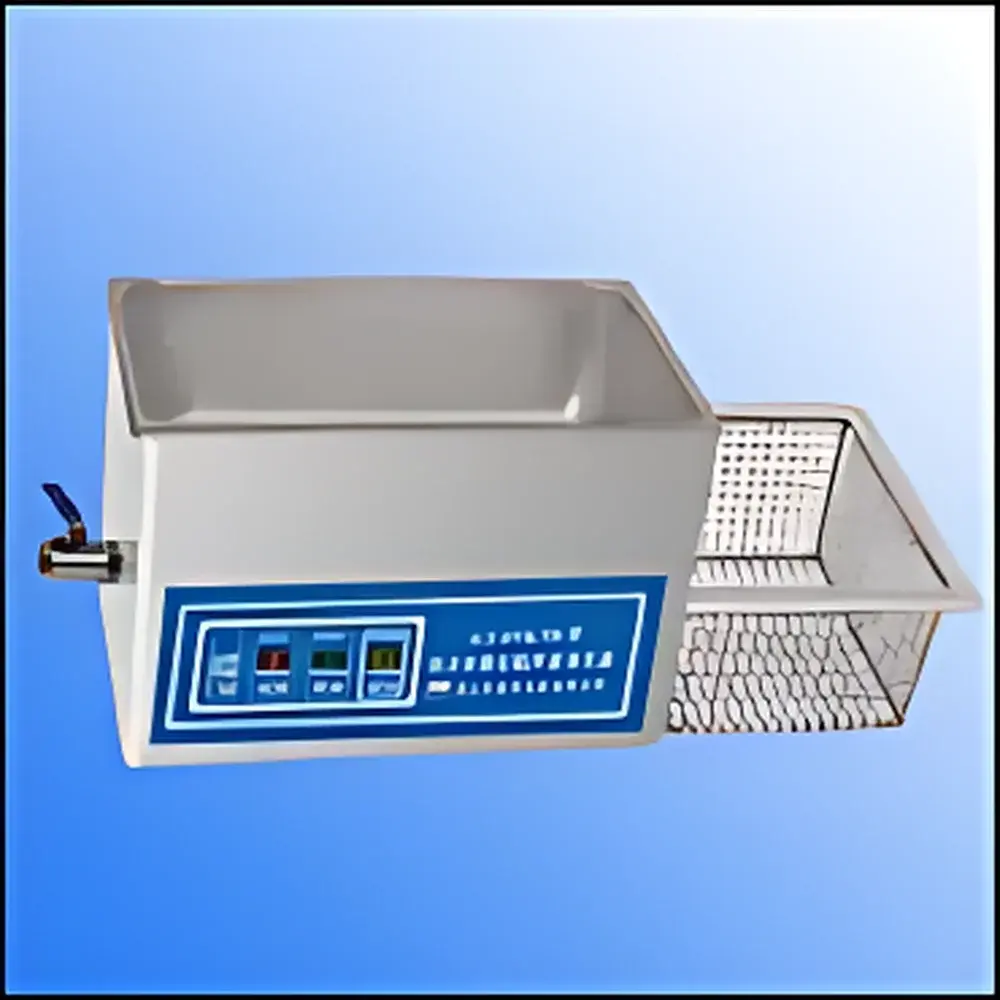
Shumei KQ5200DB Benchtop Digital Ultrasonic Cleaner
| Brand | Shumei |
|---|---|
| Model | KQ5200DB |
| Origin | Jiangsu, China |
| Dimensions (L×W×H) | 320×264×320 mm |
| Tank Internal Dimensions (L×W×H) | 300×240×150 mm |
| Tank Capacity | 10 L |
| Ultrasonic Frequency | 40 kHz |
| Total Ultrasonic Power | 200 W |
| Power Adjustment Range | 40–100 % |
| Heating Power | 600 W |
| Temperature Control Range | 20–80 °C |
| Timer Range | 1–480 min |
Overview
The Shumei KQ5200DB is a benchtop digital ultrasonic cleaner engineered for precision cleaning, degassing, and sample preparation in laboratory, academic, and industrial quality control environments. It operates on the principle of high-frequency ultrasonic cavitation—generating microscopic vacuum bubbles in liquid media that rapidly collapse to produce localized high-pressure shockwaves. This physical mechanism enables effective removal of particulate contaminants, organic residues, and surface-adsorbed films from delicate components such as optical lenses, semiconductor wafers, microfluidic devices, analytical glassware, and biological substrates without mechanical abrasion or chemical aggression. The integrated transducer design ensures optimal energy coupling between the generator and stainless steel tank, minimizing power loss and enhancing long-term operational stability. With its 40 kHz frequency, the unit delivers a balanced compromise between penetration depth and cleaning intensity—ideal for routine decontamination of small-to-medium-sized parts and labware.
Key Features
- Digitally controlled ultrasonic output with adjustable power from 40% to 100%, enabling process optimization for sensitive or heavily soiled samples.
- Precise digital temperature regulation (20–80 °C) via integrated heating element (600 W), supporting temperature-dependent cleaning protocols including solvent-assisted residue dissolution and enzymatic decontamination.
- Programmable digital timer (1–480 minutes) with auto-shutdown functionality to prevent overexposure and ensure repeatability across cleaning cycles.
- Dual digital display showing real-time bath temperature and set temperature, plus simultaneous indication of elapsed time, remaining time, and ultrasonic power level.
- Robust 304 stainless steel tank (300 × 240 × 150 mm internal) and exterior housing—corrosion-resistant, non-porous, and compatible with aqueous and mild organic solvents.
- Included stainless steel mesh basket (argon-welded construction) for secure sample placement and uniform acoustic exposure; removable for easy cleaning and maintenance.
- Comprehensive safety architecture: low-level liquid detection, over-temperature, over-voltage, and over-current protection with visual alarm indicators.
- Microcontroller-based firmware supporting cumulative operational logging up to 999,999 hours—facilitating preventive maintenance scheduling and GLP-compliant equipment history tracking.
Sample Compatibility & Compliance
The KQ5200DB accommodates a broad range of sample types—including metal, ceramic, glass, silicon, and polymer substrates—as well as assembled devices with complex geometries. Its 10 L capacity supports standard volumetric flasks, Petri dishes, cuvettes, pipette tips, filtration membranes, and disassembled instrumentation components. While not certified to IEC 61000-6-3 (EMC) or ISO 13485 out-of-the-box, the device conforms to general electrical safety requirements for Class I laboratory appliances (IEC 61010-1). When operated within specified parameters and paired with validated cleaning agents, it supports compliance with ASTM D2603 (ultrasonic cleaning performance testing), USP (cleaning validation guidance), and internal SOPs aligned with ISO/IEC 17025 accreditation requirements for calibration laboratories.
Software & Data Management
This model operates via embedded microcontroller firmware—no external PC software or driver installation required. All operational parameters (time, temperature, power level, start/stop status) are retained in non-volatile memory following power cycling, ensuring consistent setup recall. The digital interface logs cumulative runtime and displays manufacturing date for warranty tracking per regional consumer protection standards. While lacking network connectivity or FDA 21 CFR Part 11-compliant audit trail features, its deterministic behavior and hardware-based parameter locking support manual record-keeping in GxP-regulated workflows where electronic signatures are not mandated.
Applications
- Routine cleaning of HPLC vials, GC syringes, and spectrophotometer cuvettes to eliminate carryover and baseline drift.
- Pre-analytical sample preparation: cell lysis (e.g., bacterial or yeast disruption prior to DNA extraction), nanoparticle dispersion, and homogenization of colloidal suspensions.
- Electronics manufacturing: removal of flux residues, solder paste remnants, and particulate debris from PCBs and MEMS components.
- Materials science labs: degassing of resin precursors prior to casting, cleaning of sputtering targets, and surface activation of substrates before thin-film deposition.
- Pharmaceutical QC: cleaning of tablet punches, capsule fillers, and dissolution apparatus parts in accordance with cGMP Annex 15 hygiene guidelines.
FAQ
Is the KQ5200DB suitable for cleaning delicate optics or MEMS devices?
Yes—when operated at reduced power (40–60%) and moderate temperature (30–45 °C) with deionized water or low-surface-tension solvents, it provides gentle yet effective contaminant removal without surface pitting or coating damage.
Does the unit include a lid for noise reduction or vapor containment?
No—the KQ5200DB does not ship with a sound-dampening lid. Users requiring noise mitigation or volatile solvent containment should source a compatible acrylic or stainless steel cover separately.
Can the heater be disabled while running ultrasonics only?
Yes—temperature setting can be held at ambient or turned off independently of ultrasonic activation, allowing cold-cavitation protocols for thermolabile samples.
What maintenance is recommended for long-term reliability?
Regular descaling of the tank using 5–10% citric acid solution every 2–3 months (depending on water hardness), inspection of the drain valve seal integrity, and periodic verification of transducer adhesion to the tank bottom using ultrasonic power mapping.
Is technical documentation available in English?
Yes—operation manuals, dimensional drawings, and CE-conformity declarations (where applicable) are provided in English upon request through authorized Shumei distributors.



