
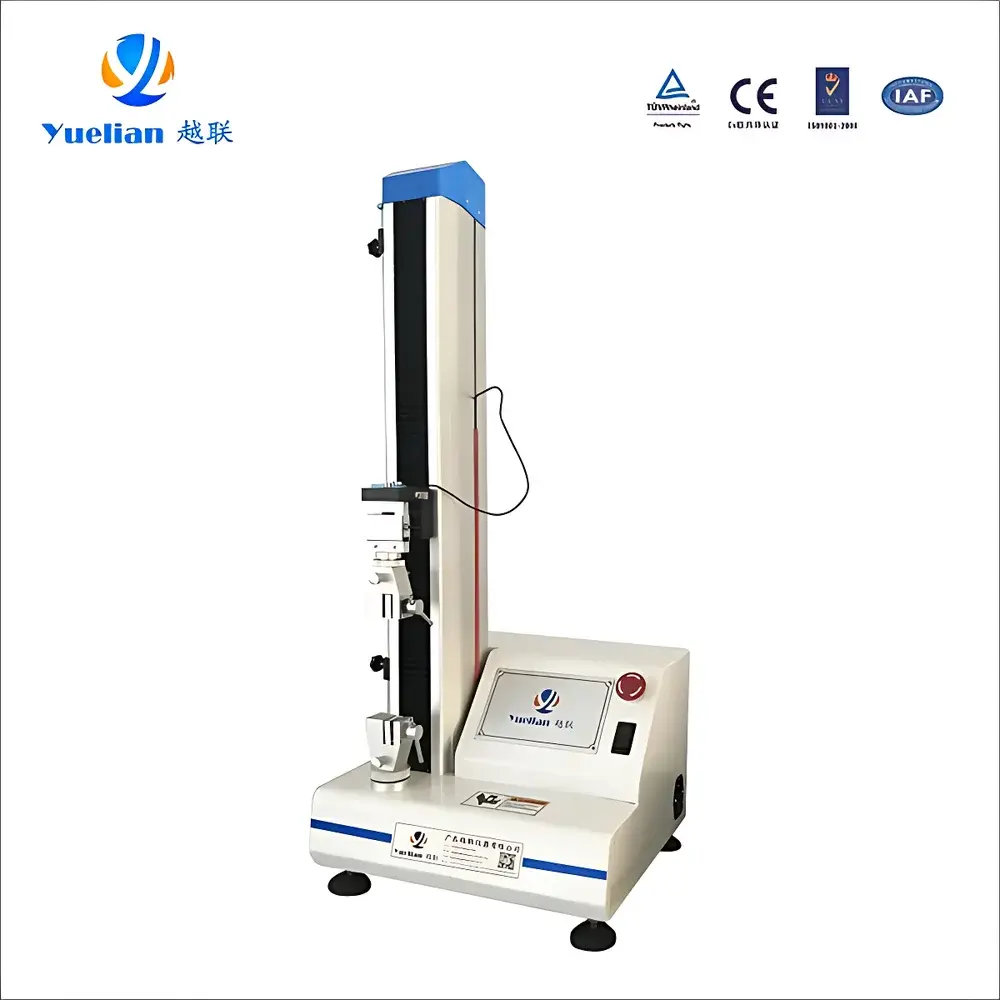
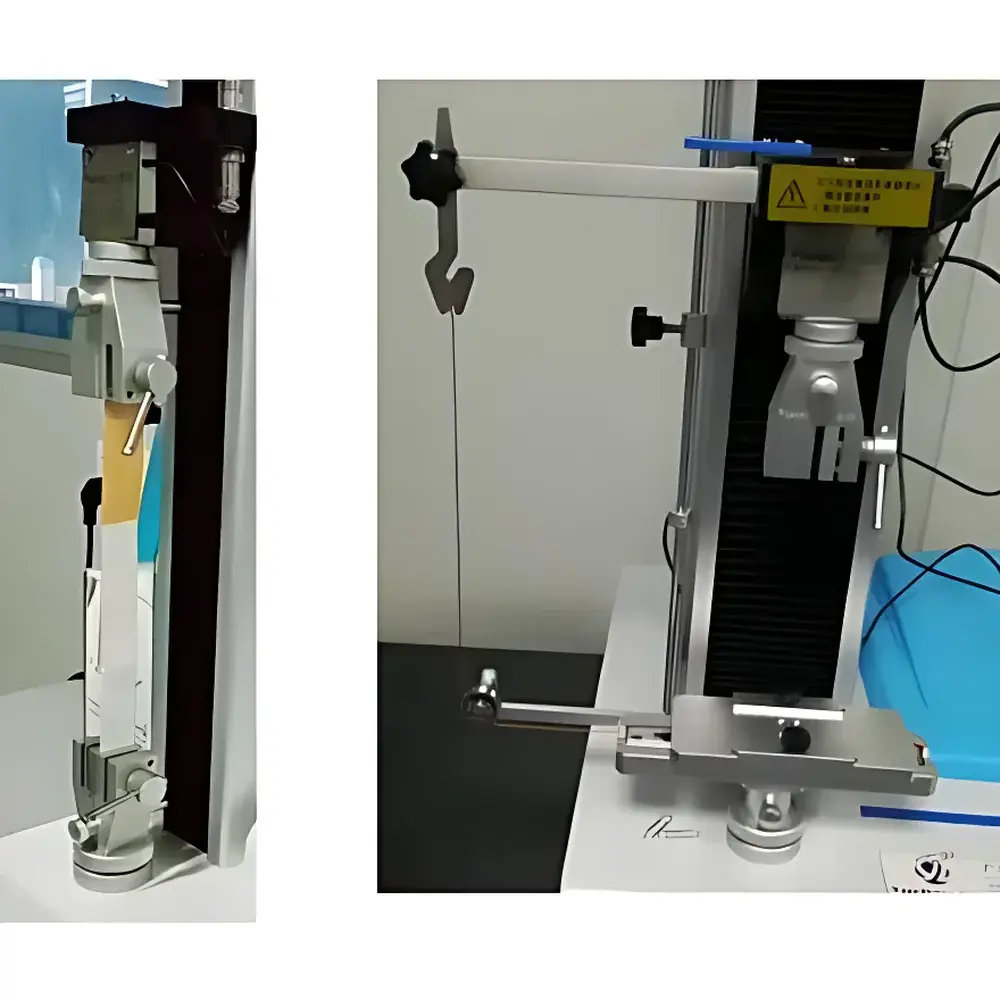
Yuelian YL-S91 Universal Testing Machine for Plastic Film Peel Strength Testing
| Brand | Yuelian |
|---|---|
| Origin | Guangdong, China |
| Model | YL-S91 |
| Instrument Type | Electronic Universal Testing Machine |
| Capacity Options | 10 N, 20 N, 50 N, 100 N, 200 N, 500 N, 1 kN (dual-range configuration available) |
| Display | PC-based interface |
| Force Resolution | 1/500,000 full scale |
| Force Accuracy | ±0.30% of reading |
| Stroke Resolution | 1/500,000 |
| Test Speed Range | 0.1–500 mm/min (software-controlled) |
| Maximum Stroke | 500 mm / 800 mm |
| Test Width | 110 mm |
| Drive System | Stepper motor + precision ground ball screw |
| Power Supply | 220 V, 50/60 Hz, 10 A |
| Power Consumption | 180 W |
| Dimensions (W×D×H) | 40×37×92 cm or 40×37×120 cm |
| Weight | 28 kg / 35 kg |
| Compliance Standards | GB/T 2792, ASTM D3330, GB/T 12914–1991, GB 13022–91, GB/T 1040–92, GB 2792–81, GB/T 14344–9, GB/T 2191–95, QB/T 2171–95, GB/T 10003–2008 |
Overview
The Yuelian YL-S91 Universal Testing Machine is an electromechanical force measurement system engineered for high-reproducibility mechanical property evaluation of thin flexible materials—particularly plastic films, laminates, adhesives, and coated substrates. It operates on the principle of controlled uniaxial tension application via a stepper motor-driven precision ball screw actuator, enabling precise displacement control and real-time force acquisition during peel, tensile, tear, shear, and compression tests. Designed to meet stringent quality assurance requirements in packaging R&D, film manufacturing, and regulatory compliance laboratories, the YL-S91 delivers traceable, repeatable data under standardized test conditions defined by ISO, ASTM, and GB methodologies. Its modular architecture supports both standalone operation and integration into automated QA workflows via USB or RS-232 interfaces.
Key Features
- High-resolution force sensing with ±0.30% accuracy and 1/500,000 full-scale resolution ensures detection of subtle interfacial failures during low-force peel events (e.g., 90° or 180° peel per ASTM D3330).
- Software-defined test speed range (0.1–500 mm/min) enables protocol alignment with material viscoelastic response—critical for temperature-sensitive polymers and pressure-sensitive adhesives.
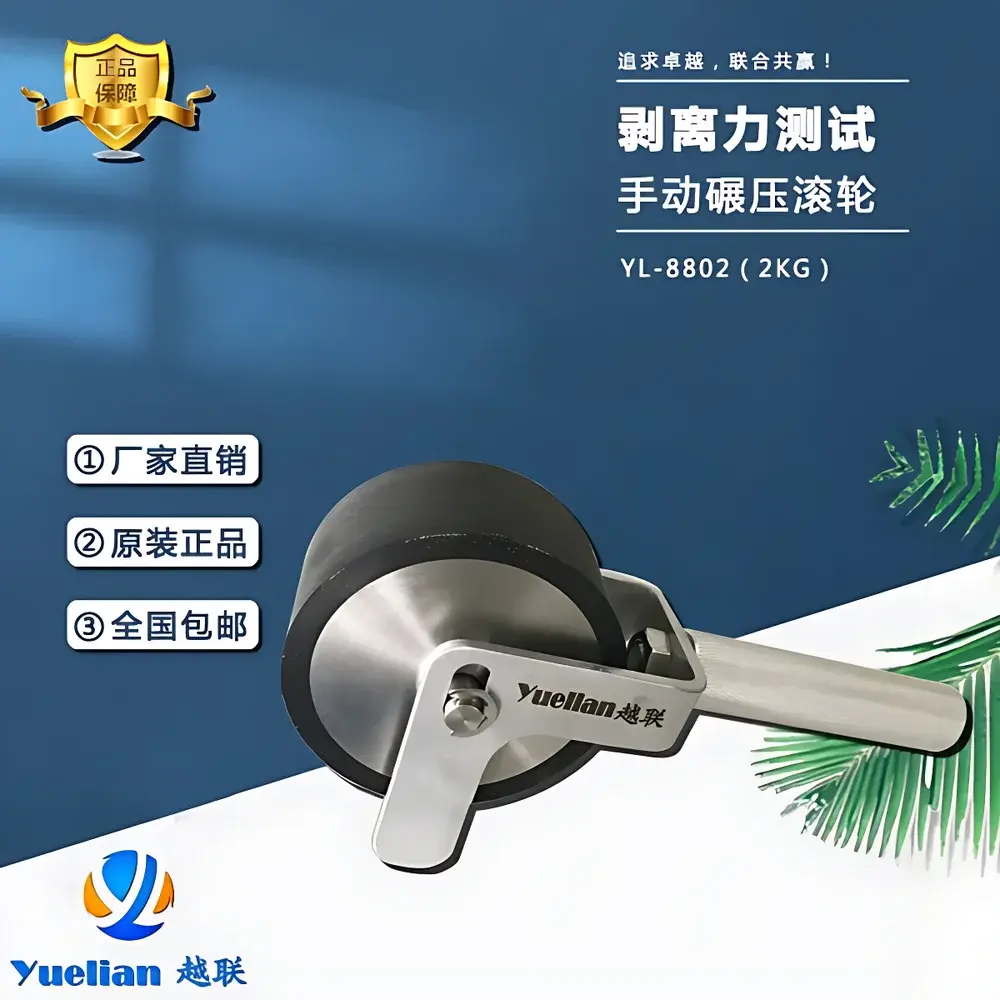
- Quick-change modular fixture interface accommodates standardized peel grips (e.g., T-peel, loop tack, ring tack), tensile jaws, and custom tooling per GB/T 2792 and GB/T 10003–2008.
- Dual-stroke configurations (500 mm / 800 mm) provide flexibility for extended elongation testing of elastic films or multi-layer composites without repositioning.
- Integrated auto-return and programmable stop logic—including overload cutoff, specimen rupture detection, and upper/lower limit enforcement—minimizes operator intervention and safeguards hardware integrity.
- PC-based control software supports GLP-compliant data handling: timestamped raw force-displacement curves, statistical summary (mean, SD, CV%), pass/fail thresholding, and export to CSV, PDF, or Excel formats.
Sample Compatibility & Compliance
The YL-S91 is validated for mechanical characterization of polymeric thin films (PET, BOPP, PE, CPP), metallized laminates, aluminum foil composites, paperboard laminates, and medical-grade barrier films. It satisfies mandatory test protocols referenced in national and international standards including GB/T 2792 (peel strength of pressure-sensitive tapes), ASTM D3330 (180° peel adhesion), GB/T 12914–1991 (tensile properties of plastic films), and GB/T 10003–2008 (general-purpose biaxially oriented polypropylene films). All firmware and software modules are designed to support audit-ready documentation required under ISO/IEC 17025-accredited laboratory practices.
Software & Data Management
The proprietary Windows-compatible software provides full test method scripting, real-time graphical monitoring, and post-test analysis tools—including derivative-based peak identification (for initial tack onset), plateau averaging (for steady-state peel force), and hysteresis loop quantification. Data files include embedded metadata: operator ID, environmental conditions (optional sensor input), calibration certificate ID, and instrument serial number. Audit trail functionality logs all parameter modifications, test executions, and report generations—supporting FDA 21 CFR Part 11 readiness when paired with user access controls and electronic signatures.
Applications
- Quantitative peel strength validation of heat-seal layers in food and pharmaceutical blister packaging.
- Adhesive bond durability assessment across temperature and humidity gradients (when integrated with environmental chambers).
- Comparative evaluation of surface treatment efficacy (e.g., corona, plasma) on polyolefin film adhesion performance.
- Tensile modulus and elongation-at-break determination for monolayer and coextruded films per GB/T 1040–92.
- Shear resistance profiling of double-sided tapes and transfer adhesives used in electronics assembly.
- Quality conformance screening for incoming raw materials against supplier specifications or internal SOPs.
FAQ
What peel angles does the YL-S91 support?
The system accommodates standard 90° and 180° peel configurations using certified fixtures compliant with ASTM D3330 and GB/T 2792. Custom angular fixtures (e.g., 45°) can be commissioned upon request.
Is the force transducer calibrated traceable to national standards?
Yes—each unit ships with a factory calibration certificate traceable to CNAS-accredited reference standards. Optional annual recalibration services include uncertainty reporting per ISO/IEC 17025.
Can the software generate GMP-compliant test reports?
The software supports configurable report templates with header/footer fields, digital signature placeholders, and automatic inclusion of calibration status, environmental notes, and statistical summaries—fully compatible with GMP documentation workflows.
Does the YL-S91 require external amplifiers or signal conditioners?
No—the integrated load cell signal conditioning circuitry is embedded within the main controller; no external modules are needed for standard operation.
What is the minimum resolvable peel force at the 10 N capacity range?
With 1/500,000 resolution, the theoretical minimum detectable force increment is 0.02 mN—sufficient for ultra-thin film and low-tack adhesive applications.



