
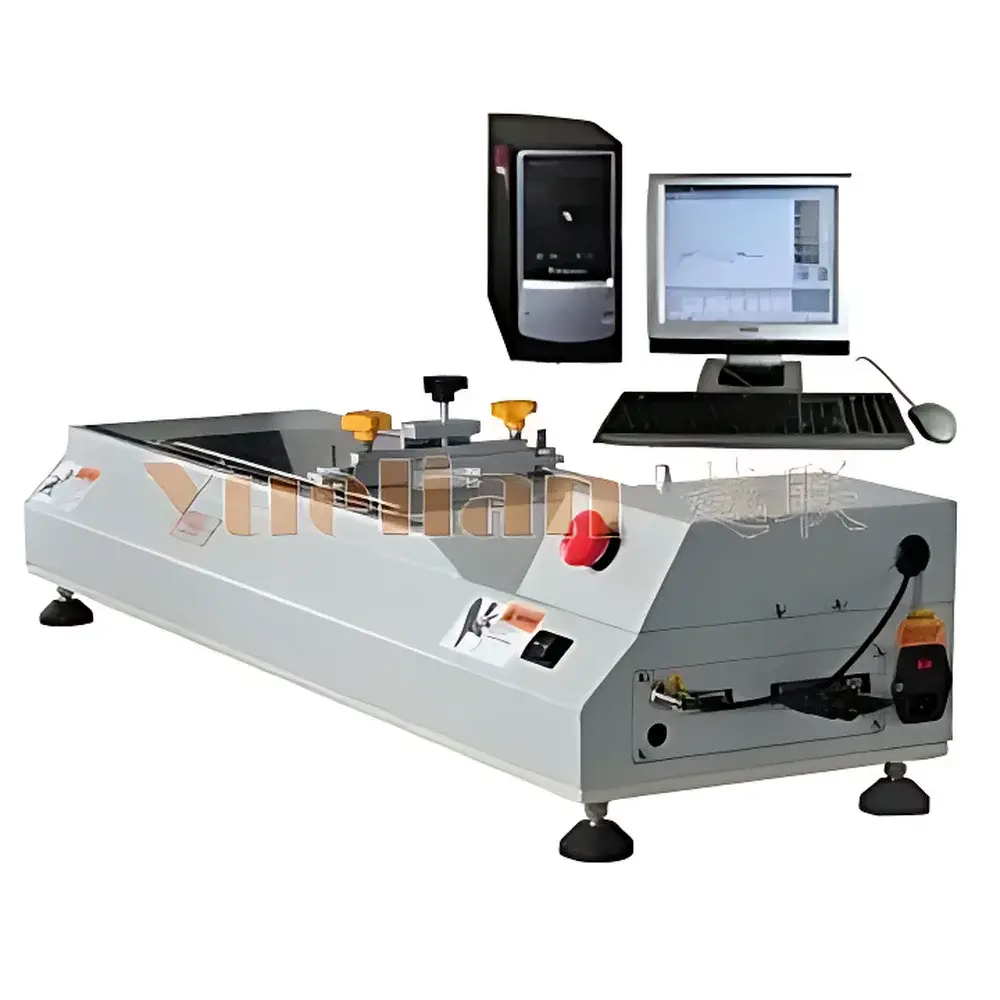
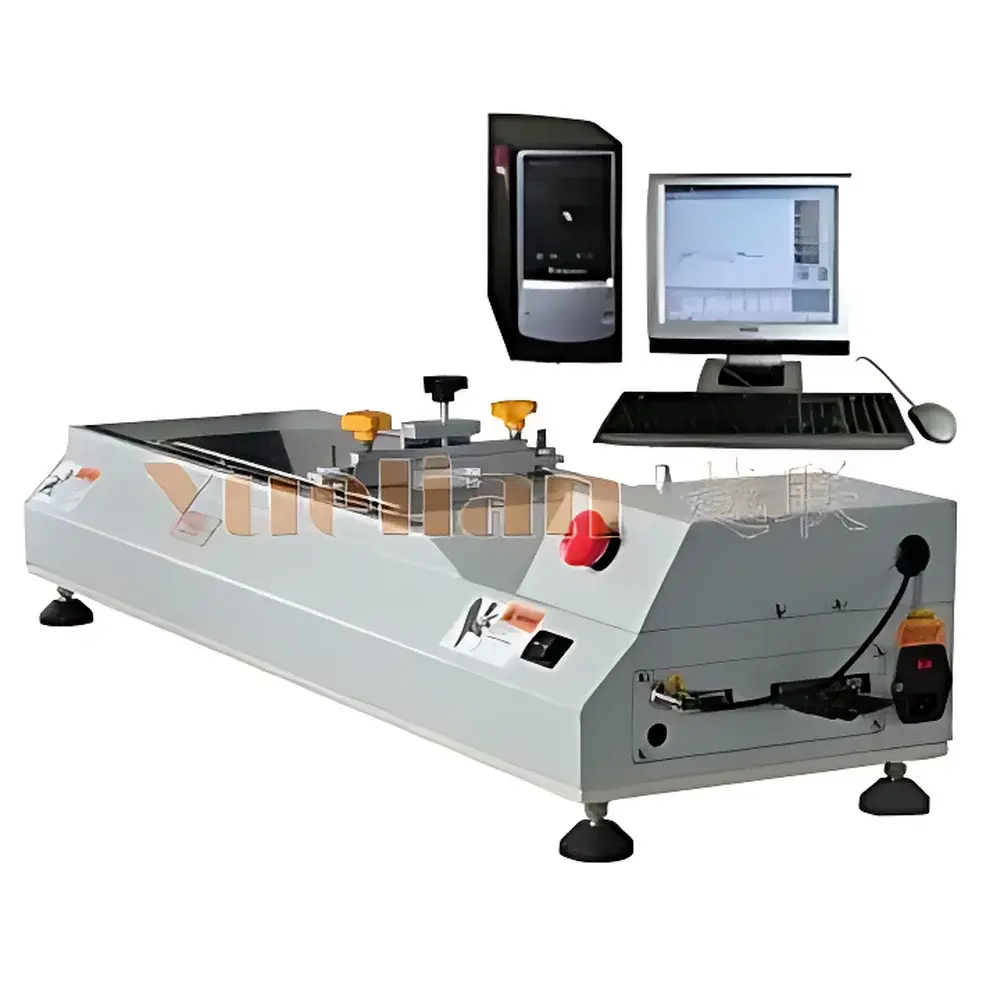
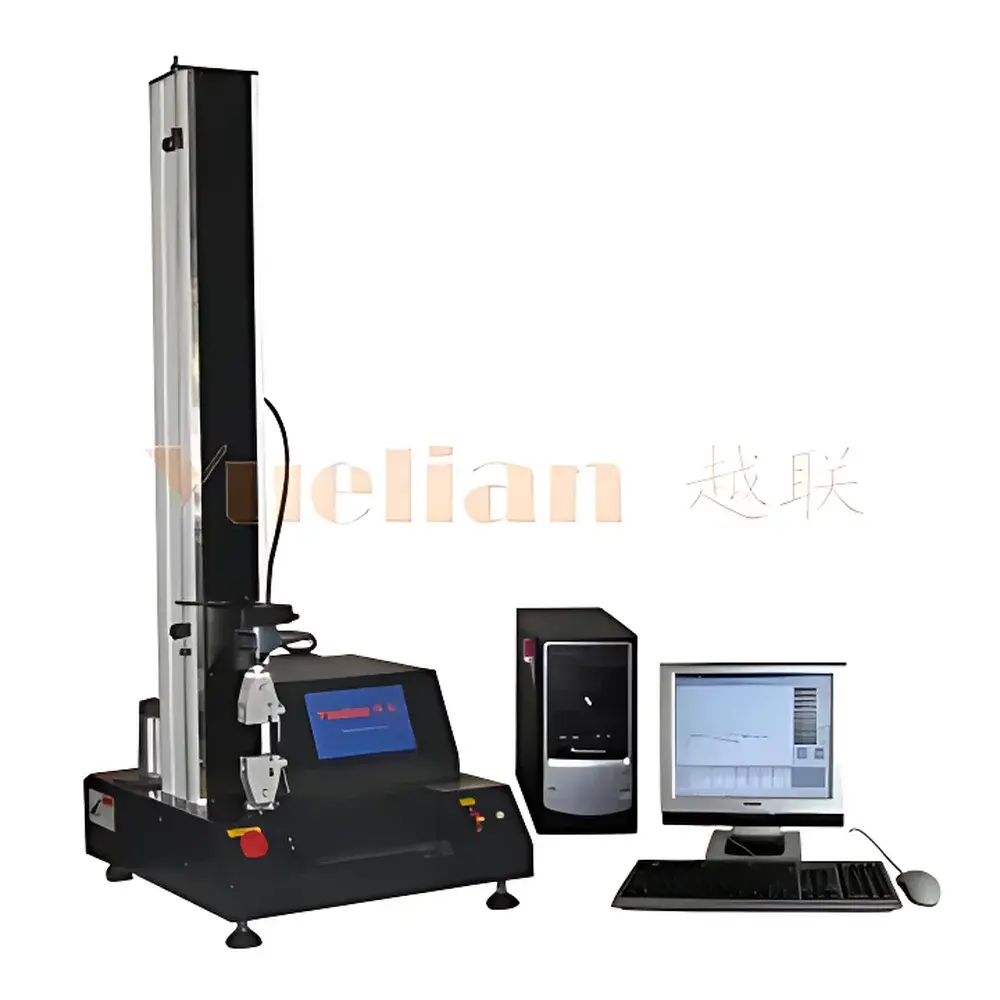
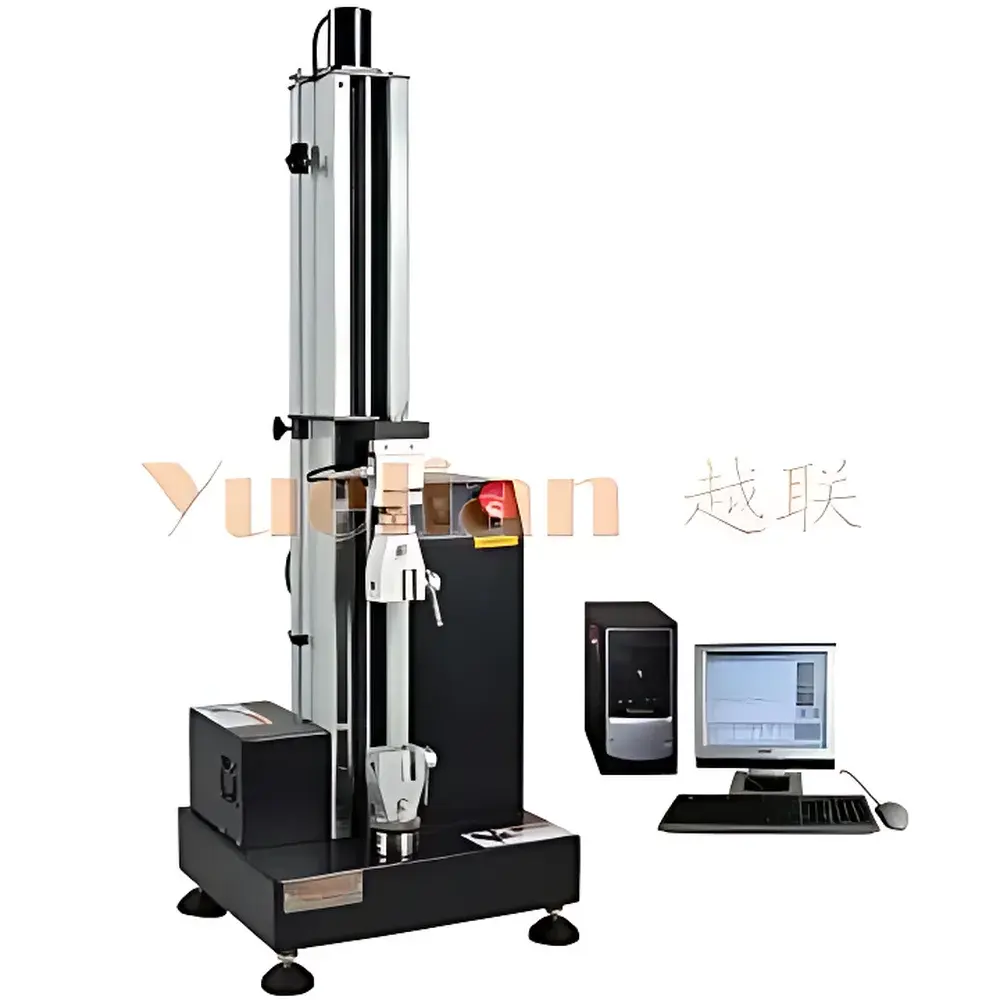
Yuelian YL-1103 180-Degree Carrier Tape Peel Tester
| Brand | Yuelian |
|---|---|
| Origin | Guangdong, China |
| Model | YL-1103 |
| Load Capacity Options | 10 N, 20 N, 50 N, 100 N, 200 N (dual-range configuration available) |
| Force Resolution | 1/250,000 full scale |
| Force Accuracy | ≤ ±0.5% FS |
| Travel Resolution | 0.005 mm |
| Test Speed Range | 5–500 mm/min (PC-programmable) |
| Maximum Travel | 500 mm |
| Test Width | Ø140 mm |
| Control System | PC-based closed-loop control with USB interface |
| Data Acquisition | Real-time force/displacement sampling, MS-ACCESS database support |
| Compliance Features | Audit trail-ready data logging, configurable pass/fail limits, automatic stop on specimen failure or overload |
| Power Supply | 220 V, 50/60 Hz, 5 A |
| Motor Type | Stepper motor with timing belt and precision ball screw drive |
| Dimensions (W×D×H) | 1063 × 300 × 200 mm |
| Weight | ~45 kg |
| Power Consumption | 180 W |
| Standard Accessories | One set of peel fixtures, proprietary test software, USB communication cable |
Overview
The Yuelian YL-1103 180-Degree Carrier Tape Peel Tester is a dedicated electromechanical testing system engineered for quantitative evaluation of adhesive bond integrity between carrier tapes and component pockets—critical in electronics packaging, surface-mount technology (SMT), and tape-and-reel manufacturing workflows. It operates on the principle of controlled tensile separation at a fixed 180° peel angle, conforming to standardized test geometries defined in IPC-TM-650 2.4.1, JIS Z 0237, and ASTM D903. The instrument integrates a high-resolution stepper-driven actuation system with real-time force transduction and displacement tracking, enabling precise measurement of peel force profiles—including initial peak load, steady-state average peel force, and post-yield detachment behavior. Its rigid frame architecture, low-inertia motion train, and digital signal conditioning ensure high reproducibility across repeated tests, essential for incoming quality control (IQC), process validation, and supplier qualification protocols.
Key Features
- Programmable peel speed from 5 to 500 mm/min, adjustable in 1 mm/min increments via PC interface for method-specific compliance (e.g., 300 mm/min per IPC-TM-650)
- Dual-range load cell configuration support (e.g., 10 N / 200 N) enables high-resolution measurement of low-force adhesive bonds without sacrificing upper-range capability
- Force resolution of 1 part in 250,000 full scale and accuracy better than ±0.5% FS meet ISO 7500-1 Class 0.5 requirements for static force measurement systems
- Travel resolution of 0.005 mm supports accurate displacement-triggered event detection (e.g., onset of delamination, final separation)
- Automated stop conditions include overload protection, specimen rupture detection, user-defined upper/lower force limits, and emergency manual halt
- Integrated auto-return function repositions crosshead to origin post-test without operator intervention, reducing cycle time in high-throughput labs
- USB-connected architecture eliminates proprietary hardware dependencies; compatible with Windows 10/11 x64 platforms and standard office IT infrastructure
Sample Compatibility & Compliance
The YL-1103 accommodates standard industry carrier tapes (e.g., embossed plastic reels per EIA-481-D, punched paper tapes, conductive antistatic variants) with pocket widths up to 140 mm. Fixtures are designed for secure clamping of both tape web and peeled tab without slippage or edge deformation. The system supports test configurations aligned with IPC-A-610 acceptance criteria for tape adhesion strength, as well as internal OEM specifications requiring traceable peel performance data. All test parameters—including speed, dwell time, trigger thresholds, and pass/fail logic—are fully configurable and stored with timestamped metadata. Raw data files (.accdb) retain unprocessed sensor outputs, satisfying GLP/GMP documentation requirements for audit readiness and FDA 21 CFR Part 11 electronic record integrity when deployed with validated computer systems.
Software & Data Management
The embedded test software provides a graphical interface for test method definition, real-time curve visualization (force vs. displacement), and post-test analysis. It computes key metrics including average peel force (N), maximum peel force (N), total energy to peel (mJ), and coefficient of variation (%CV) across replicate specimens. Curve smoothing, baseline correction, and region-of-interest selection enable granular interpretation of interfacial failure modes. Data export options include CSV, PDF reports, and native MS-ACCESS database format—ensuring compatibility with enterprise LIMS environments and statistical process control (SPC) platforms. Audit trail functionality logs all user actions, parameter changes, and calibration events with operator ID and timestamp, supporting regulatory review and internal quality audits.
Applications
- Quantitative verification of carrier tape adhesive performance across temperature and humidity preconditioning cycles
- Comparative evaluation of alternative tape formulations (e.g., acrylic vs. rubber-based adhesives)
- Process capability studies for tape slitting, printing, and component loading operations
- Root cause analysis of component pop-off or pocket lifting during pick-and-place handling
- Supplier qualification against contractual peel strength specifications (e.g., ≥8 N minimum for 8 mm wide tape)
- Supporting Failure Modes and Effects Analysis (FMEA) for tape-and-reel packaging reliability
FAQ
What standards does the YL-1103 comply with for peel testing?
It supports test execution per IPC-TM-650 2.4.1, ASTM D903, JIS Z 0237, and ISO 8510-2, with programmable geometry and speed settings matching each standard’s requirements.
Can the system store test methods and recall them for routine QC checks?
Yes—up to 100 preconfigured test methods can be saved, each with unique speed profiles, stop conditions, and reporting templates.
Is third-party calibration certification available?
Calibration certificates traceable to NIM (National Institute of Metrology, China) or ISO/IEC 17025-accredited laboratories can be provided upon request.
Does the software support multi-user access with role-based permissions?
The current version supports single-user operation; however, database-level security controls (via MS-ACCESS user groups) allow integration into networked environments with domain authentication.
What maintenance is required for long-term repeatability?
Annual verification of force transducer linearity and travel encoder accuracy is recommended; routine cleaning of the ball screw and lubrication of linear guides every 6 months ensures mechanical stability.



