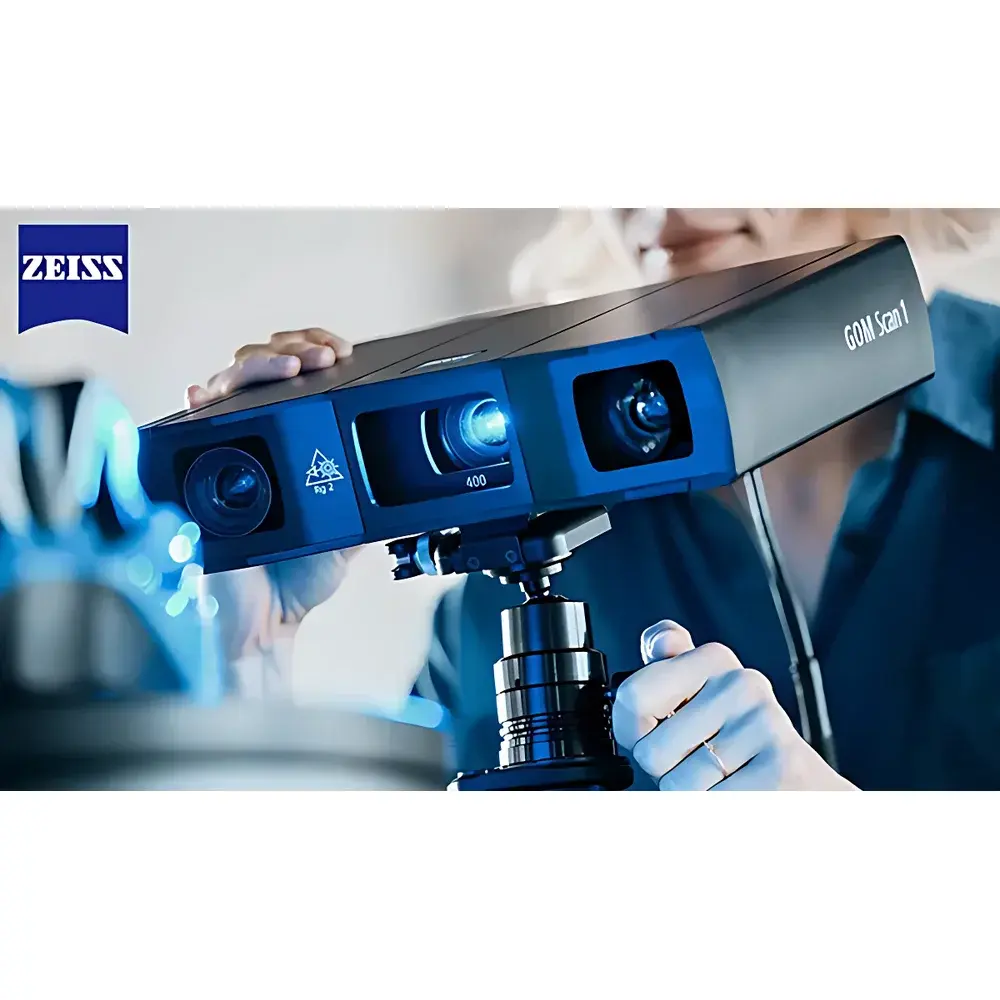
ZEISS GOM Scan 1 Blue Light 3D Scanner
| Brand | ZEISS |
|---|---|
| Origin | Germany |
| Manufacturer Type | Authorized Distributor |
| Product Origin | Imported |
| Model | GOM Scan 1 (MV 100 / MV 200 / MV 400) |
| Price Range | USD 42,000 – 70,000 |
Overview
The ZEISS GOM Scan 1 is a high-precision, portable optical 3D scanner engineered for industrial metrology applications requiring traceable, repeatable surface digitization. Based on fringe projection profilometry (FPP) with structured blue LED light illumination, the system captures full-field 3D surface topography by projecting calibrated sinusoidal light patterns onto the object and reconstructing geometry from stereo image disparity between two synchronized high-resolution cameras. This principle—rooted in triangulation and phase-shifting algorithms—ensures sub-pixel measurement stability and robustness against ambient light interference. Designed for integration into quality assurance workflows, R&D labs, and digital manufacturing pipelines, the GOM Scan 1 delivers certified geometric fidelity compliant with ISO 10360-8 (coordinate measuring machines) and ASTM E2925 (standard guide for 3D scanning systems). Its compact form factor (290 × 215 × 80 mm), low mass (~2.5 kg), and USB 3.0 interface enable deployment in constrained environments—including production floors, inspection booths, and field service locations—without sacrificing metrological integrity.
Key Features
- Blue LED fringe projection technology: Minimizes ambient light sensitivity and enables stable operation under variable lighting conditions, including typical factory floor illumination.
- Stereo camera architecture with real-time self-monitoring: Dual CMOS sensors continuously assess focus, exposure, and pattern contrast; software dynamically adjusts acquisition parameters to maintain data quality.
- Three interchangeable measurement volumes: MV 100 (100 × 65 mm² FOV), MV 200 (200 × 125 mm²), and MV 400 (400 × 250 mm²), each delivering up to 6 million points per scan with point spacing ranging from 0.037 mm to 0.129 mm.
- Integrated hardware-software calibration: Factory-certified calibration ensures traceability to national standards; on-site verification routines support periodic performance validation per ISO/IEC 17025 requirements.
- Robust mechanical design: Aluminum-magnesium alloy housing rated for continuous industrial use; IP52-rated against dust ingress and transient moisture exposure.
- USB 3.0 plug-and-play connectivity: No external power supply required; compatible with Windows 10 64-bit systems and validated for use in controlled IT environments under FDA 21 CFR Part 11-compliant configurations.
Sample Compatibility & Compliance
The GOM Scan 1 accommodates a broad range of non-reflective, matte-surfaced components common in mechanical engineering, automotive prototyping, medical device development, and cultural heritage documentation. Specular or highly transparent surfaces require standardized matting sprays (e.g., ZEISS Spray-On Reference Layer), which are documented in ASTM E3127 Annex A3 for temporary surface preparation. The system supports parts up to 500 mm in height when used with the optional GOM ROT 350 motorized rotary table (ISO 10360-8 compliant for rotational accuracy ≤ ±2.5 arcsec). All hardware and firmware versions undergo electromagnetic compatibility (EMC) testing per EN 61326-1 and safety certification per EN 61010-1. Data integrity protocols—including audit trail logging, user access control, and electronic signature support—are embedded within GOM Inspect Suite to meet GLP/GMP and ISO 9001:2015 documentation requirements.
Software & Data Management
GOM Inspect Suite serves as the native metrology platform for the GOM Scan 1, providing end-to-end processing from raw point cloud to inspection report. It implements ISO 1660:2017-compliant mesh smoothing, hole-filling, curvature line extraction, and adaptive decimation algorithms that preserve critical geometric features while optimizing file size for downstream CAD/CAM/3D printing workflows. The software supports direct import of STEP, IGES, STL, and ASCII point cloud formats, and enables automated best-fit alignment against reference CAD models using iterative closest point (ICP) and datum-based GD&T alignment methods. All measurement operations—including deviation color mapping, cross-section analysis, wall thickness evaluation, and dimensional reporting—are fully scriptable via Python API. Audit trails record operator ID, timestamp, parameter settings, and result modifications—enabling full traceability for internal audits or regulatory submissions under FDA 21 CFR Part 11.
Applications
- First-article inspection and FAI reporting per AS9102 standards
- Reverse engineering of legacy parts lacking CAD documentation
- Tooling wear analysis and mold cavity monitoring in injection molding
- Digital archiving of museum artifacts and anatomical specimens
- Pre- and post-build validation of additively manufactured components
- Surface defect detection (e.g., sink marks, warpage, delamination) via deviation heatmaps
- Educational use in metrology laboratories for teaching photogrammetric principles and GD&T interpretation
FAQ
Is the GOM Scan 1 suitable for measuring shiny or black surfaces?
Yes—when combined with ZEISS-certified matting agents and optimized exposure settings, the blue-light system achieves reliable capture on challenging surfaces. Reflectivity compensation algorithms are embedded in GOM Inspect.
Does the system support automated inspection sequences?
Yes—via GOM Inspect’s scripting interface and integration with GOM ROT 350, users can define multi-position scanning routines with automatic alignment and report generation.
Can measurement data be exported to third-party CAD platforms?
Yes—native export to STEP, IGES, STL, OBJ, PLY, and ASCII XYZ formats ensures interoperability with Siemens NX, Dassault Systèmes CATIA, Autodesk Fusion 360, and Materialise Magics.
What calibration documentation is provided with the instrument?
Each unit ships with a ZEISS Certificate of Calibration traceable to PTB (Physikalisch-Technische Bundesanstalt), including uncertainty budgets per ISO/IEC 17025 and measurement volume-specific error maps.
Is remote technical support available for international customers?
Yes—ZEISS offers global Tier-2 engineering support through authorized distributors, including remote diagnostics, software updates, and virtual training sessions aligned with ISO/IEC 17025 competency requirements.