
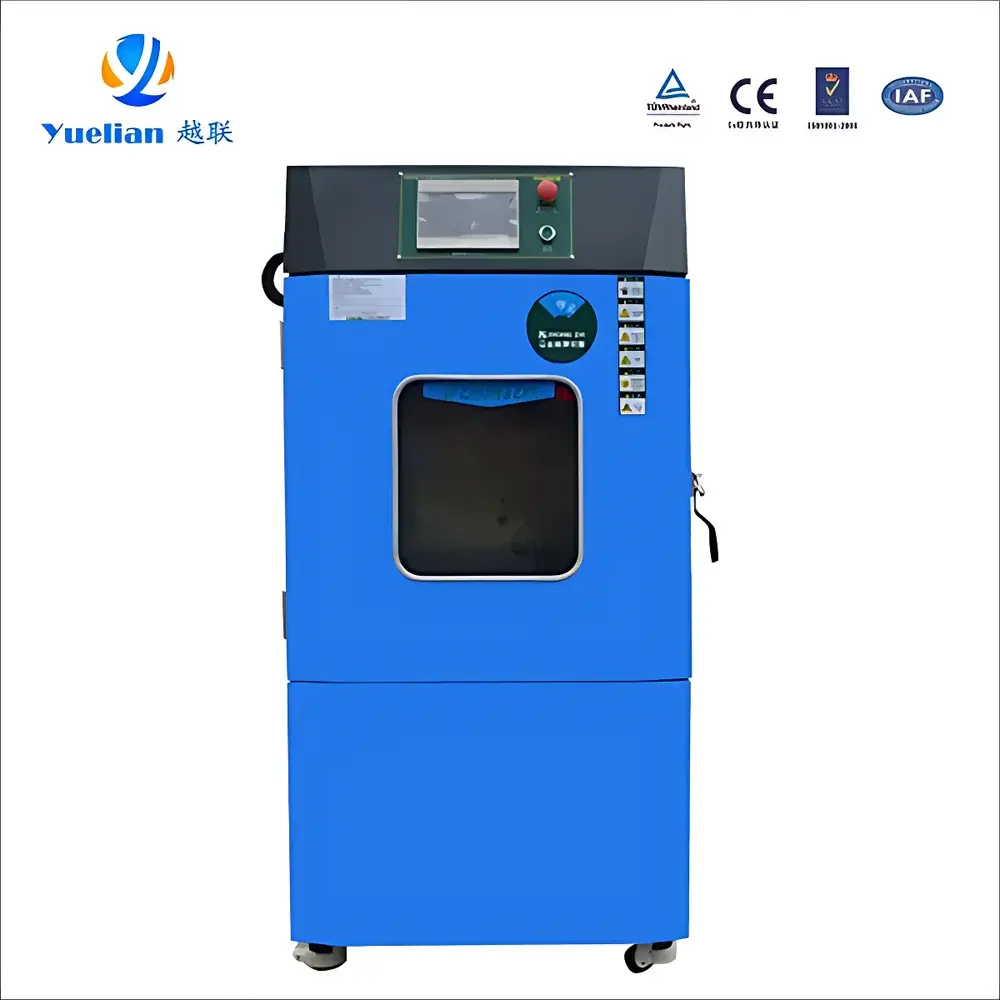
Yuelian YL-DQ-01 High-Altitude Low-Pressure Environmental Test Chamber
| Brand | Yuelian |
|---|---|
| Origin | Guangdong, China |
| Model | YL-DQ-01 |
| Internal Volume | 175 L |
| Chamber Dimensions (W×H×D) | 500×700×500 mm |
| External Dimensions (approx.) | 880×730×1680 mm |
| Vacuum Range | 0 to –99 kPa (adjustable) |
| Vacuum Accuracy | ±0.5 kPa |
| Vacuum Resolution | 0.1 kPa |
| Vacuum Stability | ±0.5 kPa |
| Hold Time Range | 0–99 h 99 min 60 s |
| Temperature Range | RT+10°C to +150°C |
| Temp. Resolution | 0.1°C |
| Temp. Uniformity | ≤2.0°C |
| Temp. Fluctuation | ±0.5°C |
| Temp. Deviation | ≤2.0°C |
| Heating Rate | ≤1°C/min (RT→150°C) |
| Control System | PLC + Touchscreen HMI |
| Construction | Monolithic |
| Outer Shell | Thickened Cold-Rolled Steel (Gray/Blue Finish) |
| Inner Chamber | Stainless Steel |
| Viewing Window | Dual-Layer Tempered Safety Glass (350×400 mm) |
| Standard Accessories | Main Unit, 2× Sample Racks, Epoxy Resin Insulating Sample Boards |
| Power Supply | AC 220 V / 50 Hz or AC 380 V / 50 Hz |
Overview
The Yuelian YL-DQ-01 High-Altitude Low-Pressure Environmental Test Chamber is an engineered system designed to replicate the low-pressure conditions encountered at high-altitude flight environments—specifically up to 15,240 meters (≈11.6 kPa absolute pressure)—for rigorous evaluation of electrochemical, mechanical, and thermal performance of components under controlled vacuum and temperature stress. It operates on the principle of regulated pneumatic evacuation via a high-efficiency vacuum pump assembly, coupled with precision PID-controlled resistive heating, enabling stable, repeatable, and traceable environmental simulation. This chamber is widely deployed in aerospace component qualification, battery safety certification (e.g., UN 38.3 Section 4.5.1), avionics packaging validation, and materials outgassing assessment per ASTM E595 and ECSS-Q-ST-70-02C.
Key Features
- Monolithic structural design ensures mechanical integrity during repeated vacuum cycling and thermal expansion.
- Dual-layer tempered safety glass viewing window (350 × 400 mm) provides real-time visual monitoring while maintaining pressure containment and operator safety.
- PLC-based control system with intuitive touchscreen HMI enables programmable vacuum ramping, hold profiles, and synchronized temperature conditioning—including independent vacuum-only, temperature-only, or combined low-pressure/thermal test modes.
- High-precision vacuum regulation with ±0.5 kPa accuracy and 0.1 kPa resolution supports compliance-critical test execution, such as IEC 62133 and GB/T 31241 battery altitude testing protocols.
- Stainless steel inner chamber and thickened cold-rolled steel outer enclosure resist corrosion, ensure long-term dimensional stability, and minimize thermal leakage.
- Integrated LED interior lighting facilitates clear observation of sample behavior—including electrolyte migration, seal integrity, or venting events—under operational vacuum conditions.
Sample Compatibility & Compliance
The YL-DQ-01 accommodates samples up to 500 mm wide × 700 mm high × 500 mm deep, with two adjustable stainless steel sample racks and epoxy resin insulating boards included to prevent electrical shorting during high-voltage or battery testing. Its vacuum and thermal performance meets requirements for international regulatory test standards including UN Manual of Tests and Criteria Part III, Subsection 38.3 (Test T.5 – Altitude Simulation), MIL-STD-810G Method 500.6, and DO-160 Section 4.10 (Low Pressure). The system’s pressure control repeatability and thermal uniformity (≤2.0°C) support GLP-aligned test documentation when paired with external data loggers compliant with FDA 21 CFR Part 11 audit trail requirements.
Software & Data Management
While the YL-DQ-01 utilizes an embedded PLC controller without proprietary PC software, its RS485/Modbus RTU interface enables seamless integration with third-party SCADA systems, LabVIEW-based acquisition platforms, or enterprise LIMS. All vacuum setpoints, actual pressure readings, chamber temperature values, elapsed time, and alarm status are continuously logged internally and exportable via USB. Timestamped event logs—including door open/close, vacuum start/stop, and over-pressure/over-temperature fault triggers—are retained for post-test forensic analysis and internal quality audits.
Applications
- Battery safety validation per UN 38.3 T.5: Simulating 15,240 m altitude (11.6 kPa) for 6 hours to assess thermal runaway, venting, leakage, or ignition risk in Li-ion, Li-metal, and solid-state cells.
- Aerospace electronics packaging verification: Evaluating hermetic seal integrity, solder joint reliability, and conformal coating performance under rapid decompression scenarios.
- Outgassing characterization of adhesives, potting compounds, and composite materials per ASTM E595 total mass loss (TML) and collected volatile condensable materials (CVCM) screening.
- Avionics cooling system validation: Assessing heat dissipation efficiency and fan operation stability under low-density atmospheric conditions.
- Medical device sterilization packaging integrity testing: Confirming barrier performance of Tyvek®-based pouches under simulated high-altitude transport conditions.
FAQ
What altitude does 11.6 kPa represent, and how is it achieved?
11.6 kPa corresponds to an approximate geometric altitude of 15,240 meters above sea level per the U.S. Standard Atmosphere (1976). This pressure is attained by controlled vacuum evacuation using the integrated pump system and held within ±0.5 kPa tolerance for the specified duration.
Can the chamber perform simultaneous low-pressure and temperature cycling?
Yes—the YL-DQ-01 supports concurrent vacuum and temperature control. Users may define multi-step profiles combining pressure ramps, dwell periods, and temperature sweeps (e.g., –40°C → +150°C under fixed vacuum) via the touchscreen HMI.
Is the system suitable for testing lithium batteries per UN 38.3?
Yes. The chamber satisfies the physical requirements of UN 38.3 Section 4.5.1 for altitude simulation testing, including pressure accuracy, stability, and hold time capability. Users must follow full test sequence per applicable edition of the UN Manual.
What maintenance is required for long-term vacuum performance?
Routine inspection of vacuum seals, periodic oil replacement in the rotary vane pump (per manufacturer schedule), and cleaning of the stainless steel chamber interior are recommended. Calibration of pressure and temperature sensors should be performed annually or per internal QA protocol.
Does the unit include data export capability for regulatory submissions?
Yes—test data (pressure, temperature, time stamps, alarms) are stored internally and exportable in CSV format via USB. When connected to validated external logging hardware, the system supports 21 CFR Part 11-compliant electronic records generation.
Related Products



