
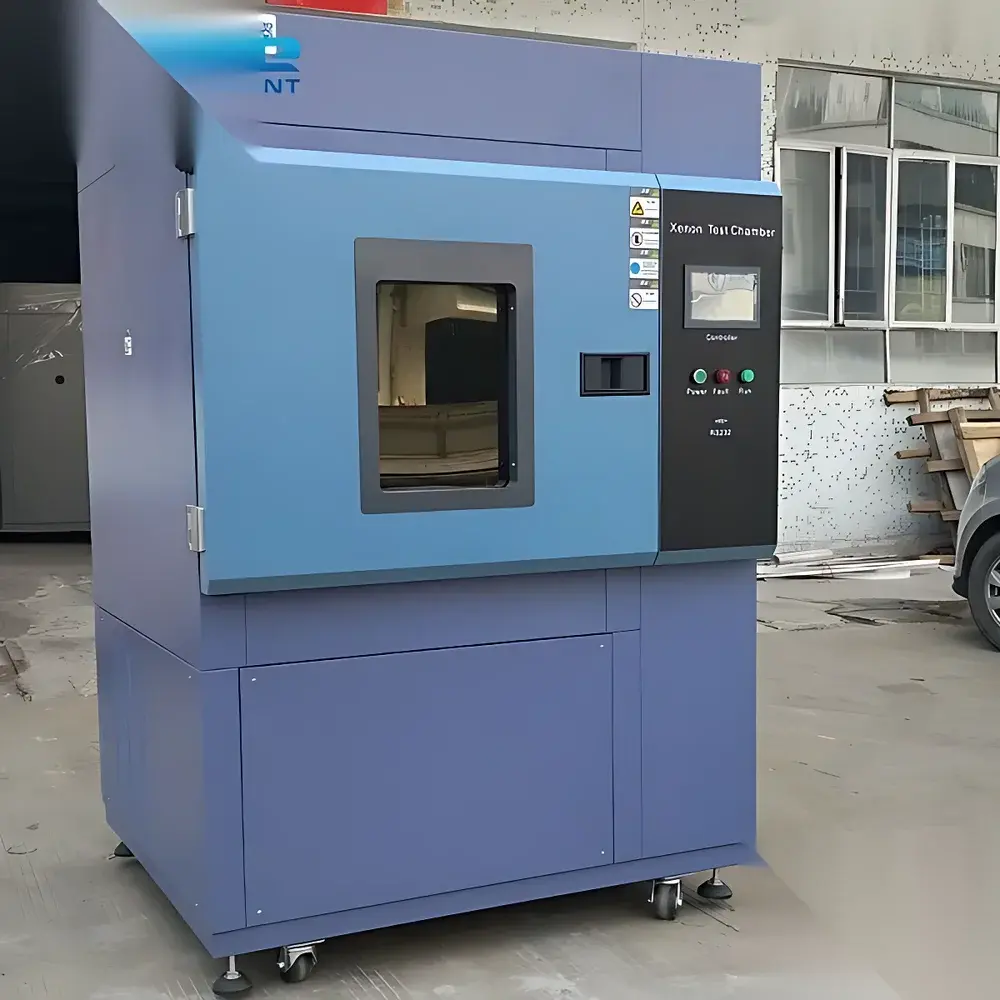
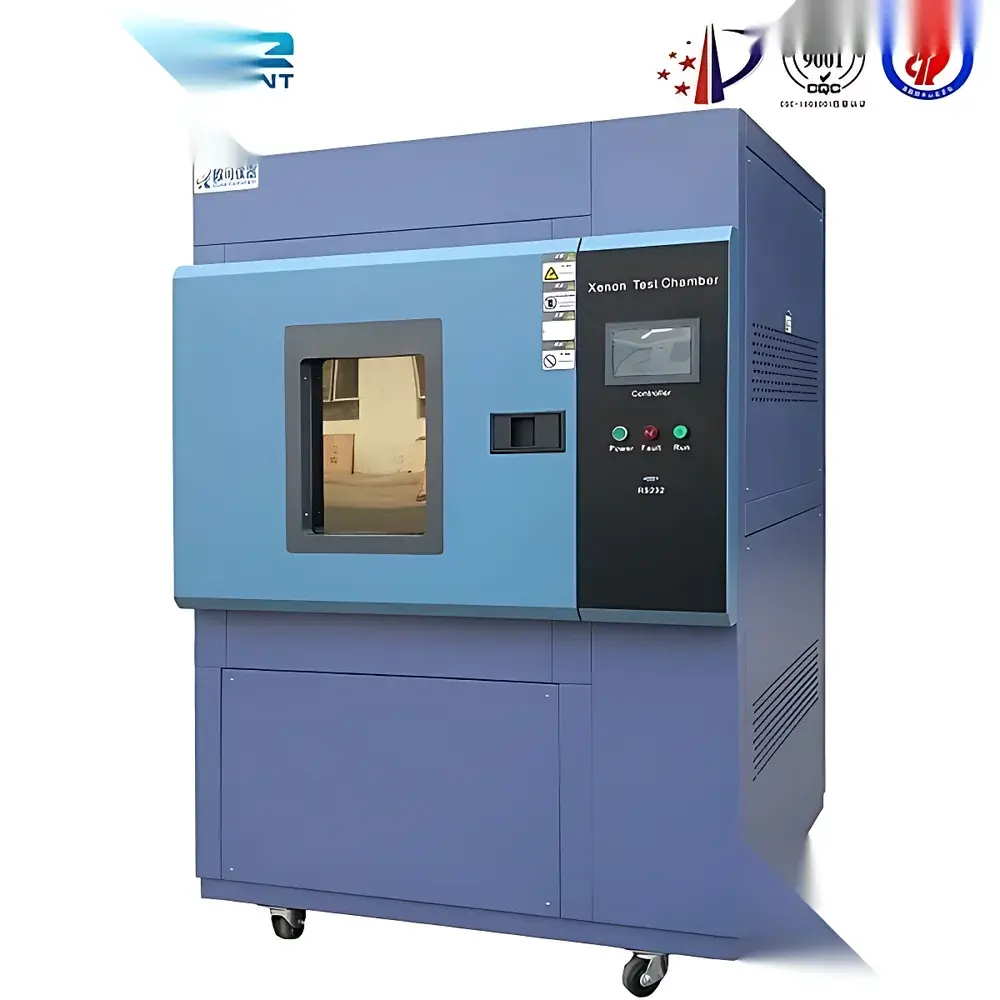
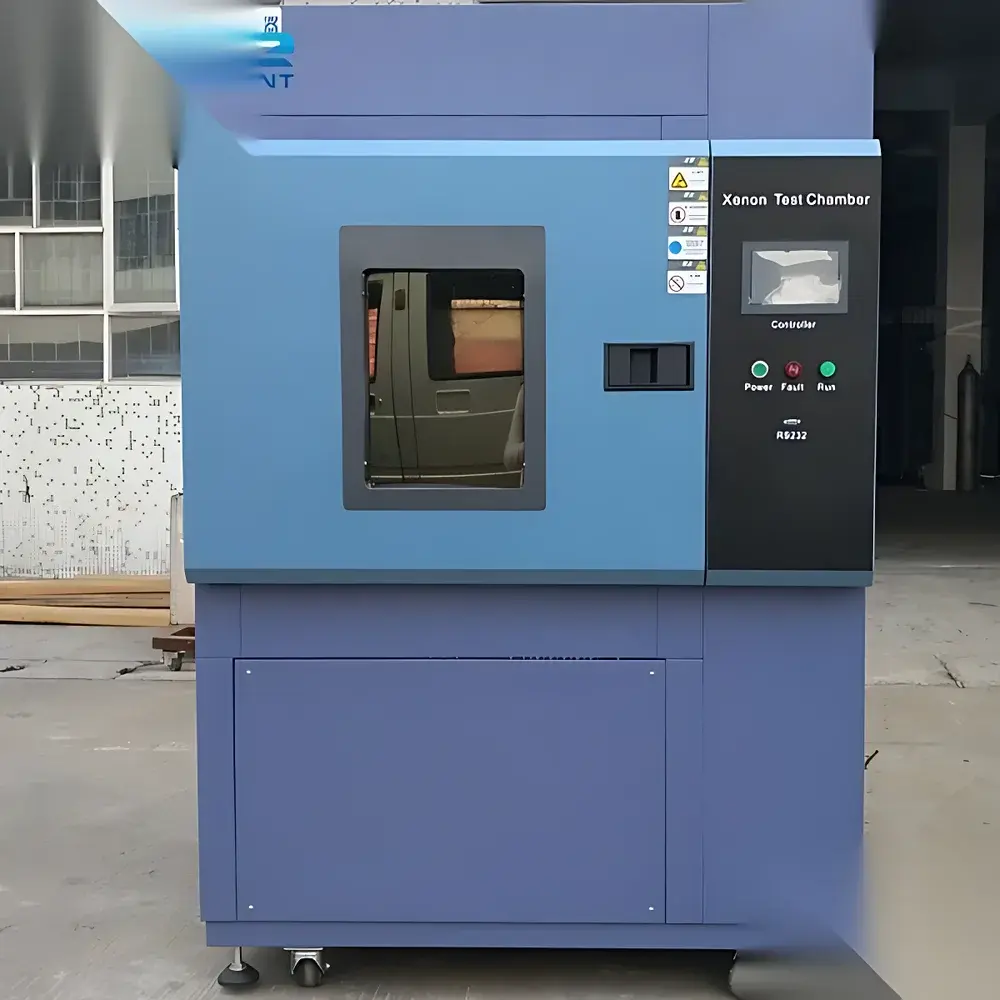
English Product Name
| Brand | OEM / Custom Brand |
|---|---|
| Origin | Imported |
| Manufacturer Type | Authorized Distributor |
| Pricing | USD 5,200 (Reference Only |
| Xenon Lamp Power | 6 kW |
| Lamp Life | ~1,600 hours |
| Irradiance Range | 550–1,200 W/m² |
| Spectral Range | 290–800 nm |
| Irradiated Area | ~0.75 m² |
| Sample-to-Arc Distance | 350–380 mm |
| Sample Rotation Speed | ≥1 rpm (Infinitely Variable) |
| Rainfall Duration | 1–9,999 min (Adjustable) |
| Rainfall Cycle Interval | 1–240 min (Adjustable) |
| Heating Power | ~3.6 kW |
| Humidification Power | ~3 kW |
| Refrigeration Compressor | 1× Hermetic Tecumseh (France) |
| Refrigerant | R404A |
| Cooling Method | Forced Air |
| Humidity Control | Relative Humidity (RH) Regulation |
| Heating Element | Stainless Steel Finned-Tube Heater with SSR Output Control |
| Lamp Type | Imported Water-Cooled Full-Spectrum Long-Arc Xenon Lamp |
Overview
The Customizable Xenon Arc Weathering Test Chamber is an engineered environmental simulation system designed to accelerate material degradation under controlled exposure to solar radiation, thermal cycling, humidity, and simulated precipitation. It operates on the principle of xenon arc irradiation—reproducing the full solar spectrum (290–800 nm), including critical UV-B, UV-A, visible, and near-infrared wavelengths—enabling quantitative assessment of photostability, color fading, gloss loss, embrittlement, and surface cracking in polymeric, coated, and composite materials. Unlike narrow-band UV fluorescent systems, this chamber delivers spectrally accurate irradiance that closely matches terrestrial sunlight filtered through window glass—a requirement specified in ASTM G155, ISO 4892-2, and SAE J2527 for automotive interior testing. Its integrated climate control architecture allows concurrent or sequential modulation of irradiance intensity, black-panel temperature (BPT), chamber air temperature, relative humidity (RH), and water spray cycles—mimicking real-world service environments ranging from arid desert exposures to tropical coastal conditions.
Key Features
- Water-cooled 6 kW long-arc xenon lamp with calibrated spectral output and stable irradiance maintenance across 290–800 nm; lamp life rated at ~1,600 hours under standard operating conditions.
- Precision irradiance control via dual-axis regulation: vertical sample-to-lamp distance adjustment (350–380 mm) and real-time lamp voltage/current feedback loop—ensuring compliance with ISO 4892-2 irradiance tolerances (±10% of setpoint).
- Multi-stage optical filtration system (e.g., Daylight-Q, Window Glass-Q, Extended UV filters) to replicate specific spectral profiles required by ASTM D4459 (indoor), ASTM G155 (outdoor), and IEC 60068-2-9 (condensation).
- Integrated rain simulation subsystem: programmable rainfall duration (1–9,999 min) and cycle interval (1–240 min); stainless steel nozzles with electromagnetic valve actuation ensure uniform droplet distribution per ISO 20623.
- Robust climate control stack: forced-air refrigeration (Tecumseh hermetic compressor, R404A refrigerant), stainless finned-tube heating (SSR-controlled, ±0.5°C stability), and steam-based humidification (±3% RH accuracy, 10–95% RH range).
- Motor-driven sample rotation basket (≥1 rpm, infinitely variable speed) ensures uniform exposure across irregularly shaped specimens—including 3D automotive trim, architectural panels, and flexible packaging substrates.
- Full-spectrum irradiance monitoring via calibrated broadband radiometer with NIST-traceable calibration certificate included.
Sample Compatibility & Compliance
This chamber accommodates flat, curved, and three-dimensional samples up to 750 mm × 500 mm × 200 mm (W×D×H) within its rotating specimen basket. Fixture adaptability supports ASTM D2565-compliant plaques, ISO 11341-2013 paint panels, and custom jigs for electronic enclosures or textile swatches. All operational parameters—including irradiance setpoints, temperature ramps, humidity profiles, and spray sequences—are programmable and auditable per FDA 21 CFR Part 11 requirements when paired with optional compliant software. The system meets structural and safety standards per IEC 61000-4 (EMC), UL 61010-1 (electrical safety), and CE marking directives. It supports test method validation per ISO/IEC 17025 for accredited laboratories conducting weathering assessments under GLP or GMP frameworks.
Software & Data Management
The embedded controller features a 10.1″ capacitive touchscreen interface with multi-user access levels (operator, engineer, administrator). Test programs are defined using step-based logic—each step specifying irradiance (W/m²), BPT (°C), chamber air temperature (°C), RH (%), spray ON/OFF, and duration. Real-time data logging records all sensor inputs at 1-second intervals; raw files export as CSV or XML for traceability. Optional PC-based software enables remote monitoring, automated report generation (PDF/Excel), trend analysis against reference standards (e.g., Blue Wool Scale, Grey Scale), and integration with LIMS platforms via OPC UA or Modbus TCP. Audit trails include user login/logout timestamps, parameter changes, alarm events, and lamp usage hours—fully compliant with 21 CFR Part 11 electronic signature and record retention mandates.
Applications
This chamber serves as a primary tool for accelerated aging validation across regulated and industrial sectors. In automotive R&D, it replicates 5-year dashboard fade under South Florida sunlight per SAE J2412. In pharmaceutical packaging development, it assesses UV-induced degradation of blister foil laminates per USP . For architectural coatings, it validates ASTM D4587 QUV-equivalent performance without spectral mismatch artifacts. Additional use cases include: outdoor signage durability (ISO 11341), aerospace composite UV resistance (ASTM D7869), medical device polymer yellowing (ISO 10993-12), and food packaging barrier integrity under light+humidity stress (ASTM F1980). Its ability to decouple irradiance from thermal load makes it uniquely suited for studying photochemical vs. thermo-oxidative degradation mechanisms.
FAQ
What spectral filters are available, and how do they affect test validity?
Standard filter configurations include Daylight-Q (full-spectrum outdoor), Window Glass-Q (indoor through glazing), and Extended UV-Q (enhanced UV-B for aggressive screening). Filter selection must align with target application standards—e.g., Window Glass-Q is mandatory for ISO 11341 interior automotive testing.
Can the chamber operate without water cooling for the xenon lamp?
No. This system requires continuous deionized water circulation (≥2.5 L/min, 15–25°C inlet) for lamp thermal management. Dry-cooled alternatives are not supported due to spectral drift and reduced lamp lifetime.
Is calibration of the irradiance sensor performed before shipment?
Yes. Each unit ships with a NIST-traceable calibration certificate for the broadband radiometer, valid for 12 months. Field recalibration services are available annually via certified metrology partners.
How is condensation simulated during dark cycles?
Condensation is achieved via controlled RH ramping (up to 95%) combined with substrate cooling below dew point—complying with ISO 4892-2 “dark cycle with condensation” protocols. No separate humidifier condensate pan is used.
Does the system support automated lamp replacement alerts?
Yes. The controller tracks cumulative lamp-on hours and triggers configurable alerts at 1,400 h (warning) and 1,600 h (replacement recommended), synchronized with maintenance logs in the audit trail.
Related Products



