
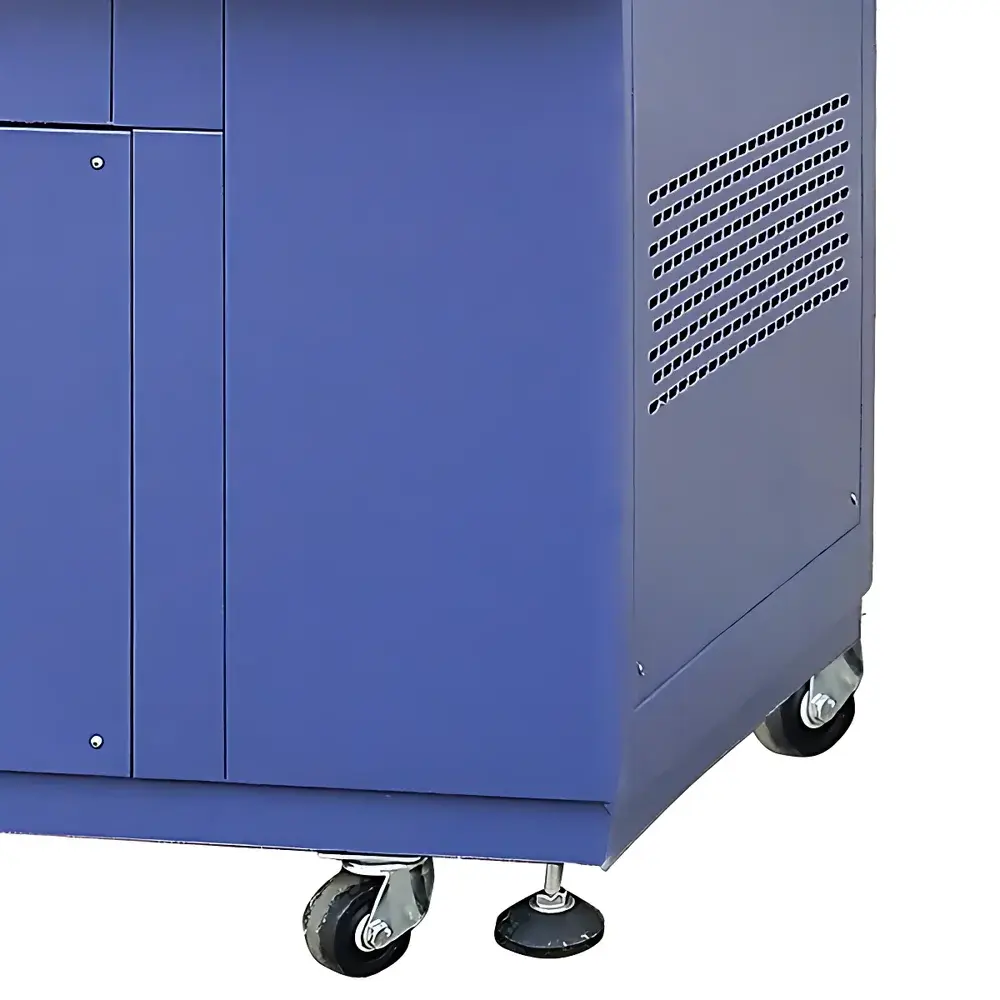
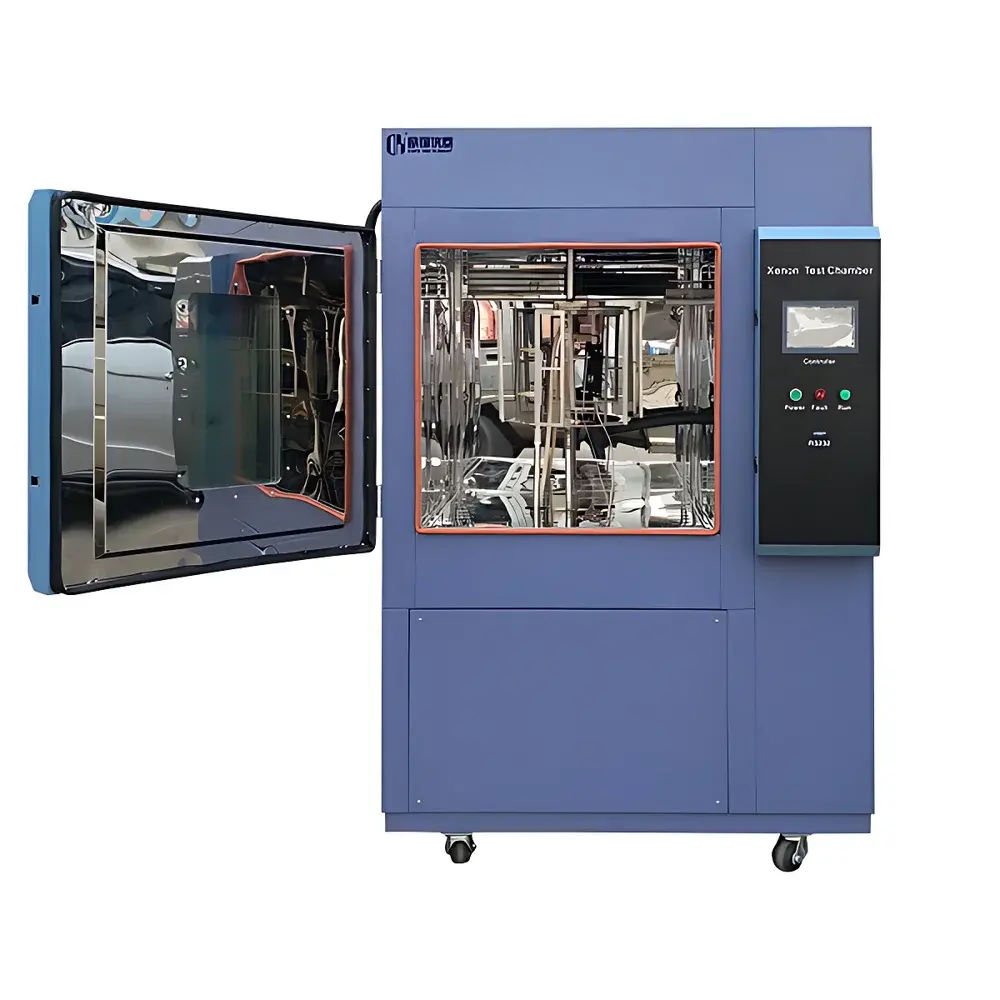
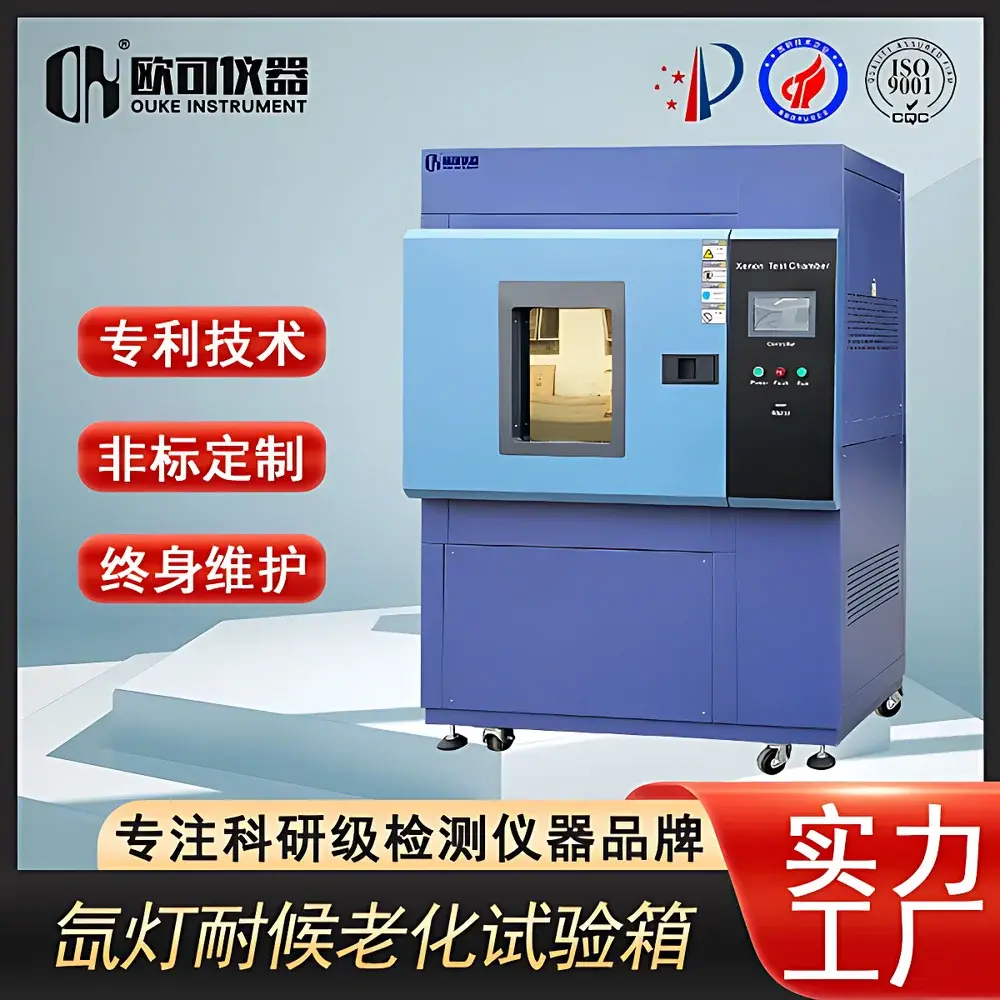
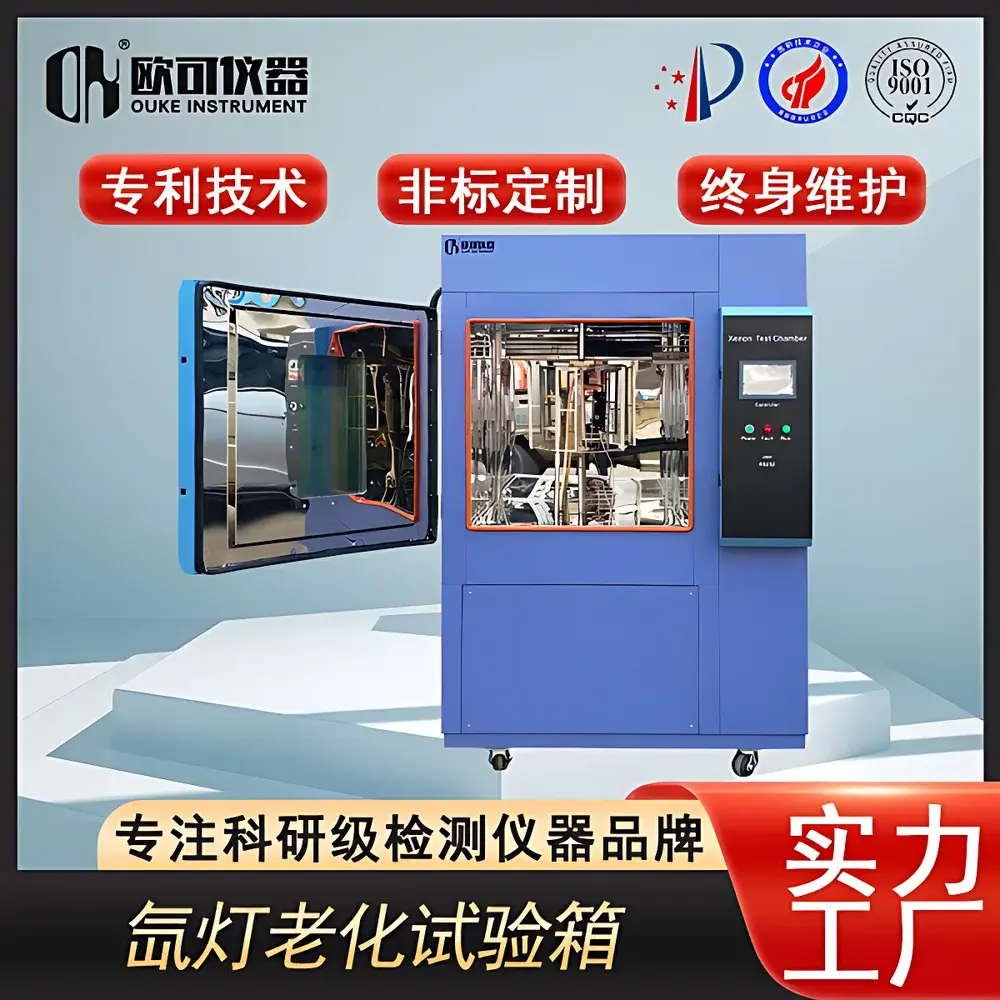
OK-XD-225 Xenon Arc Weathering Test Chamber
| Brand | OK Instruments |
|---|---|
| Origin | Guangdong, China |
| Manufacturer Type | Direct Manufacturer |
| Product Category | Domestic |
| Model | OK-XD-225 |
| Price | USD 5,300 (FOB Guangdong) |
| Xenon Lamp Power | 6 kW |
| Irradiance Range | ≤1200 W/m² (broadband, 290–2500 nm) |
| Light Cycle Duration | 1–999 hours/minutes/seconds (programmable) |
| Humidity Range (Light Cycle) | 20–75% RH |
| Temperature Control Range | Ambient +10°C to 80°C (black panel temperature) |
| Cooling Method | Air-cooled lamp system with forced convection |
| Filter Options | Daylight-Q (ISO 4892-2), Window Glass-Q (ISO 4892-2), Extended UV-Q (ASTM G155) |
| Compliance | ISO 4892-2, ASTM G155, ISO 16474-2, SAE J2527, AATCC TM16-3 |
Overview
The OK-XD-225 Xenon Arc Weathering Test Chamber is an engineered environmental simulation system designed to replicate the integrated effects of solar radiation, thermal stress, and humidity—key drivers of material degradation—in a controlled laboratory setting. It employs a 6 kW long-arc xenon lamp whose spectral output closely matches natural sunlight across the ultraviolet (290–400 nm), visible (400–700 nm), and near-infrared (700–2500 nm) ranges. Unlike narrow-band UV sources, this full-spectrum irradiation enables physiologically relevant photochemical aging mechanisms—such as polymer chain scission, pigment photolysis, and hydrolytic degradation—to proceed under conditions that correlate strongly with real-world outdoor exposure. The chamber integrates precise irradiance monitoring (via calibrated broadband or narrowband (340 nm) sensors), black-panel temperature control, programmable relative humidity regulation, and timed water spray cycles—enabling users to execute standardized weathering protocols per ISO 4892-2, ASTM G155, SAE J2527, and other internationally recognized test methods.
Key Features
- 6 kW air-cooled xenon lamp with high-stability arc ignition and automatic power compensation to maintain consistent irradiance over lamp life
- Interchangeable optical filter systems: Daylight-Q (for outdoor exposure simulation), Window Glass-Q (for indoor applications), and Extended UV-Q (for accelerated UV-rich testing)
- Real-time irradiance feedback control with NIST-traceable broadband sensor (290–2500 nm) and optional 340 nm narrowband sensor
- Black-panel temperature range: 35–80°C, controlled via PID-regulated heating and refrigerated cooling circuits
- Humidity control during light cycles: 20–75% RH, achieved through steam-based humidification and precision desiccant-assisted dehumidification
- Programmable multi-segment test cycles including light-only, light + spray, dark + condensation, and hybrid sequences with sub-minute resolution
- Touchscreen HMI with embedded data logging (≥100,000 data points), USB export, and password-protected user profiles
- Rotating sample drum (standard) or flat-bed sample holder (optional), accommodating up to 48 standard 75 × 150 mm specimens
Sample Compatibility & Compliance
The OK-XD-225 supports diverse substrate geometries—including rigid panels, flexible films, textiles, molded automotive components, and coated substrates—without requiring custom fixtures. Its uniform irradiance distribution (±5% across 80% of sample area per ISO 4892-2 Annex B) ensures reproducible dose delivery. The system meets mechanical and functional requirements for ISO 4892-2 (Plastics), ISO 16474-2 (Paints and varnishes), ASTM G155 (Non-metallic materials), SAE J2527 (Automotive exterior), and AATCC TM16-3 (Textiles). All control parameters—including irradiance setpoint, black-panel temperature, RH, and spray timing—are logged with timestamps and operator IDs, supporting GLP-compliant audit trails. Optional 21 CFR Part 11 compliance packages include electronic signatures, role-based access, and immutable data archiving.
Software & Data Management
The embedded controller runs OKWeather v3.2 firmware, offering intuitive test programming with drag-and-drop cycle builders and real-time graphical monitoring of irradiance, temperature, humidity, and spray status. Exported data files conform to ASTM E2091-compliant CSV format, enabling direct import into statistical analysis tools (e.g., JMP, Minitab) or LIMS platforms. Remote monitoring is supported via Ethernet (Modbus TCP) or optional Wi-Fi module; alarm notifications (email/SMS) trigger on parameter deviation, lamp failure, or safety interlock activation. Calibration history, lamp usage hours, and filter replacement logs are maintained automatically and exportable for quality audits.
Applications
This chamber is routinely deployed in R&D and QC laboratories across sectors where long-term durability under solar exposure is mission-critical. In the automotive industry, it validates color shift (ΔE*), gloss loss (%), and microcracking resistance of instrument panels, door trims, and headlamp lenses per SAE J2412/J2527. Coatings manufacturers use it to quantify chalking, blistering, and adhesion loss in architectural paints and coil coatings per ISO 16474-2. Polymer compounders assess embrittlement and tensile retention in polyolefins and thermoplastic elastomers after 1,000–5,000 MJ/m² UV dose equivalents. Photovoltaic material suppliers screen backsheet yellowing and encapsulant delamination per IEC 61215-2 MQT10. Textile labs apply it for AATCC TM16-3 colorfastness grading under simulated subtropical conditions.
FAQ
What spectral filters are included with the OK-XD-225, and how do they differ?
The standard configuration includes Daylight-Q and Window Glass-Q filters compliant with ISO 4892-2. Daylight-Q replicates unfiltered terrestrial solar radiation (AM1.5G); Window Glass-Q attenuates UV-B and short-wave UV-A to simulate interior exposure through standard float glass.
Does the chamber support automated irradiance calibration?
Yes—the system performs self-checks at startup and allows scheduled recalibration using an external reference radiometer. Sensor drift compensation is applied in real time during operation.
Can the OK-XD-225 run ASTM D4459 (plastics) and ASTM D6695 (coatings) protocols out of the box?
Yes—preloaded method templates cover all required irradiance setpoints (e.g., 0.35 W/m² @ 340 nm), temperature ramps, and humidity profiles specified in these standards.
What maintenance intervals are recommended for optimal performance?
Xenon lamps require replacement every 1,500–2,000 hours; quartz sleeves and optical filters every 3,000 hours; and humidity sensors annually. Full preventive maintenance is advised quarterly.
Is third-party certification available for IQ/OQ/PQ validation?
OK Instruments provides factory-issued IQ/OQ documentation and supports on-site PQ execution by qualified metrology partners accredited to ISO/IEC 17025.



