
Yuelian PW-UCD122-40 Video Extensometer-Equipped Environmental Tensile Tester for Thin Films
| Brand | Yuelian |
|---|---|
| Origin | Guangdong, China |
| Model | PW-UCD122-40 |
| Load Capacity | 50 N (configurable) |
| Temperature Range | −40 °C to +150 °C |
| Humidity Range | 20–98% RH |
| Force Resolution | 1/1,000,000 full scale |
| Force Accuracy | ±0.03% of reading |
| Accuracy Class | ISO 7500-1 Class 0.5 |
| Displacement Resolution | 1/1,000,000 |
| Temperature Control Stability | ±0.1 °C |
| Temperature Uniformity | ±1 °C |
| Test Speed | 0.01–500 mm/min (programmable) |
| Test Stroke | 600 mm |
| Chamber Dimensions | 350 × 350 × 1000 mm (W×D×H) |
| Power Supply | 220/380 V, 50/60 Hz, 30 A |
| Total Power | ~5 kW |
| Weight | ~350 kg |
| Video Extensometer Resolution | 0.5 µm |
| Displacement Uncertainty | ±1 µm (±7 µm at 800 mm FOV) |
| Strain Range | 0.002% to >1000% |
| Calibration Compliance | ISO 9513 Class 0.5 |
| Max Frame Rate | 200 fps |
| FOV Adjustable | 60–1000 mm |
| Standard Software | PW 2023 Video Extensometry Suite |
Overview
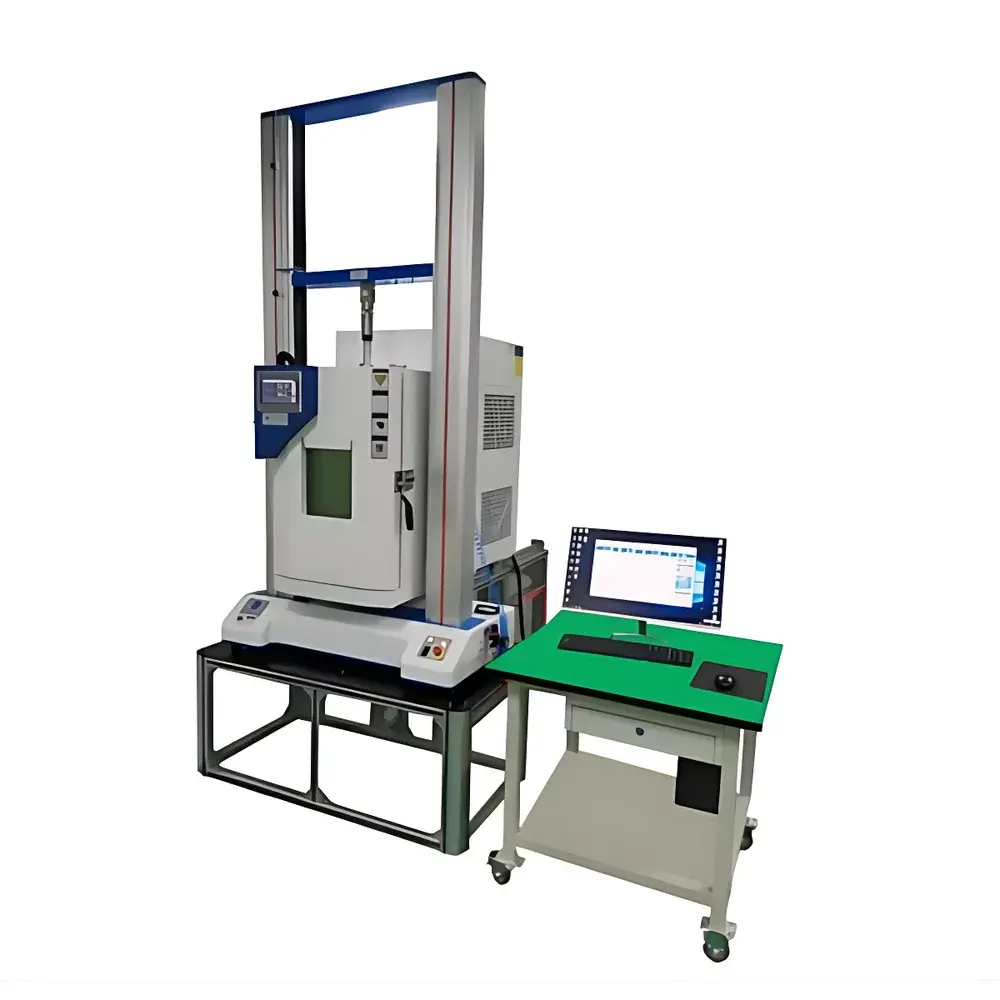
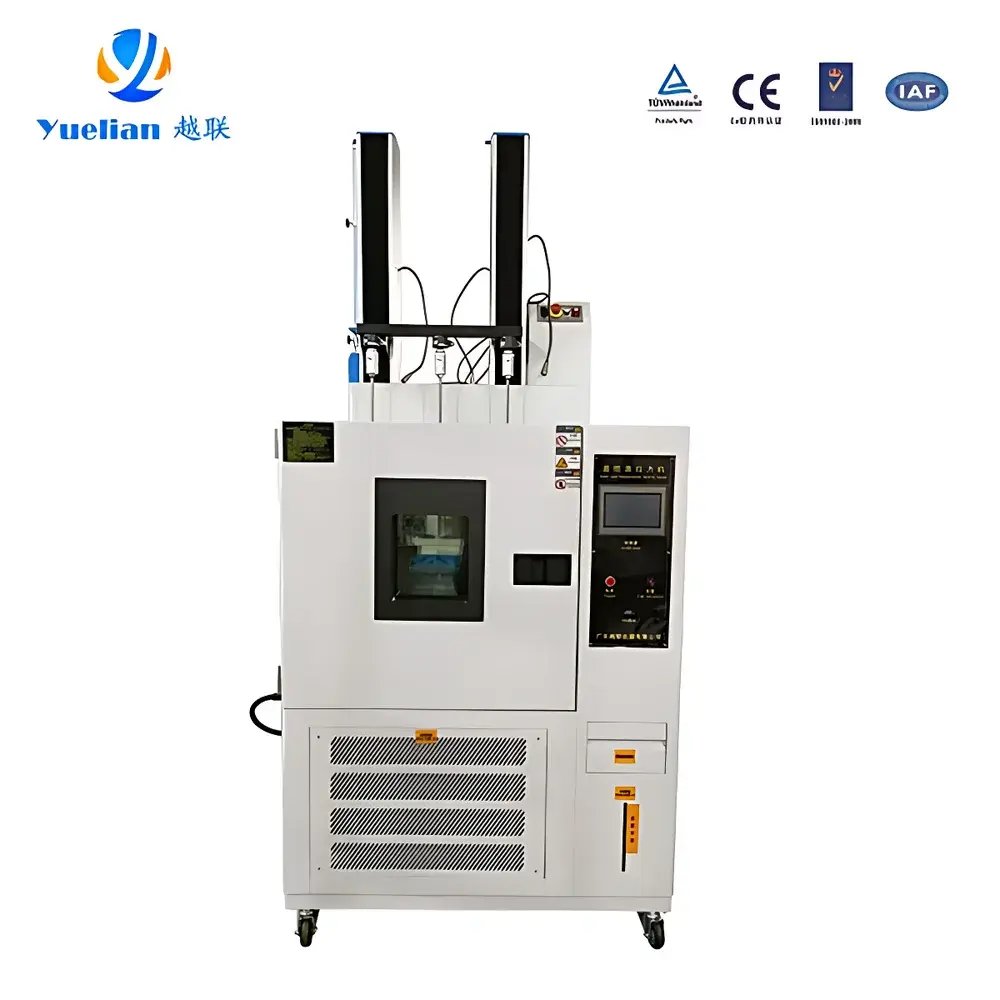
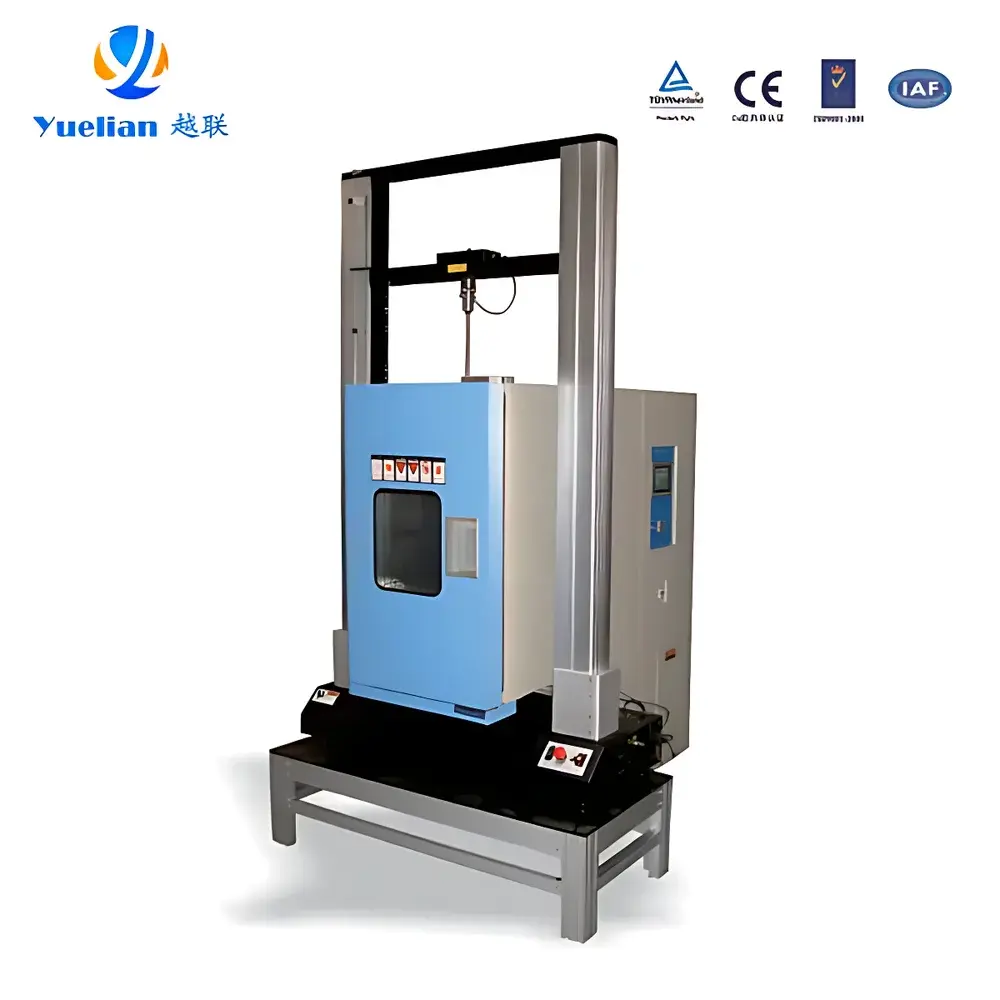
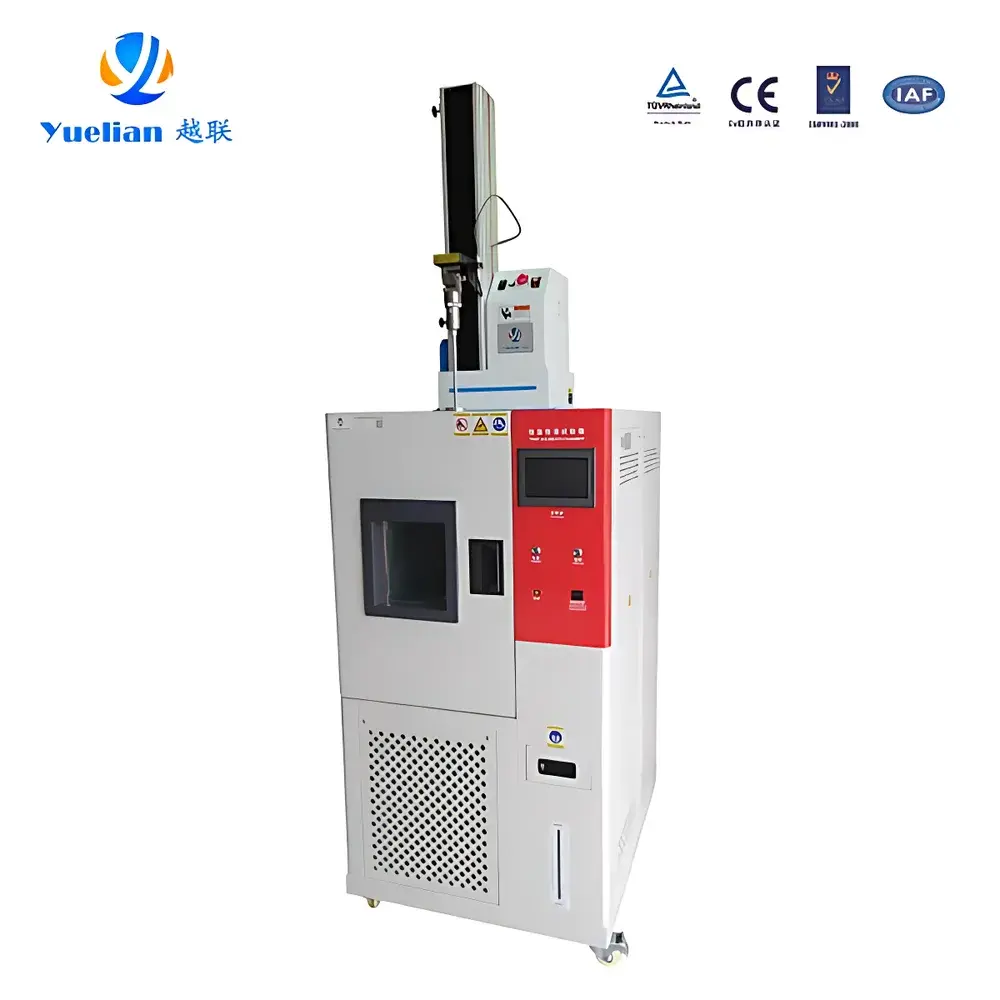
The Yuelian PW-UCD122-40 is a fully integrated environmental tensile testing system engineered for high-fidelity mechanical characterization of thin films, elastomers, adhesives, and polymeric materials across extreme thermal conditions. Designed specifically for the film and flexible packaging industries, it combines a precision servo-driven electromechanical frame with a climate-controlled test chamber and a non-contact video extensometer compliant with ISO 9513 Class 0.5. The system operates on fundamental principles of uniaxial quasi-static tensile loading under controlled temperature and humidity—enabling measurement of tensile strength, elongation at break, Young’s modulus, Poisson’s ratio, compressive yield, and stress–strain hysteresis. Its dual-mode architecture allows seamless transition between ambient and conditioned testing without hardware reconfiguration: the chamber door opens rearward to expose the full 600 mm stroke for room-temperature tests, effectively doubling usable workspace volume while preserving alignment integrity.
Key Features
- Climate-controlled chamber with PID-regulated temperature control (−40 °C to +150 °C) and humidity regulation (20–98% RH), featuring French Tecumseh hermetic compressors, electronic expansion valve modulation, and SUS304 stainless steel construction for corrosion resistance and thermal stability.
- High-resolution video extensometer with sub-pixel image correlation algorithm, supporting real-time longitudinal and transverse strain calculation across deformations from 0.002% to over 1000%, eliminating mechanical interference and enabling fracture-to-fracture tracking.
- Force measurement system calibrated to ISO 7500-1 Class 0.5, delivering 0.03% force accuracy and 1 µm displacement resolution (traceable to NIST-equivalent standards), with programmable load cell options up to 50 N standard and scalable upon request.
- 7-inch industrial touchscreen HMI with multi-segment thermal profile programming, auto-tuning PID parameters, and synchronized data logging across force, displacement, temperature, and video metadata streams.
- Dual-interface control architecture: native PC-based software (PW 2023) for advanced analysis, plus embedded PLC-level logic for emergency stop, overload cutoff, upper/lower limit enforcement, and automatic return-to-home functionality.
- Modular optical subsystem including adjustable LED blue-light illumination (flicker-free, intensity-dimmable), manual or motorized linear rail positioning, and interchangeable calibration rulers (PW-RU60/PW-RU200) for rapid field validation.
Sample Compatibility & Compliance
The PW-UCD122-40 accommodates standardized specimens per ASTM D882 (thin plastic sheeting), ISO 527-3 (films and sheets), GB/T 1040.3 (Chinese national standard for plastics), and JIS K7127 (Japanese film tensile testing). Its open-chamber configuration supports ISO 11357-compliant dynamic mechanical thermal analysis (DMTA)-adjacent protocols, while the video extensometer satisfies ISO 9513 requirements for extensometer classification and verification. The system meets electromagnetic compatibility (EMC) per IEC 61326-1 and safety requirements under IEC 61010-1. All firmware and software modules support audit trail generation, user access levels, and electronic signature capability—facilitating compliance with FDA 21 CFR Part 11, GLP, and GMP documentation workflows when deployed in regulated QC laboratories.
Software & Data Management
PW 2023 software provides a unified interface for acquisition, synchronization, analysis, and reporting. It natively supports USB3.0 cameras with plug-and-play enumeration, real-time ROI selection via mouse-drag framing, and dual-mode calibration (auto and manual). Users define up to ten independent gauge lengths simultaneously—including custom, standardized, or filament-specific configurations—with independent longitudinal and transverse strain computation. The software implements both small-strain (correlation-based) and large-deformation (feature-tracking) algorithms, enabling accurate modulus derivation even during necking or post-yield softening. Data export conforms to ASTM E1434 and ISO 14556 formats; all curves (stress–strain, force–time, strain–time) are exportable as CSV or Excel-compatible XLSX. Image storage supports triggered, timed, or memory-buffered capture, with metadata embedding (timestamp, temperature, load, frame index). Communication interfaces include 16-bit analog I/O (2 outputs / 16 inputs) and digital TTL sync signals for third-party instrumentation integration.
Applications
This system is routinely deployed in R&D and QA labs for evaluating biaxially oriented polypropylene (BOPP), PET, PE, PVDC, and metallized film laminates under simulated end-use environments—such as refrigerated transport (−25 °C), sterilization cycles (+121 °C), or tropical storage (40 °C / 95% RH). It supports peel strength pre-conditioning per ASTM D3330, adhesive tack evaluation under thermal cycling, and creep compliance mapping per ISO 899-1. In academic settings, it enables investigation of glass transition effects on modulus gradients, humidity-induced plasticization in hydrophilic polymers, and strain-rate dependence of viscoelastic recovery. The video extensometer’s non-contact nature makes it ideal for fragile, coated, or micro-patterned substrates where traditional clip-on extensometers induce slippage or surface damage.
FAQ
Does the video extensometer require physical attachment to the specimen?
No. It is a fully non-contact optical system using real-time digital image correlation—no markers, adhesives, or mechanical fixtures are needed.
Can the system perform tests at sub-zero temperatures while maintaining measurement accuracy?
Yes. The chamber achieves stable −40 °C operation with ±1 °C uniformity; the video extensometer’s LED illumination remains stable across the full range, and lens focus drift is compensated via thermal calibration routines.
Is the software compatible with LIMS or ERP systems?
Yes. PW 2023 supports OPC UA and TCP/IP-based data streaming, enabling direct ingestion into laboratory information management systems (LIMS) and enterprise resource planning (ERP) platforms via configurable JSON or XML payloads.
What validation documentation is provided for ISO 9513 compliance?
A full extensometer verification report—including calibration certificate, uncertainty budget, and traceability statement to national metrology institutes—is supplied with each unit.
Can the system be upgraded to higher load capacities or extended temperature ranges?
The base frame supports retrofitting with 100 N or 200 N load cells; however, the current chamber design is optimized for −40 °C to +150 °C. Extended ranges require custom thermal insulation and compressor upgrades, available under engineering consultation.



