
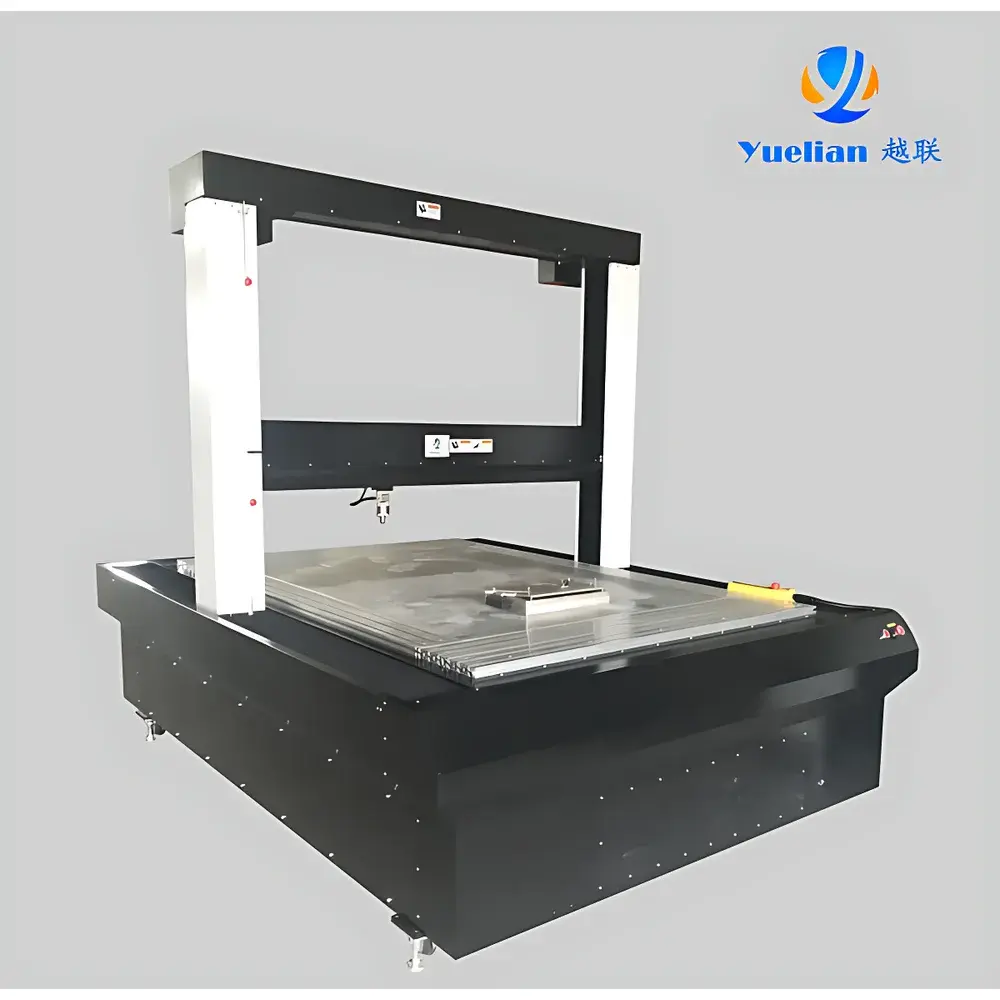
Yuelian YL-D1813Z5 Triaxial Tensile Testing System
| Brand | Yuelian |
|---|---|
| Origin | Guangdong, China |
| Manufacturer Type | Authorized Distributor |
| Country of Origin | China |
| Model | YL-D1813Z5 |
| Load Capacity Options | 10 N, 20 N, 50 N, 100 N, 200 N, 500 N, 1 kN, 2 kN (dual-range configuration available) |
| Display Interface | PC-based GUI |
| Axes of Motion | X, Y, Z (independent translational axes) |
| Force Resolution | 1/500,000 full scale |
| Force Accuracy | ±0.5% of reading |
| Stroke Resolution | 1/500,000 |
| Maximum Stroke | 1000 mm |
| Test Width | 1500 mm |
| Speed Range | 0.01–1000 mm/min (programmable via software) |
| Force Unit Conversion | kgf, N, lbf, g, ton, MPa |
| Safety & Control Modes | Overload shutdown, emergency stop, specimen failure detection, upper/lower limit auto-stop, automatic return-to-home |
| Drive System | Servo motor with timing belt and precision ball screw transmission |
| Power Requirement | 220 V AC, 50/60 Hz, 10 A |
| Rated Power | 400 W |
| Standard Accessories | One set of universal grips, proprietary test software, USB interface cable |
Overview
The Yuelian YL-D1813Z5 Triaxial Tensile Testing System is an electromechanical materials testing platform engineered for high-precision mechanical characterization of large-area and structurally heterogeneous specimens under controlled multi-directional loading conditions. Unlike conventional uniaxial or biaxial testers, this system implements independent X-, Y-, and Z-axis motion control to enable spatially resolved force application—critical for evaluating localized mechanical behavior in non-uniform samples such as automotive trim panels, photovoltaic laminates, composite aerospace skins, and architectural façade systems. The system operates on the principle of servo-controlled displacement actuation, where load cells measure reaction forces while high-resolution encoders track positional feedback in real time. Its architecture supports both displacement-controlled and load-controlled test modes, conforming to fundamental ASTM E4, ISO 7500-1, and GB/T 228.1 test method frameworks for static tensile and compressive property determination.
Key Features
- Triaxial translational stage (X/Y/Z) enabling precise positioning of the load train without re-fixturing large or rigid specimens—eliminating handling-induced variability and improving repeatability across multiple test zones.
- High-fidelity force measurement with ≤0.5% accuracy and 1/500,000 internal resolution, supporting dual-capacity sensor configurations for seamless transition between low-force peel/adhesion tests and high-force structural integrity evaluations.
- Programmable speed range from 0.01 mm/min (for creep and relaxation studies) to 1000 mm/min (for impact-simulated loading), fully compliant with ASTM D882 (thin plastics), ASTM D3330 (adhesive tape), and ISO 11339 (peel resistance) rate requirements.
- Integrated safety logic including overload cutoff, programmable upper/lower displacement limits, automatic specimen rupture detection, and hardware-level emergency stop—meeting IEC 61508 SIL1 functional safety expectations for laboratory equipment.
- Servo-driven motion system with precision ground ball screws and synchronous belt transmission ensures minimal backlash (<2 µm), thermal stability over extended test durations, and long-term calibration retention.
Sample Compatibility & Compliance
The YL-D1813Z5 accommodates specimens up to 1500 mm wide and 1000 mm in vertical stroke—making it suitable for full-scale validation of automotive interior modules, solar panel edge seals, wind turbine blade skin laminates, and modular building envelope components. Its modular grip interface supports standardized fixtures per ASTM D638 (tensile bars), ASTM D790 (flexural beams), ASTM D1876 (T-peel), ASTM D903 (adhesive strength), and ISO 1974 (tear resistance). All firmware and software layers are designed to support audit-ready data integrity: electronic signatures, user access levels, timestamped test logs, and immutable raw-data storage—all aligned with GLP and GMP documentation expectations per FDA 21 CFR Part 11 when deployed in regulated QC environments.
Software & Data Management
The system is operated via a Windows-based application built on .NET Framework, featuring a graphical test sequence editor, real-time multi-curve overlay (force vs. displacement, stress vs. strain, modulus mapping), and automated parameter extraction—including peak load, yield point (0.2% offset method), secant modulus, elongation at break, and average peel force over defined intervals. Raw data exports to CSV, XML, or native MS Access database format; optional integration with LIMS platforms via ODBC drivers is supported. All test configurations, calibration histories, and user actions are logged with SHA-256 hashed audit trails. Software updates are delivered through secure, signed package repositories—ensuring traceability and version control in validated laboratories.
Applications
- Mechanical validation of photovoltaic module encapsulation adhesion and backsheet delamination resistance under thermal cycling preconditioning.
- Multi-point tensile mapping of carbon fiber-reinforced polymer (CFRP) automotive body panels to identify resin-rich zone weaknesses.
- Peel and shear strength assessment of pressure-sensitive adhesive (PSA) bonds used in medical device assembly and wearable electronics lamination.
- Compression buckling analysis of corrugated packaging substrates under variable span conditions.
- Dynamic flexural fatigue testing of architectural glass interlayers and structural silicone sealants per ASTM C1135 and ETAG 002 protocols.
FAQ
Does the system support ASTM E2921-compliant biaxial tension testing?
While the YL-D1813Z5 provides independent X/Y/Z motion, true biaxial tension requires coordinated force control in two orthogonal directions—functionality not natively embedded. However, custom script-based synchronization via the API layer enables sequential or staggered biaxial protocols for research applications.
Is calibration certification included with shipment?
Yes—a NIST-traceable certificate of calibration for the primary load cell and encoder system is supplied, valid for 12 months. Optional annual recalibration services with ISO/IEC 17025-accredited third-party verification are available.
Can the software generate PDF reports compliant with ISO/IEC 17025 documentation requirements?
Yes. Report templates include mandatory fields: operator ID, equipment ID, environmental conditions (optional sensor input), uncertainty statements per GUM, and digital signature blocks—all exportable as password-protected PDF/A-1b files.



