
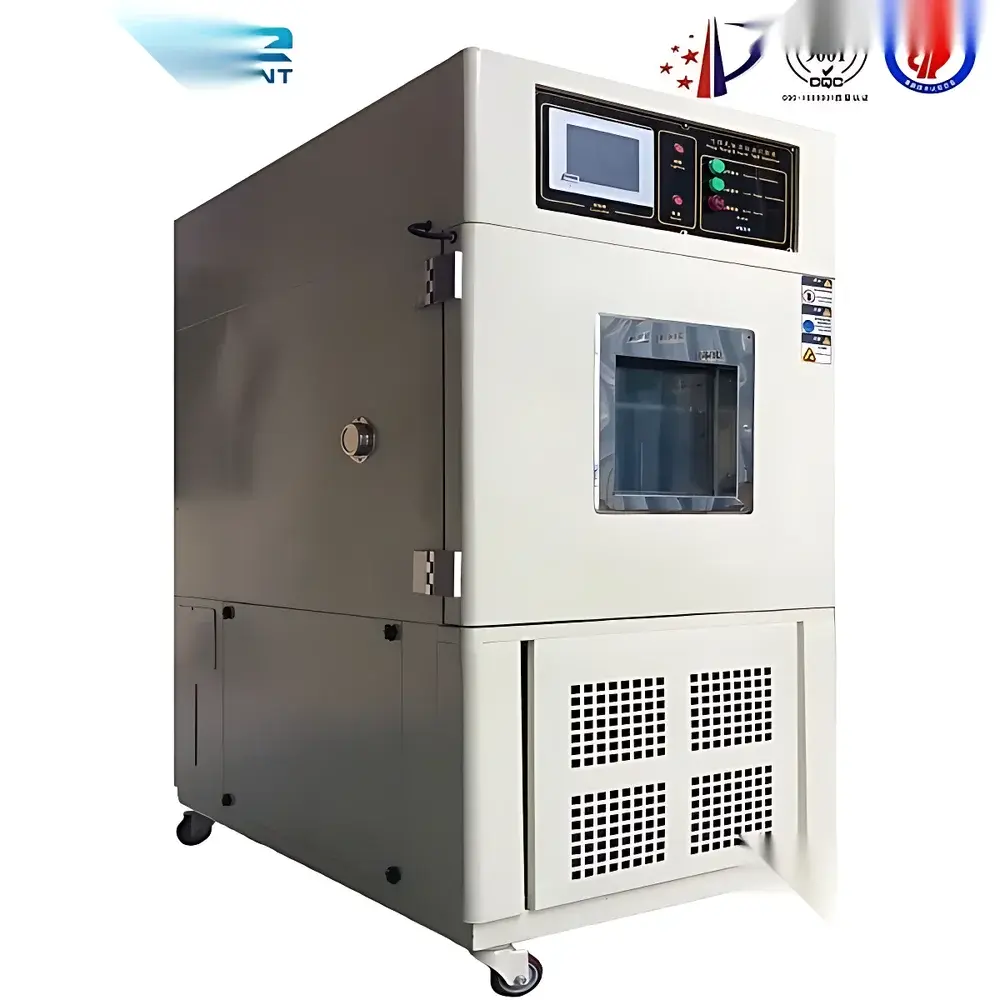
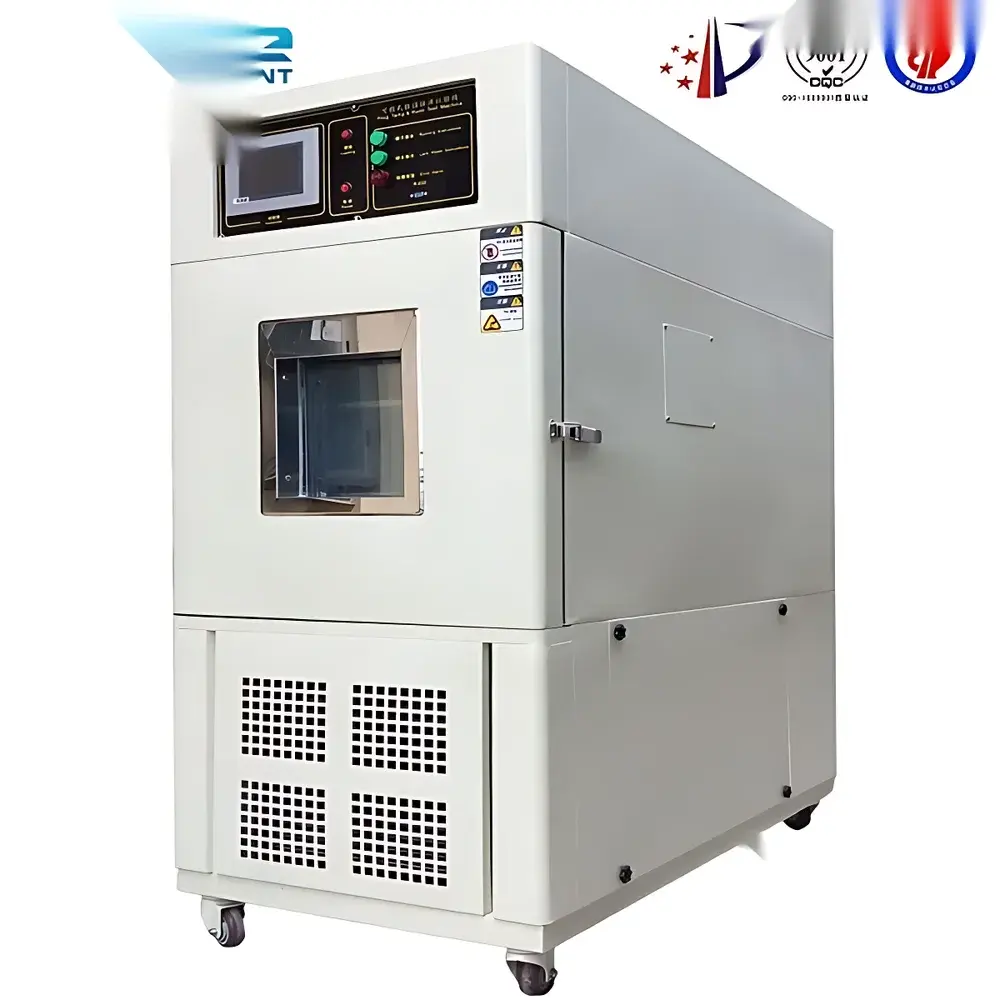
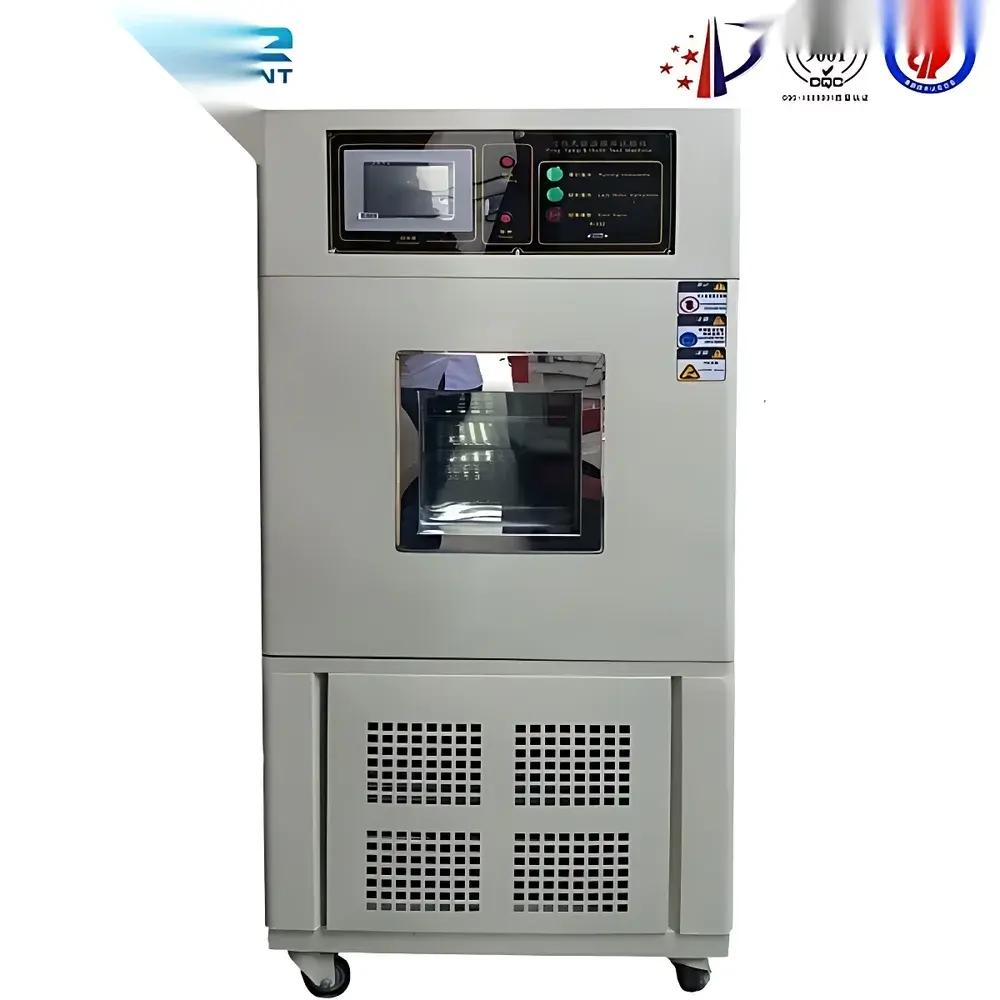
Programmable Temperature and Humidity Controlled Chamber – OEM-Branded Environmental Test Chamber
| Brand | OEM / Other Brands |
|---|---|
| Origin | Imported |
| Manufacturer Type | Authorized Distributor |
| Price | USD 3,000–4,200 (FOB) |
| Temperature Range | −70 °C to +150 °C |
| Humidity Range | 20–98% RH |
| Compliance | GB/T 5170.2–1996, GB/T 5170.5–1996, GB 2423.1–1989, GB 2423.2–1989, GB 2423.22–1987, GB 10589–1989, GB 10592–1989, GB 11158–1989 |
Overview
The Programmable Temperature and Humidity Controlled Chamber is an engineered environmental test system designed for precise, repeatable simulation of thermal and hygrothermal stress conditions in laboratory and industrial quality assurance environments. Based on the principle of balanced heating, cooling, humidification, and dehumidification—implemented via a Bi-directional Thermal & Humidity Control (BTHC) architecture—the chamber maintains stable setpoints through proportional-integral-derivative (PID) control of solid-state relays (SSRs), ensuring dynamic equilibrium between energy input and thermal/hygric loss. It supports standard-compliant testing per major national and industry specifications including GB/T 5170.2 (temperature equipment calibration), GB/T 5170.5 (humidity equipment calibration), and the full suite of GB 2423 series environmental test methods for electronic components and materials. The chamber operates within a wide temperature range (−70 °C to +150 °C) and relative humidity range (20–98% RH), with programmable ramp rates optimized for both steady-state conditioning and cyclic stress profiling.
Key Features
- Full-arc ergonomic enclosure design with high-gloss, corrosion-resistant stainless steel interior and seamless welded construction for long-term sealing integrity and condensation resistance.
- Imported multi-function touch-screen controller with intuitive GUI, real-time trend logging, and up to 99 programmable segments per test profile—including ramp-hold-soak cycles with user-defined rate limits.
- BTHC control algorithm enabling simultaneous, decoupled regulation of temperature and humidity without cross-interference; eliminates overshoot and stabilizes setpoints within ±0.3 °C / ±2% RH (at 25 °C, no-load, steady state).
- Capillary-tube-based refrigeration circuit with automatic capacity modulation—superior to expansion valve systems in transient response, low-temperature stability, and long-term reliability under continuous operation.
- Integrated water-cooled condenser requiring inlet coolant at 10–28 °C and 0.1–0.3 MPa pressure—ensuring consistent cooling performance across extended sub-zero operation down to −70 °C.
- Modular structural design supports custom chamber dimensions, door configurations (single/double leaf, hinged/sliding), and optional features such as internal lighting, observation windows, or electrical feedthroughs.
Sample Compatibility & Compliance
This chamber accommodates a broad spectrum of physical specimens—from PCB assemblies and polymer packaging to automotive sensors and pharmaceutical primary packaging—without compromising test fidelity. Internal volume options span from compact benchtop units (80 L) to walk-in configurations (>10 m³), all conforming to mechanical and metrological requirements defined in GB 10589 (low-temperature chambers), GB 11158 (high-temperature chambers), and GB 10592 (combined temperature/vacuum testing). All models undergo factory calibration traceable to national standards, with documentation supporting ISO/IEC 17025-aligned QA processes. The system meets essential requirements for GLP-compliant environmental qualification studies and supports audit-ready data integrity when paired with compliant software (see below).
Software & Data Management
Equipped with optional PC-based monitoring software compliant with FDA 21 CFR Part 11, the chamber provides electronic signature capability, role-based access control, and immutable audit trails for all parameter changes, alarm events, and calibration records. Raw temperature and humidity data are logged at configurable intervals (1 s to 60 min) and exported in CSV or XML format for integration into LIMS or statistical process control (SPC) platforms. Firmware supports time-synchronized multi-chamber coordination for accelerated life testing protocols and supports remote diagnostics via Ethernet or RS485 interfaces. Data encryption, backup scheduling, and user-defined report templates further align with GMP and ICH Q5C/Q9 validation frameworks.
Applications
- Environmental stress screening (ESS) of electronic components per MIL-STD-883 and JEDEC JESD22-A108.
- Accelerated aging of polymers, adhesives, and composites under controlled thermal-hygric cycling.
- Stability testing of medical devices and active pharmaceutical ingredients (APIs) per ICH Q1A(R2) guidelines.
- Qualification of battery modules and EV power electronics under extreme ambient profiles.
- Validation of packaging barrier performance (e.g., moisture vapor transmission rate correlation) under dynamic humidity gradients.
- Material coefficient of thermal expansion (CTE) characterization via dimensional metrology during controlled thermal ramps.
FAQ
What is the typical temperature uniformity specification across the working volume?
Uniformity is typically ±1.5 °C (horizontal) and ±2.0 °C (vertical) at 25 °C, measured per GB/T 5170.2 using a 9-point sensor array. Actual values depend on load configuration and airflow obstruction.
Can the chamber operate continuously at −70 °C with 20% RH?
Yes—provided the cooling water supply meets specified temperature and pressure requirements and the chamber is equipped with dual-stage cascade refrigeration. Continuous operation at extreme low-temperature/low-humidity conditions requires pre-conditioning and dew point management.
Is third-party calibration certification available?
Yes—NIST-traceable calibration certificates (including uncertainty budgets) can be supplied upon request, covering temperature, humidity, and ramp rate verification per GB/T 5170.2 and GB/T 5170.5.
Does the controller support protocol-based communication for automated test sequencing?
Yes—the embedded controller supports Modbus RTU/TCP and SCPI command sets, enabling integration with test sequencers, PLCs, and MES systems for fully unattended operation.
How does the BTHC system differ from conventional ON/OFF or PID-only humidity control?
BTHC dynamically balances latent and sensible heat loads by coordinating heater, humidifier, chiller, and dehumidifier outputs in real time—eliminating humidity lag during temperature transitions and improving repeatability in combined environmental profiles.



