
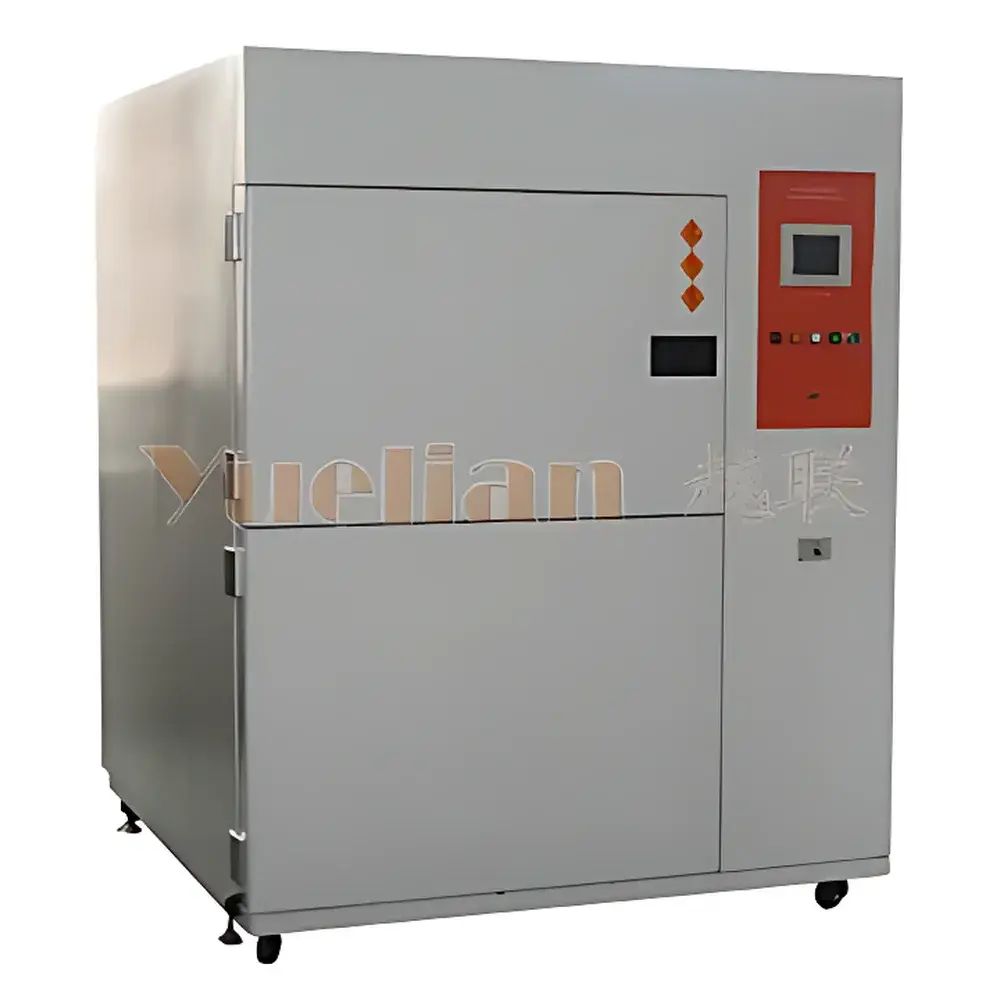
Yuelian YL-2231 Thermal Shock Test Chamber (Three-Zone Gas-Transfer Type)
| Brand | Yuelian |
|---|---|
| Origin | Guangdong, China |
| Manufacturer Type | Authorized Distributor |
| Country of Origin | China |
| Model | YL-2231 |
| Price | USD 14,000 (FOB Guangdong) |
| Temperature Range | Preheat Zone: +60°C to +200°C |
| Precool Zone | −10°C to −70°C |
| Test Zone | −65°C to +150°C |
| Temperature Transition Time (2-zone) | ≤5 min (RT ↔ −65°C or RT ↔ +150°C) |
| Temperature Uniformity | ±2.0°C |
| Construction | SUS#304 Stainless Steel Interior & Exterior |
| Refrigeration System | Dual-Stage Cascade with Eco-Friendly Refrigerant |
| Cooling Method | Water-Cooled |
| Control System | OYO-8226 PID Controller with LCD (320×240), RS-232 Interface, 120 Programmable Profiles, 9999 Cycles Max |
| Compliance | ASTM D5229/D5229M, ISO 16750-4, JESD22-A104, MIL-STD-810H Method 503.5, IEC 60068-2-14 |
Overview
The Yuelian YL-2231 Thermal Shock Test Chamber is an engineered environmental stress screening (ESS) system designed for rapid, high-fidelity evaluation of material and component reliability under extreme thermal transients. It operates on the principle of gas-transfer thermal shock—utilizing three physically isolated chambers (high-temperature soak, low-temperature soak, and test chamber) to eliminate mechanical movement of test specimens while enabling precise, repeatable exposure to abrupt temperature extremes. Unlike single-chamber ramp-based systems, the YL-2231 achieves thermal transitions via high-speed pneumatic damper switching (<10 s) between pre-conditioned airstreams, ensuring zero specimen displacement and minimizing thermal inertia effects. This architecture meets the stringent requirements of accelerated life testing (ALT), qualification per MIL-STD-810H Method 503.5, and process validation for lead-free electronics manufacturing (e.g., tin whisker assessment per JEDEC JESD22-A104). The chamber is calibrated and validated for operation within ambient conditions of 10–35°C and supports both two-zone (hot/cold) and three-zone (preheat/precool/test) operational modes.
Key Features
- Triple-chamber gas-transfer architecture with independent temperature control in preheat (+60°C to +200°C), precool (−10°C to −70°C), and test (−65°C to +150°C) zones
- High-speed air-path switching mechanism (<10 s cycle time) ensures specimen remains stationary during thermal transition, eliminating vibration-induced artifacts
- Temperature recovery time ≤5 minutes for both high- and low-temperature shocks (RT ↔ ±150°C / RT ↔ −65°C), verified per IEC 60068-2-14 Annex A
- Dual-stage cascade refrigeration system using environmentally compliant refrigerants (R404A/R23 blend), water-cooled condenser for stable operation in industrial environments
- OYO-8226 microprocessor-based controller with 320×240 dot-matrix LCD, supporting bilingual (English/Chinese) interface, 120 programmable profiles, and up to 9999 cycles per program
- Integrated RS-232 serial interface with PC-compatible software for remote program editing, real-time data logging, alarm history export, and GLP-compliant audit trail generation
- Automated post-test ambient return function prevents condensation and frost formation on sensitive DUTs; programmable start position (hot-first or cold-first) and auto-defrost scheduling
- SUS#304 stainless steel construction throughout interior and exterior surfaces; reinforced insulated panels with low thermal conductivity (<0.025 W/m·K)
Sample Compatibility & Compliance
The YL-2231 accommodates rigid and semi-rigid samples up to 10 kg (model-dependent), including PCB assemblies, automotive ECUs, aerospace connectors, polymer housings, and ceramic substrates. Its fixed-position test zone eliminates handling errors associated with shuttle mechanisms, improving measurement reproducibility across repeated qualification runs. The system complies with key international standards governing thermal shock testing: ASTM D5229/D5229M (composite materials), ISO 16750-4 (road vehicles), JESD22-A104 (JEDEC for semiconductor devices), MIL-STD-810H Method 503.5 (environmental engineering considerations), and IEC 60068-2-14 (basic environmental testing procedures). All temperature sensors (T-type thermocouples ×4) are mounted directly within the test zone—not in ductwork—to satisfy validity requirements specified in ISO/IEC 17025 Clause 6.4.2 for calibration traceability.
Software & Data Management
The embedded OYO-8226 controller provides native support for ASTM-compliant data acquisition, including real-time plotting of chamber setpoint vs. actual temperature curves, deviation alarms, and cycle completion timestamps. Through the RS-232 interface and included Windows-based software, users can configure multi-step profiles with dwell times, ramp rates, and conditional branching (e.g., “if max deviation > ±1.5°C, pause and log error”). Data exports are generated in CSV format compatible with statistical process control (SPC) platforms such as Minitab or JMP. For regulated industries, optional firmware upgrade enables 21 CFR Part 11 compliance—including electronic signatures, user-level access control (admin/operator), and immutable audit logs with timestamped operator ID and action type (e.g., “Profile Modified”, “Cycle Aborted”).
Applications
- Qualification testing of surface-mount technology (SMT) assemblies prior to high-volume production, especially for Pb-free solder joint integrity assessment
- Failure mode analysis of MEMS sensors, optoelectronic modules, and battery management systems subjected to field-relevant thermal cycling
- Material compatibility screening for encapsulants, conformal coatings, and adhesives used in automotive power electronics
- Accelerated aging studies of polymer composites in aerospace structural components per SAE AIR4777
- Process validation of reflow soldering profiles and thermal interface material (TIM) performance under cyclic load
- Reliability screening for medical device PCBs requiring ISO 13485-aligned environmental verification protocols
FAQ
What is the difference between two-zone and three-zone thermal shock operation?
Two-zone mode uses direct hot-to-cold or cold-to-hot airflow transfer between only two chambers, optimizing speed for standard qualification tests. Three-zone mode adds a dedicated test chamber, enabling simultaneous pre-conditioning of multiple sample batches and eliminating cross-contamination risks from residual moisture or outgassing.
Does the YL-2231 support liquid nitrogen (LN₂) assist for ultra-fast cooling?
No—this model relies solely on mechanical cascade refrigeration. LN₂ integration is available as a factory-installed option on the YL-2280 series but is not part of the YL-2231 base configuration.
Can temperature uniformity be verified and documented per ISO/IEC 17025?
Yes—the chamber includes four calibrated T-type thermocouples permanently installed in the test zone volume, and validation reports—including as-found/as-left calibration certificates traceable to NIM (China National Institute of Metrology)—are provided with each unit.
Is remote monitoring supported over Ethernet or only RS-232?
Standard communication is RS-232; Ethernet (TCP/IP) and Modbus TCP interfaces are available as configurable options upon order confirmation.
What maintenance intervals are recommended for the refrigeration system?
Compressor oil and filter-drier replacement every 24 months; annual inspection of heat exchanger fins, coolant levels, and damper actuator responsiveness; full system leak check and refrigerant recharge every 36 months—documented in the included Maintenance Logbook.



