
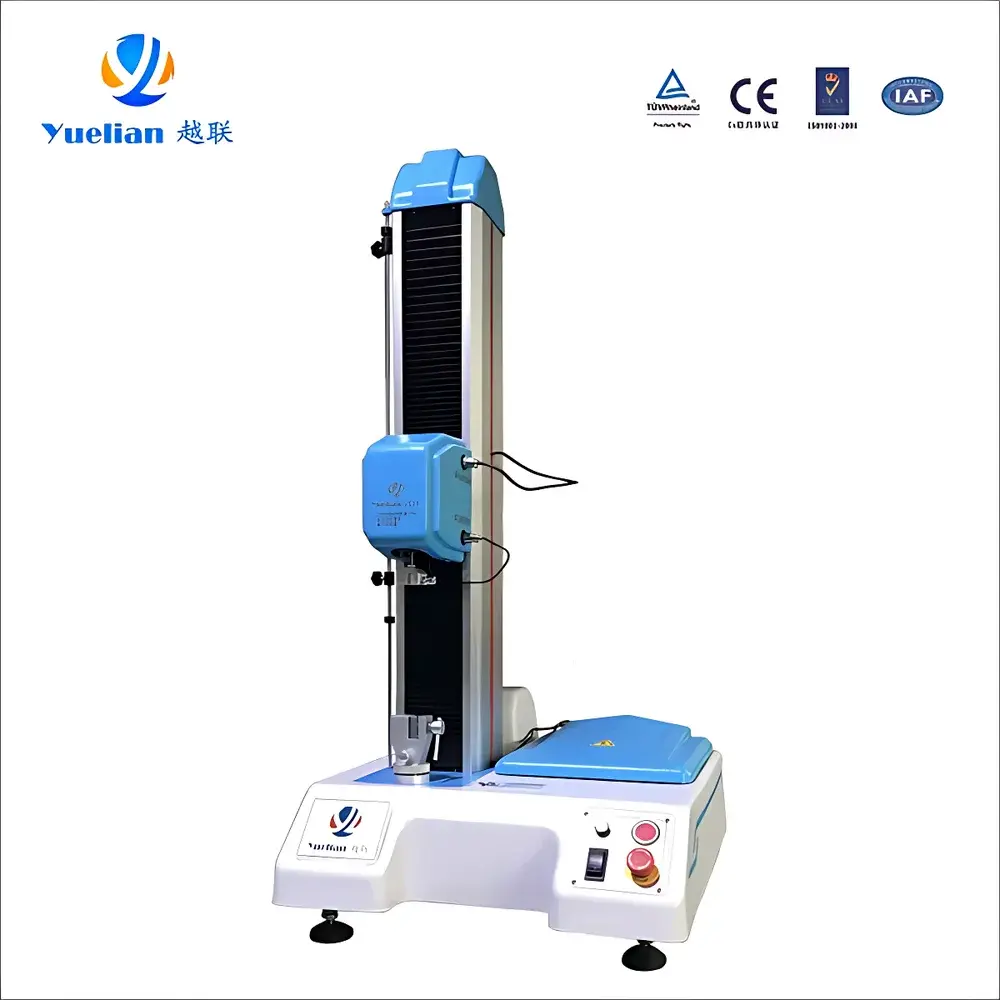
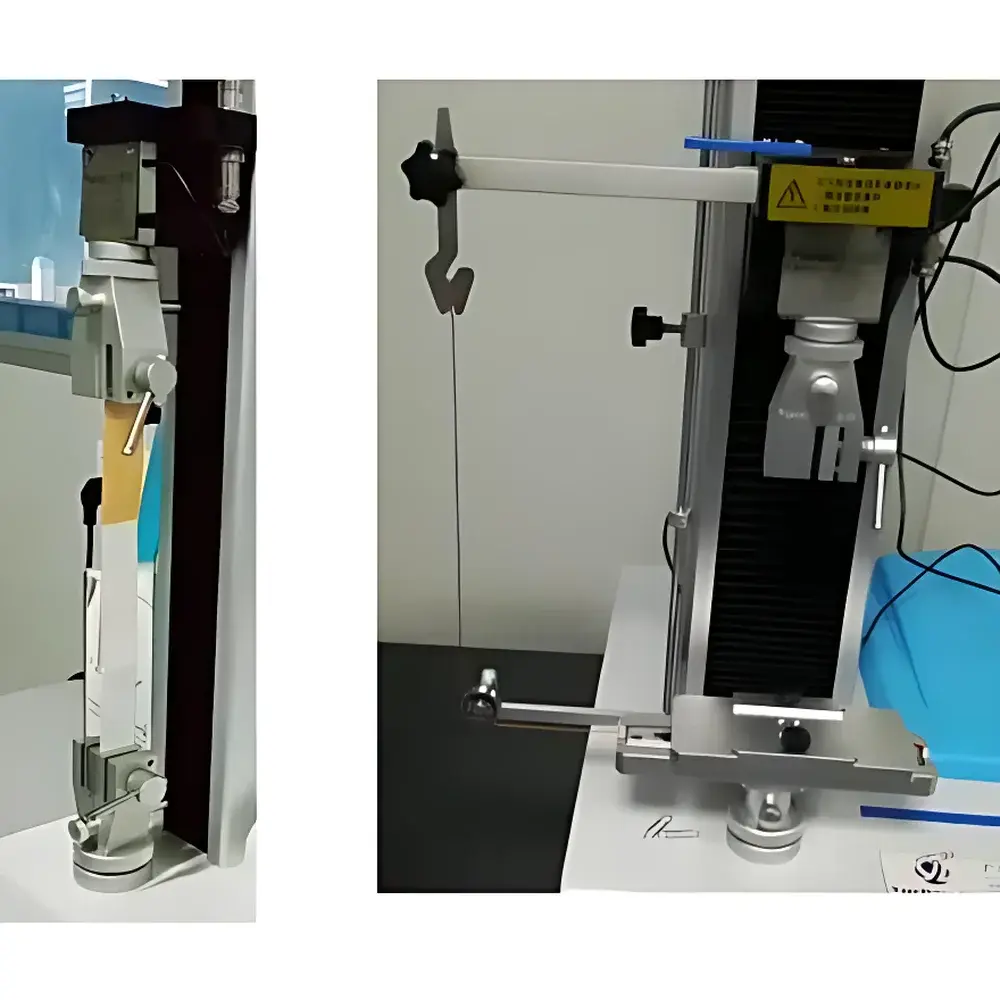
Yuelian YL-S72 Electronic Tensile Testing Machine
| Brand | Yuelian |
|---|---|
| Origin | Guangdong, China |
| Model | YL-S72 |
| Maximum Test Load | 5 kN |
| Force Measurement Range | 10 N – 5 kN |
| Force Accuracy | Better than Class 0.5 |
| Test Stroke | 450 mm |
| Displacement Resolution | 1/500,000 mm |
| Drive System | AC Servo Motor + Precision Ball Screw |
| Control Mode | Full PC-Based Control |
| Data Acquisition Rate | 50 Hz |
| Test Speed Range | 0.01–500 mm/min |
| Power Supply | 220 V, 50–60 Hz |
| Net Weight | 55 kg |
Overview
The Yuelian YL-S72 Electronic Tensile Testing Machine is a high-precision universal material testing system engineered for quantitative mechanical characterization of films, foils, laminates, adhesives, and coated substrates—particularly engineered for release liner and pressure-sensitive adhesive (PSA) applications requiring standardized peel, tack, and release force evaluation. Operating on the principle of controlled uniaxial force application via servo-driven linear motion, the YL-S72 complies with core test methodologies defined in ASTM D3330 (peel adhesion), ASTM D903 (peel strength), ISO 8510-2 (adhesive tape peel), and PSTC-101 (release liner testing). Its rigid frame architecture, coupled with high-resolution load cell feedback and sub-micrometer displacement tracking, ensures reproducible force-displacement profiling under static and quasi-static loading conditions. The system is designed for laboratory-based quality control (QC), R&D validation, and production line verification in flexible packaging, medical device manufacturing, label converting, and functional film development.
Key Features
- High-fidelity load measurement with better-than-Class-0.5 accuracy across a 10 N to 5 kN range—enabling precise quantification of low-force release events (e.g., silicone-coated PET liners) and higher-load substrate integrity tests.
- Precision ball screw transmission driven by an AC servo motor, delivering smooth, backlash-free motion and consistent speed control from 0.01 to 500 mm/min—critical for simulating real-world peeling angles and rates per ISO 2922 or FINAT FTM 1.
- Displacement resolution of 1/500,000 mm (≤2 nm effective step size) supports accurate strain calculation and fine-grained event detection—including initial adhesion onset, cohesive failure transitions, and post-yield relaxation behavior.
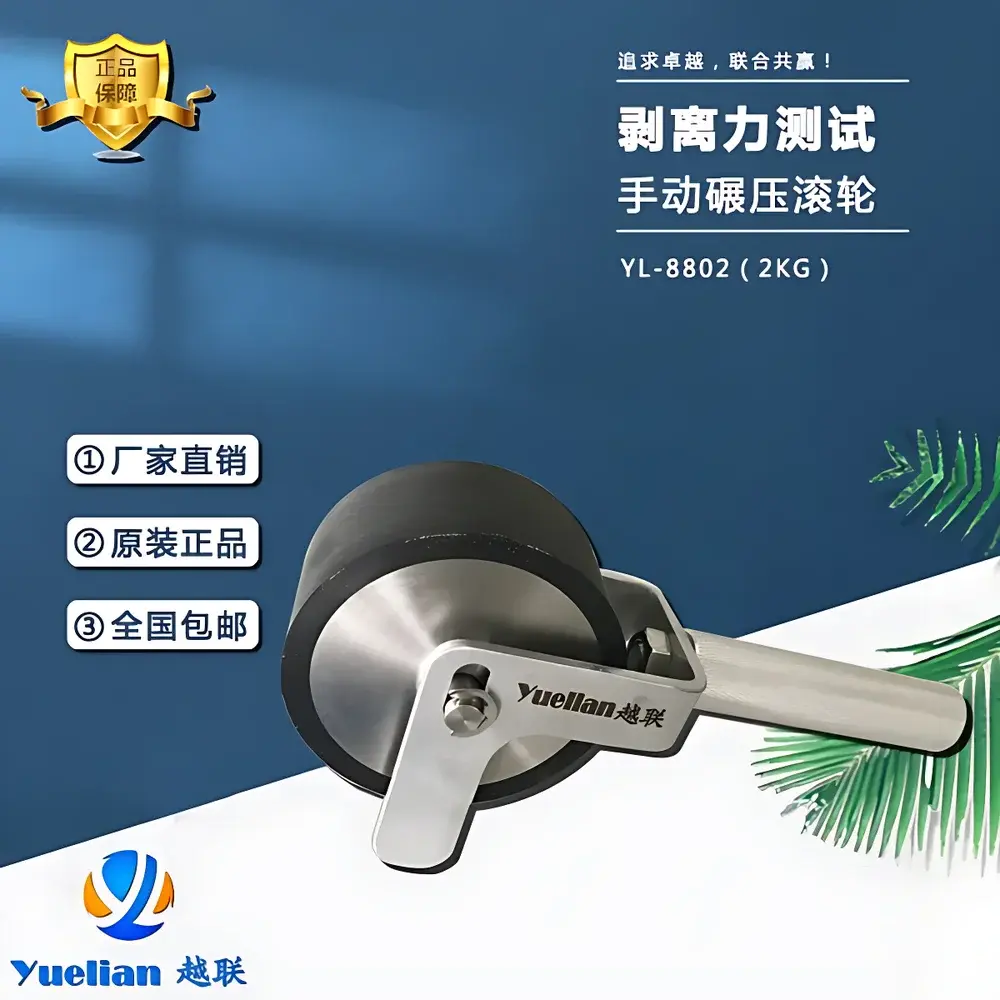
- Modular quick-release fixture interface allows rapid interchange of standardized grips (e.g., 180° peel jigs, T-peel clamps, loop tack fixtures) without tools—reducing setup time and cross-test contamination risk.
- Comprehensive safety architecture: programmable upper/lower stroke limits, overload cutoff, emergency stop circuitry, and automatic fracture detection with pre-configurable stop criteria (e.g., load drop >15% within 100 ms).
- Integrated dual-directional load cell calibration support—enabling both tensile and compressive mode validation without hardware reconfiguration.
Sample Compatibility & Compliance
The YL-S72 accommodates specimens ranging from thin polymer films (≥12 µm) to composite laminates and elastomeric tapes. Standard configurations support specimen widths up to 140 mm and thicknesses ≤5 mm. With optional extensometer integration (2-point contact or non-contact video-based), the system extends compliance to ISO 527-1/2 (tensile properties of plastics) and ASTM D882 (thin plastic sheeting). All firmware and software modules are structured to support audit-ready data integrity per FDA 21 CFR Part 11 requirements—including electronic signatures, immutable audit trails, and role-based access control. Calibration certificates traceable to NIM (National Institute of Metrology, China) and optional UKAS-accredited third-party verification are available upon request.
Software & Data Management
Yuelian’s proprietary TESTMaster v4.2 software provides full test method scripting, real-time multi-curve visualization (force vs. displacement, stress vs. strain, force vs. time), and statistical post-processing compliant with ISO/IEC 17025 documentation standards. Users define up to seven independent test segments per method—each with distinct control modes (constant rate, constant load, or closed-loop strain targeting). The software enables up to 40 manual cursor-based data points and 120 auto-sampled points per curve, supporting extraction of key metrics including peak release force, average peel force over specified intervals, standard deviation, CpK process capability indices, and median separation energy. Raw ASCII and XML export formats facilitate integration with LIMS platforms and automated reporting workflows. All test records include embedded metadata: operator ID, environmental timestamp, calibration status, fixture ID, and version-controlled method parameters.
Applications
- Release liner peel force verification per FINAT FTM 1 and ISO 1520 (cupping test for coated papers)
- Pressure-sensitive adhesive (PSA) tack and shear resistance profiling (ASTM D3121, D3654)
- Composite film delamination strength assessment (e.g., aluminum foil–polymer laminates)
- Medical-grade backing film integrity testing (ISO 10993-5 cytotoxicity sample preparation validation)
- Automotive interior trim bonding performance under thermal cycling preconditioning
- Recyclable packaging seal strength and tear propagation analysis (ASTM F88, F1160)
FAQ
Does the YL-S72 comply with GLP/GMP documentation requirements?
Yes—the TESTMaster software includes full 21 CFR Part 11 compliance features: electronic signatures, audit trail logging, user permission tiers, and immutable record archiving. Optional IQ/OQ documentation packages are available for regulated environments.
Can the system perform 90° and 180° peel tests per ISO 8510-2?
Yes—standard fixture kits include precision-aligned peel angle blocks (90° and 180°) with adjustable specimen anchoring, validated for repeatability ≤±1.2% RSD across five replicate runs.
Is third-party calibration certification included with shipment?
Factory calibration is performed using NIST-traceable reference loads; formal calibration certificates (with uncertainty budgets) are available as an add-on service—traceable to CNAS-accredited labs.
What is the minimum measurable force resolution at full scale?
With 1/500,000 internal resolution and Class 0.5 accuracy, the system achieves ≤0.01 N effective resolution at the 5 kN capacity—sufficient for sub-gram release force quantification when configured with appropriate load cell scaling.
Can the software generate reports compliant with ISO/IEC 17025?
Yes—templates include mandatory elements: equipment ID, calibration dates, environmental conditions, uncertainty statements, and analyst verification fields. Custom report layouts can be exported as PDF or Excel.
Related Products



