
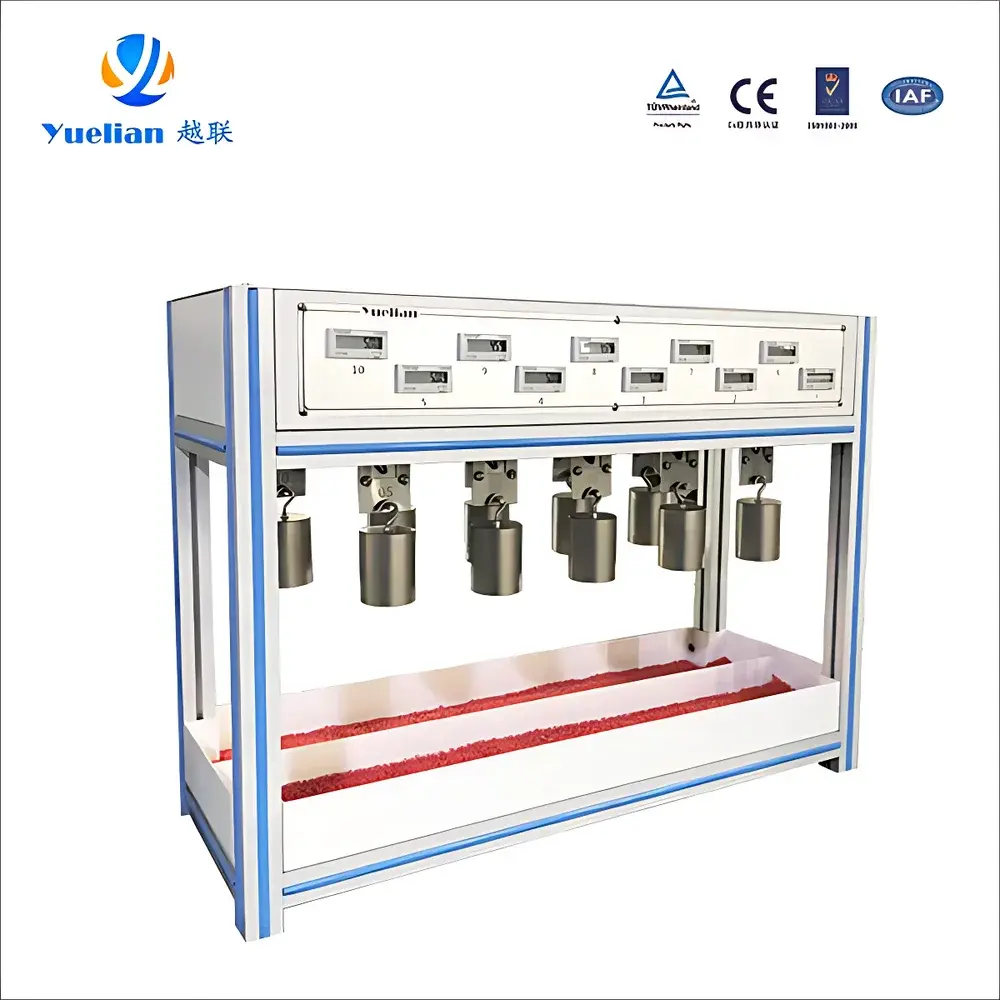
Yuelian S71CR Conductive Foam and Conductive Film Compression Resistance Tester
| Brand | Yuelian |
|---|---|
| Origin | Guangdong, China |
| Manufacturer Type | Authorized Distributor |
| Product Origin | Domestic (China) |
| Model | S71CR |
| Price Range | USD 1,400 – 7,200 |
| Load Capacity Options | 10 N to 5 kN (dual-range configurable) |
| Stroke | 450 mm |
| Speed Range | 0.01–500 mm/min |
| Force Resolution | 1/500,000 full scale |
| Force Accuracy | Better than ±0.5% FS |
| Data Acquisition Rate | 50 Hz |
| Compliance | ASTM D3786, ISO 13934-1 (adapted for compressive resistivity), GB/T 2423.17 (salt mist compatibility support) |
Overview
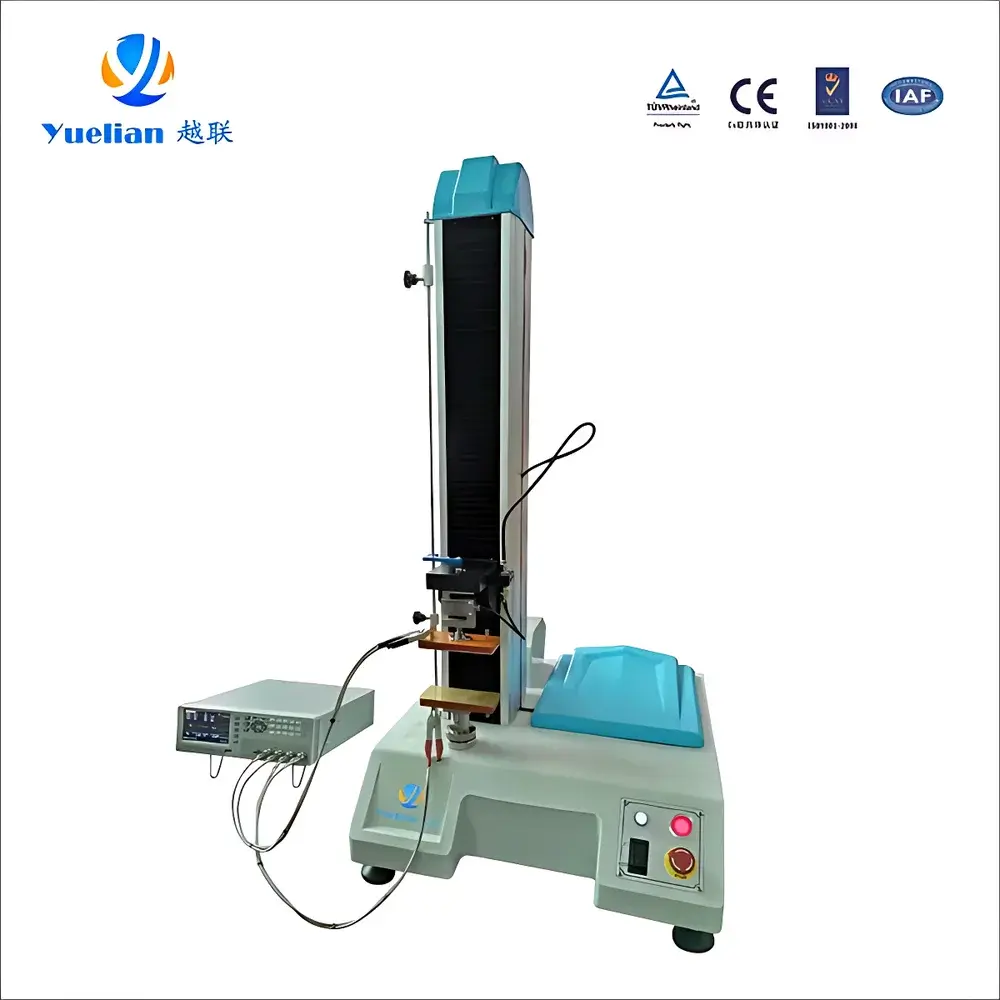
The Yuelian S71CR Conductive Foam and Conductive Film Compression Resistance Tester is an electromechanical testing system engineered for precise, repeatable measurement of electrical resistance under controlled uniaxial compression. It integrates a high-fidelity force-displacement actuation platform with real-time four-wire (Kelvin) resistance monitoring—enabling simultaneous acquisition of mechanical load, axial deformation, and bulk/surface resistivity changes in conductive elastomeric materials. Designed specifically for R&D laboratories and quality control departments in EMI shielding, flexible electronics, and advanced packaging industries, the instrument operates on the principle of compressive contact resistance evaluation: as conductive foam or thin-film substrates are compressed between parallel electrodes, interfacial contact area, particle bridging, and percolation network density evolve—directly influencing measured resistance. This dynamic relationship is captured with synchronized temporal resolution (50 Hz), supporting ISO/IEC 17025-compliant uncertainty budgets when paired with traceable calibration standards.
Key Features
- AC servo motor-driven precision ball-screw actuation system with aluminum extrusion protective housing and anodized silver finish for long-term dimensional stability
- Dual-channel real-time data acquisition: force/displacement via calibrated load cell (±0.5% FS accuracy) and resistance via external 4-wire digital ohmmeter (e.g., Keysight B2901A or equivalent) communicating via RS-232/USB
- Seven programmable test zones, up to 40 manual and 120 automatic data points per test, with cross-curve overlay capability for comparative analysis across multiple samples or compression cycles
- Comprehensive safety architecture: dual mechanical limit switches (upper/lower stroke), overload cut-off, emergency stop button, and auto-stop on specimen failure or force threshold breach
- Modular fixture interface with quick-release couplings for rapid adaptation to flat-plate, ring, or custom electrode configurations (standard electrode diameter: Ø140 mm)
- Full software control enabling closed-loop modes: constant strain rate, constant load ramp, constant resistance tracking, and multi-step nested sequences with conditional branching
Sample Compatibility & Compliance
The S71CR accommodates standard conductive foam specimens (e.g., nickel/copper-plated polyurethane, silver-coated silicone) and thin-film laminates (ITO/PEDOT:PSS on PET, graphene oxide composites, metal mesh hybrids) with thicknesses from 0.5 mm to 25 mm and planar dimensions up to 120 × 120 mm. Its mechanical design conforms to ISO 2041 (testing machine terminology) and incorporates structural damping to minimize vibrational noise during low-force (<10 N) resistivity measurements. While not certified to UL or IEC 61000-4 series by default, the system supports GLP/GMP documentation workflows—including electronic audit trails, user access levels, and FDA 21 CFR Part 11–compliant signature logs—when deployed with validated software configuration and periodic metrological verification.
Software & Data Management
The embedded Windows-based test suite provides native support for ASTM D3786 (burst strength correlation) and ISO 13934-1 (tensile behavior adaptation) test templates. Raw data exports to CSV, XLSX, and XML formats include timestamped metadata: environmental temperature/humidity (optional sensor input), operator ID, calibration certificate IDs, and instrument firmware revision. Curve visualization tools include zoom, pan, crosshair cursoring, and point extraction with interpolation. Statistical reporting modules compute CpK, standard deviation, median, trimmed mean (high/low outliers excluded), and confidence intervals at 95% level. All test files are digitally signed and checksum-verified to ensure data integrity per ALCOA+ principles.
Applications
- EMI gasket performance validation: quantifying resistance hysteresis across compression-recovery cycles (5–80% strain)
- Flexible battery interconnect reliability: evaluating contact resistance stability under thermal cycling-induced compression relaxation
- Stretchable sensor substrate qualification: correlating resistivity drift with cyclic compressive strain amplitude and frequency
- Conductive adhesive bondline integrity assessment: detecting delamination onset via abrupt resistance jumps during monotonic loading
- ISO 10993-5 cytotoxicity screening support: verifying mechanical stability of biocompatible conductive foams prior to biological testing
FAQ
What resistance measurement method does the S71CR use?
It employs a four-terminal (Kelvin) sensing configuration via external programmable ohmmeters, eliminating lead resistance errors and enabling accurate measurements from 1 mΩ to 100 MΩ.
Can the system perform cyclic compression fatigue tests?
Yes—software supports unlimited step loops with dwell time, ramp rate, and termination conditions per cycle, fully programmable for up to 100,000 cycles.
Is third-party calibration documentation included?
A factory calibration report traceable to CNAS-accredited standards is provided; optional UKAS/NIST-traceable certificates available upon request.
Does the software meet FDA 21 CFR Part 11 requirements?
Out-of-the-box functionality includes electronic signatures, audit trail logging, and role-based permissions—validated configurations require site-specific IQ/OQ protocols.
What is the maximum sample thickness supported?
With standard fixtures, up to 25 mm; extended-height configurations (S72/S73 models) accommodate specimens up to 60 mm thick.
Related Products





