
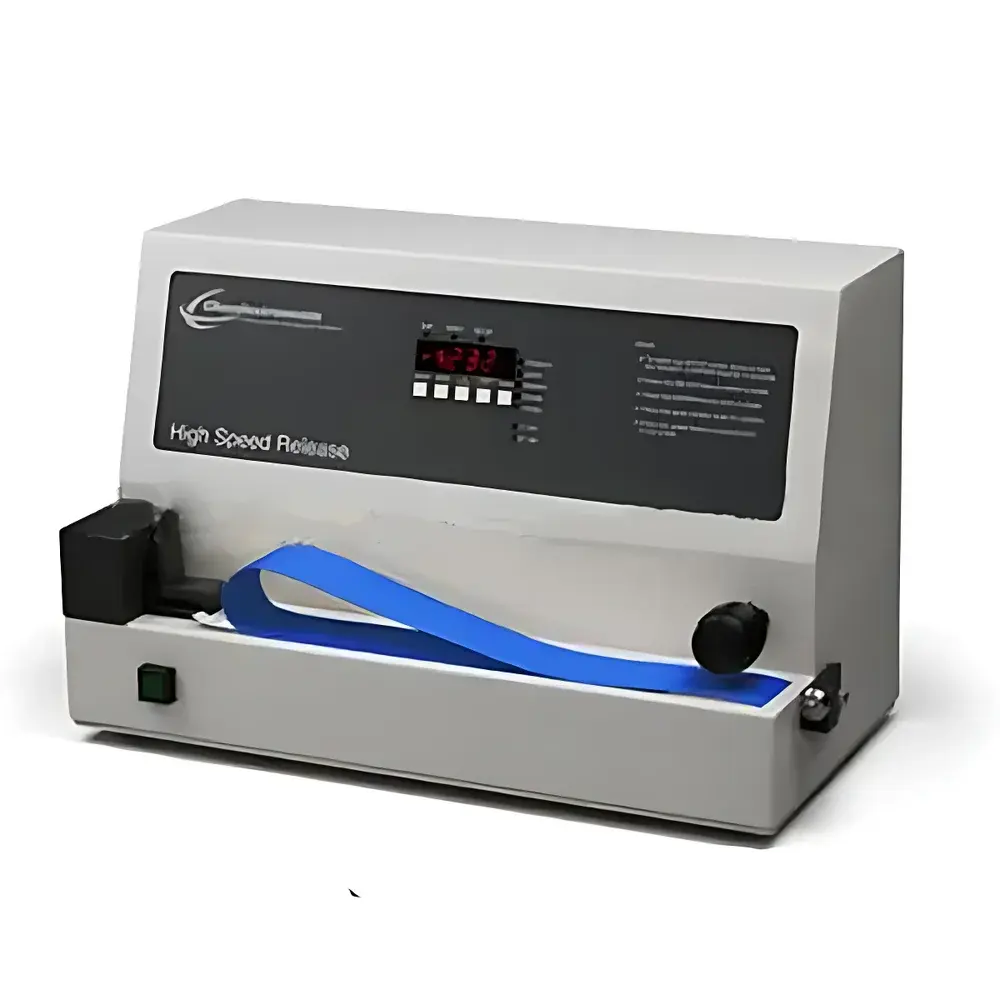
ChemInstruments HSR-1000 High-Speed Release Force Tester
| Origin | USA |
|---|---|
| Manufacturer Type | Authorized Distributor |
| Origin Category | Imported |
| Model | HSR-1000 |
| Pricing | Upon Request |
Overview
The ChemInstruments HSR-1000 High-Speed Release Force Tester is a precision-engineered instrument designed specifically for quantifying release force—the interfacial separation force between pressure-sensitive adhesives (PSAs) and release liners—under dynamically controlled peel conditions. It operates on the fundamental principle of constant-speed, 90° or 180° peel testing in accordance with standardized kinematic configurations defined by FINAT, ASTM D3330, and ISO 8510-2. Unlike conventional tensile testers, the HSR-1000 integrates high-fidelity load cell feedback with real-time velocity control across an exceptionally wide speed range—from 10 m/min (30 fpm) up to 300 m/min (1,000 fpm)—enabling direct simulation of industrial coating, laminating, and converting line speeds. Its modular architecture supports bidirectional measurement: release liner removal from adhesive surfaces (standard release) and reverse peel (adhesive removal from liner), providing critical insight into interfacial energy asymmetry and anchorage stability.
Key Features
- High-speed peel capability spanning 10–300 m/min (30–1,000 fpm), covering both low-speed QC verification and high-speed production-line validation
- Integrated self-calibration routine compliant with traceable metrological protocols; eliminates manual zeroing drift over extended operation cycles
- Load cell accuracy of ±0.1% of full-scale output (FSO), calibrated to NIST-traceable standards using a 1 kg (2 lb) standard transducer
- Operating temperature range: 0 °C to 70 °C, suitable for ambient lab environments and controlled-humidity chambers
- Compact footprint (32 × 55 × 26 cm) and lightweight design (14 kg) facilitate benchtop integration without dedicated floor space
- RS-232 serial interface for deterministic, low-latency data streaming to external host systems
Sample Compatibility & Compliance
The HSR-1000 accommodates standard test specimens per FINAT Technical Specification No. 4 (FINAT 4), including 50 mm (2″) wide release liner strips mounted on 150 mm (6″) rigid backing plates. Optional accessories—such as the 5 cm × 15 cm stainless-steel test plate, 2 kg manual roller (for consistent sample conditioning), and precision die-cutting tool—ensure repeatability across substrate types (e.g., silicone-coated PET, fluoropolymer liners, paper-based releases). All mechanical and electronic subsystems conform to IEC 61000-6-3 (EMC emissions) and IEC 61010-1 (electrical safety for laboratory equipment). Data acquisition workflows support GLP/GMP-aligned audit trails when used with validated EZ-LAB software configurations.
Software & Data Management
The EZ-LAB data acquisition system is a purpose-built Windows application engineered for real-time force analytics in PSA characterization labs. It samples load signals at 400 Hz, capturing transient peak forces, plateau regions, and oscillatory deviations during peel propagation. For each test run, EZ-LAB automatically computes and displays maximum, minimum, and arithmetic mean force values—alongside standard deviation and coefficient of variation (CV%). Up to 20 complete test datasets are retained in volatile memory with timestamped metadata (date, operator ID, test speed, unit selection). Export options include CSV and XML formats compatible with LIMS integration. Unit switching (g, kg, lb, N) is user-configurable per test series. When deployed under FDA 21 CFR Part 11-compliant server environments, EZ-LAB supports electronic signatures, role-based access control, and immutable audit logs.
Applications
- Release liner qualification for medical device tapes, transdermal patches, and diagnostic substrates
- Process validation of silicone release coatings across PET, PP, and cellulose-based carriers
- Comparative evaluation of low-adhesion backsize (LAB) performance in multi-layer laminates
- Root-cause analysis of adhesive transfer or liner splitting defects during high-speed slitting
- Development of ultra-low-release films for optical film handling and semiconductor wafer dicing tape applications
FAQ
What peel angles does the HSR-1000 support?
The instrument is configured for 90° peel geometry per FINAT 4 and ASTM D3330; 180° peel fixtures are available as optional accessories.
Is the load cell factory-calibrated and user-replaceable?
Yes—each unit ships with a NIST-traceable calibration certificate; the 1 kg load cell is field-replaceable using standard M3 mounting hardware and requires recalibration via EZ-LAB’s guided procedure.
Can the HSR-1000 operate standalone without a computer?
No—real-time data acquisition, display, and storage require connection to a Windows PC running EZ-LAB; however, basic motor control and status indicators are accessible via front-panel LED feedback.
Does EZ-LAB support statistical process control (SPC) charting?
Native SPC functions (X-bar/R charts, Cpk calculation) are not embedded but can be implemented externally via CSV export to Minitab, JMP, or custom Python/Pandas workflows.
What electrical requirements must the host PC meet?
A Windows 10/11 system with RS-232 COM port (or USB-to-serial adapter), ≥4 GB RAM, and ≥500 MB free disk space is required; no GPU acceleration or specialized drivers are needed.



