
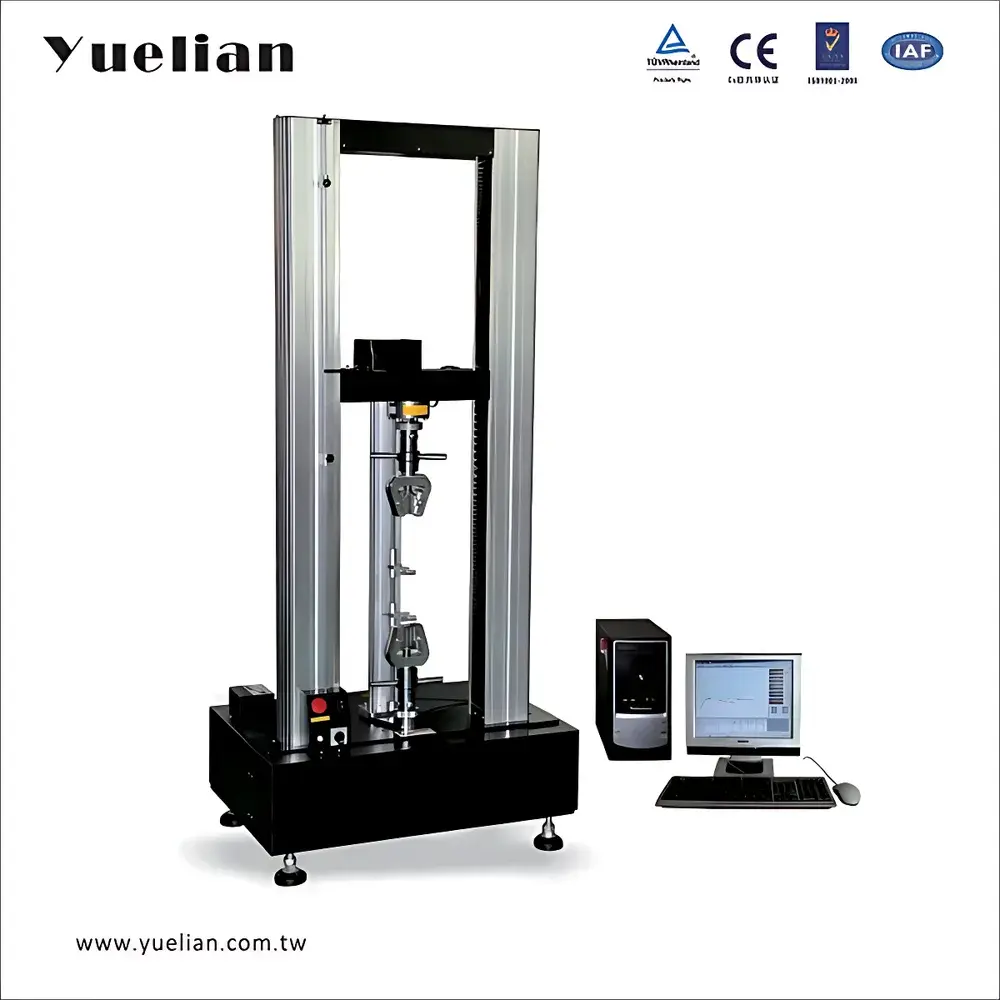
Yuelian YL-1125 Computer-Controlled Universal Testing Machine
| Brand | Yuelian |
|---|---|
| Origin | Guangdong, China |
| Model | YL-1125 |
| Instrument Type | Electronic Universal Testing Machine |
| Load Capacity Options | 10 N to 50 kN (dual-range configuration available) |
| Force Resolution | 1/500,000 full scale |
| Force Accuracy | ±0.3% of reading |
| Crosshead Travel | 1200 mm |
| Test Width | 420 mm |
| Speed Range | 0.01–1000 mm/min (programmable via PC) |
| Position Resolution | 1/500,000 full stroke |
| Control Interface | PC-based with USB connectivity |
| Compliance Standards | ISO 7500-1, ASTM E4, GB/T 228.1, GB/T 9341, GB/T 1449, ASTM D6109, JJG 475 |
| Power Supply | 220 V, 50/60 Hz, 10 A |
| Motor Drive | Servo motor with precision ball screw and timing belt transmission |
| Dimensions (W×D×H) | 92 × 62 × 199 cm |
| Weight | ~422 kg |
| Software | Windows-based test control & data analysis suite with MS Access database support, real-time curve plotting, multi-sensor input, GLP-compliant audit trail, and automated parameter calculation per ISO, ASTM, GB, JIS, DIN, EN standards |
Overview
The Yuelian YL-1125 Computer-Controlled Universal Testing Machine is an electromechanical force-testing system engineered for high-reproducibility static mechanical characterization of metallic, polymeric, composite, ceramic, and fibrous materials. It operates on the principle of controlled displacement-driven loading, where a servo-motor-actuated crosshead applies axial or flexural load through calibrated load cells and precision-ground ball screws. The machine conforms to fundamental metrological requirements defined in ISO 7500-1 (static calibration of force-proving instruments) and ASTM E4 (practices for force verification of testing machines), ensuring traceability to national standards. Designed for routine QC laboratories, R&D facilities, and accredited testing centers, it supports standardized tensile, compression, bending (3-point and 4-point), shear, peel, tear, and adhesion testing—fully compliant with GB/T 228.1–2021 (metallic materials), GB/T 9341–2019 (plastics flexural properties), ASTM D6109–2010 (wood-based composites), and ISO 179–1 (impact-modified plastics). Its modular architecture enables seamless integration into quality management systems requiring documented validation, calibration records, and electronic signature capability.
Key Features
- High-resolution force measurement with ±0.3% accuracy and 1/500,000 internal resolution across 12 selectable load ranges (10 N to 50 kN), including optional dual-capacity configurations for extended dynamic range.
- Precision motion control system featuring a brushless servo motor, preloaded ball screw, and synchronous timing belt drive—delivering stable speed regulation from 0.01 to 1000 mm/min with <±0.5% speed deviation over full range.
- Robust structural frame with 420 mm test width and 1200 mm vertical travel, accommodating large specimens and multi-specimen fixtures without reconfiguration.
- PC-based digital controller with real-time data acquisition at up to 1 kHz sampling rate, supporting simultaneous inputs from up to four calibrated transducers (e.g., extensometer, environmental chamber sensor, video extensometer).
- Comprehensive safety architecture: hardware-based overload cutoff, emergency stop circuitry, specimen fracture auto-stop, programmable upper/lower travel limits, and automatic return-to-start post-test.
- Energy-efficient 750 W drive system operating on standard 220 V / 50–60 Hz supply, certified for continuous-duty industrial environments.
Sample Compatibility & Compliance
The YL-1125 accommodates a broad spectrum of specimen geometries—from thin films (≥0.05 mm thickness) and textile yarns to structural metal coupons (up to 50 mm wide × 12 mm thick) and molded polymer bars (per ASTM D790 or GB/T 9341). Standard wedge-action, pneumatic, and hydraulic grips ensure secure clamping across material classes without slippage or premature failure. Bending fixtures meet dimensional tolerances specified in ASTM D6109 (for wood composites) and GB/T 1449–2005 (fiber-reinforced plastics), while compression platens comply with ISO 14126 for orthotropic laminates. All test protocols adhere to Good Laboratory Practice (GLP) and are compatible with GMP-regulated environments when configured with 21 CFR Part 11–compliant software modules—including electronic signatures, audit trails, user access levels, and immutable data archiving.
Software & Data Management
The embedded Windows-compatible software provides full lifecycle test management: method creation, parameter definition (preload, rate, hold time, break detection logic), real-time stress–strain curve visualization, and post-test reporting. It calculates over 25 mechanical parameters automatically—including tensile strength, yield strength (0.2% offset), Young’s modulus, flexural modulus, elongation at break, peel strength (ASTM D3330), and tear resistance (ISO 34-1)—all referenced to active standards libraries. Data export supports CSV, XML, PDF, and native .accdb formats; raw time-series files are stored with metadata (operator ID, calibration date, environmental conditions). Integration with LIMS platforms is enabled via ODBC drivers and RESTful API endpoints. Calibration certificates and maintenance logs are maintained within the application, satisfying ISO/IEC 17025 documentation requirements.
Applications
This system serves as a foundational instrument in materials science laboratories conducting mechanical property validation for aerospace composites (e.g., carbon-fiber epoxy laminates per ASTM D3039), automotive elastomers (tensile set, hysteresis per ISO 3384), medical device polymers (ISO 5832-1 biocompatibility matrix), packaging films (seal strength per ASTM F88), geotextiles (wide-width tensile per ASTM D4595), and construction adhesives (shear strength per ASTM D1002). It is routinely deployed in supplier qualification programs, incoming inspection workflows, failure analysis investigations, and regulatory submission dossiers requiring mechanically verified evidence.
FAQ
Does the YL-1125 support ASTM E8/E8M for metallic tensile testing?
Yes—the system meets all geometric, alignment, and measurement criteria outlined in ASTM E8/E8M when equipped with Class 1 extensometry and calibrated grips.
Can test methods be locked to prevent unauthorized modification?
Yes—administrator-level password protection restricts editing of standard-compliant test templates and calibration settings.
Is third-party calibration certification included?
Factory calibration is performed per ISO 7500-1; NIST-traceable certificate is available upon request (additional charge).
What is the maximum specimen height for 4-point bending tests?
Up to 150 mm, depending on support span selection and fixture configuration.
Does the software generate CFR Part 11–compliant audit trails?
Yes—when activated, it logs all user actions, parameter changes, and result modifications with timestamps and operator IDs.



