
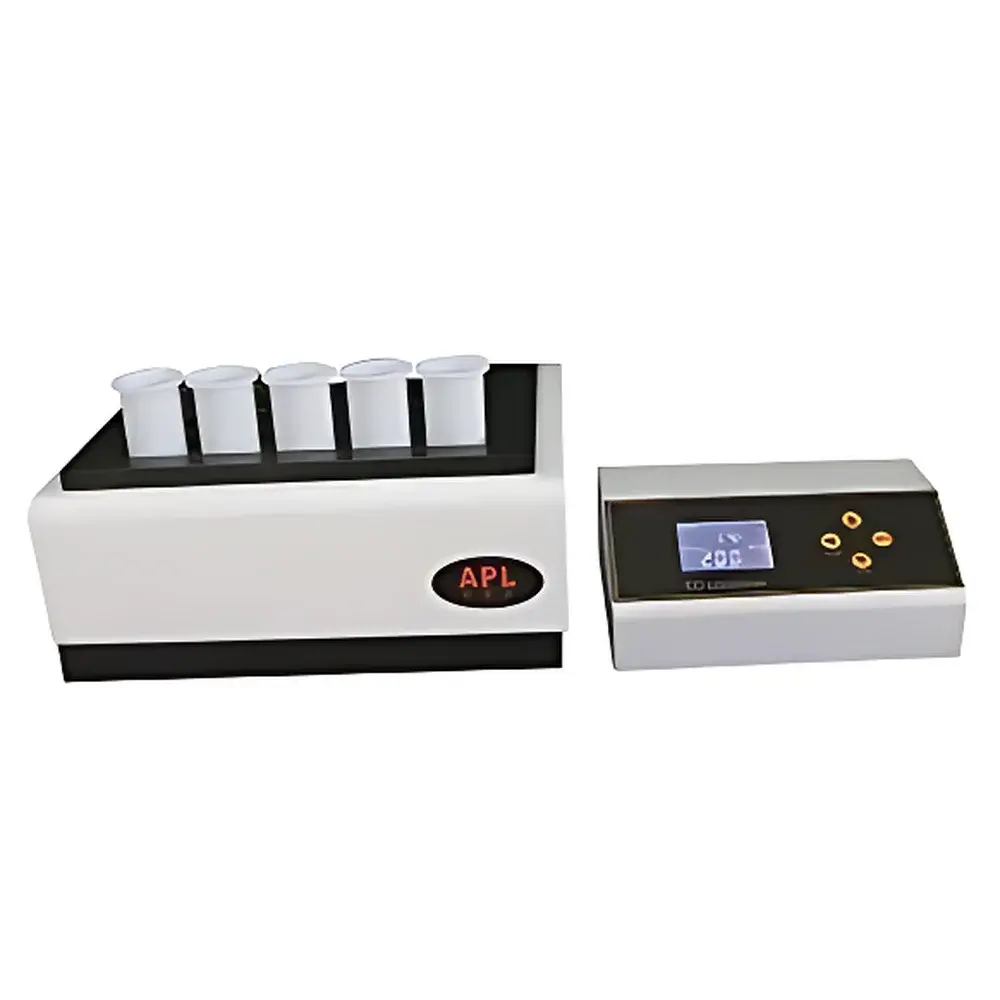
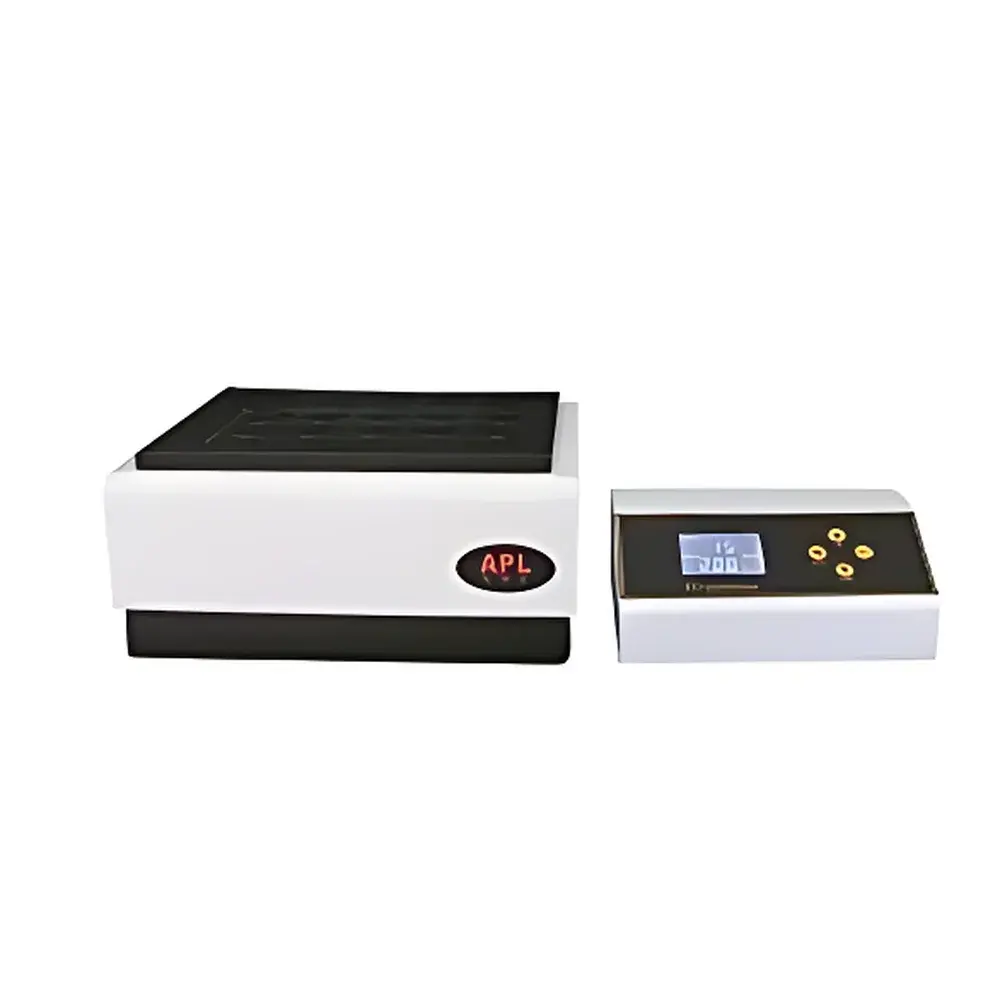
APL Optol GD20 Temperature-Controlled Graphite Block Digestion System
| Brand | APL Optol |
|---|---|
| Origin | Sichuan, China |
| Manufacturer Type | Direct Manufacturer |
| Regional Classification | Domestic (China) |
| Model | GD20 |
| Instrument Type | Graphite Block Digestion System |
| Automation Level | Semi-Automatic |
| Digestion Positions | 20 |
| Heating Temperature Range | Ambient to 350 °C |
| Temperature Control Accuracy | ±1 °C |
| Heating Principle | Electric Resistive Heating via Graphite Block |
Overview
The APL Optol GD20 Temperature-Controlled Graphite Block Digestion System is an engineered solution for reproducible, high-throughput sample preparation in analytical laboratories. Designed around a monolithic high-purity graphite heating block with proprietary high-temperature PFA coating, the system delivers uniform thermal distribution across all 20 digestion wells—enabling consistent acid digestion of solid and semi-solid matrices under controlled, open-vessel conditions. Unlike conventional hot plates or ceramic heaters, the GD20 employs circumferential resistive heating embedded within the graphite matrix, minimizing radial thermal gradients and eliminating localized overheating. This architecture supports precise thermal management from ambient up to 350 °C, making it suitable for applications requiring extended ramp-and-hold protocols—such as EPA 3050B soil digestion, GB/T 22105.1–2008 heavy metal extraction from agricultural soils, or ICP-MS sample prep for trace element quantification. The system operates without integrated reagent dispensing (0-channel configuration), aligning with laboratories that prefer manual acid addition or integrate external peristaltic dosing modules.
Key Features
- 20-position high-density graphite block with uniform well geometry (Φ40 mm × depth optimized for standard 50 mL digestion tubes)
- PFA-coated graphite surface (≥260 °C continuous service rating) ensuring chemical inertness against HNO₃, HCl, HF, and aqua regia at elevated temperatures
- PID-based digital temperature controller with real-time setpoint tracking, programmable ramp rates, and dual-stage overtemperature protection (audible + automatic cutoff)
- Thermal uniformity ≤±1.5 °C across all positions (measured at 210 °C, per ASTM E220-17 calibration practice)
- Maximum power consumption: 1.6 kW; energy-efficient design reduces average digestion cycle time by ~75% versus traditional mantle heaters
- Corrosion-resistant control panel with sealed membrane switches rated for Class C2/C3 industrial environments (IEC 60721-3-3)
- Digital RS232 serial interface for remote parameter setting, logging, and integration with LIMS or lab automation platforms
Sample Compatibility & Compliance
The GD20 accommodates standard borosilicate glass, quartz, and PTFE digestion vessels (up to 50 mL capacity). It is validated for use with regulatory digestion methods including EPA Methods 3010A, 3050B, 200.7, and 245.1; Chinese national standards GB/T 22105.1–2008 (soil), GB/T 17138–1997 (soil & sediment), and GB/T 5009.11–2003 (food arsenic determination). While not a GLP-compliant instrument out-of-the-box, its temperature log export capability (via RS232) supports audit-ready documentation when paired with compliant data acquisition software. The absence of onboard reagent handling ensures full operator control over acid addition sequence and timing—critical for method adherence in ISO/IEC 17025-accredited testing labs.
Software & Data Management
The GD20 does not include embedded software but provides ASCII-formatted serial output (9600 baud, N-8-1) containing timestamped temperature readings, setpoint values, and status flags (e.g., “HEATING”, “HOLD”, “ALERT”). Third-party SCADA or custom Python/LabVIEW scripts can parse this stream into CSV or SQL databases. For regulated environments, users may implement 21 CFR Part 11-compliant electronic signatures and audit trails via external validation of the host acquisition system. Firmware updates are performed via USB-to-serial adapter; no cloud connectivity or proprietary drivers are required.
Applications
- Pre-digestion conditioning and post-microwave acid evaporation (“赶酸”) for samples destined for AAS, ICP-OES, or ICP-MS analysis
- Batch digestion of environmental solids (soils, sediments, sludges) per EPA 3050B and GB/T 22105 series
- Food and feed matrix decomposition prior to Cd, Pb, As, and Hg quantification (GB/T 5009.11–2003, GB/T 5009.17–1996)
- Electronics waste digestion per SJ/T 11365–2006 for RoHS-relevant elements (Cr⁶⁺, Cd, Pb, Hg)
- Paint and coating analysis (GB/T 22788–2008) for total metal content screening
- Pharmaceutical excipient testing where residual catalyst metals (e.g., Pd, Pt) must be quantified at sub-ppb levels
FAQ
Is the GD20 compatible with hydrofluoric acid (HF) digestion?
Yes—when used with PTFE or quartz vessels and operated below 220 °C, the PFA-coated graphite block resists HF attack. However, HF procedures require strict safety protocols and dedicated ventilation; consult local EHS guidelines before implementation.
Can the GD20 be validated per ISO/IEC 17025 requirements?
Yes—the system’s temperature uniformity, stability, and repeatability can be verified using calibrated reference thermocouples and documented per ISO/IEC 17025 Clause 6.4.2. Full validation requires user-defined IQ/OQ protocols.
Does the GD20 support multi-step temperature programming?
Yes—up to 10 independent segments (ramp rate, target temp, hold time) can be defined via the front-panel interface or RS232 command set.
What maintenance is required for long-term accuracy?
Annual verification of temperature sensor calibration against a NIST-traceable reference thermometer is recommended. Visual inspection of PFA coating integrity should occur before each high-temperature (>280 °C) run.
Is technical support available outside mainland China?
APL Optol provides English-language documentation and remote diagnostics support via email and video call. Distributor partnerships in Southeast Asia, the Middle East, and Latin America facilitate local service coordination.



