
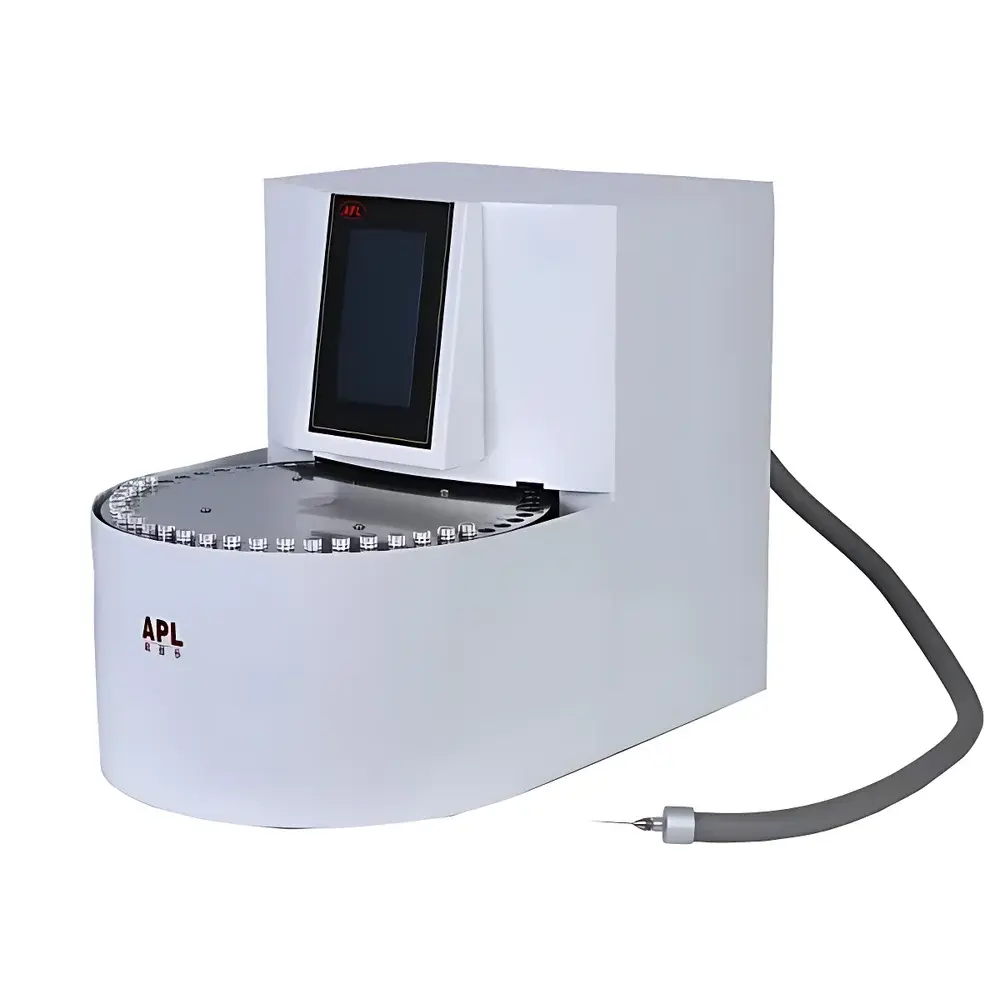
APL Optolong TD-50A Automated Two-Stage Thermal Desorber
| Brand | APL Optolong |
|---|---|
| Origin | Sichuan, China |
| Manufacturer Type | Direct Manufacturer |
| Product Category | Domestic |
| Model | APL-TD-50A |
| Instrument Type | Two-Stage Thermal Desorber / Thermal Desorption Unit |
| Automation Level | Fully Automatic |
| Desorption Temperature Range | −35 °C to 400 °C |
| Valve & Injection Zone Temperature Range | Ambient to 220 °C |
| Transfer Line Temperature Range | Ambient to 260 °C |
| Cold Trap Temperature Range | −35 °C |
| Temperature Control Accuracy | ±1 °C |
| Desorption Recovery Rate | >98% (compound-dependent) |
| Sample Capacity | 50 positions |
Overview
The APL Optolong TD-50A Automated Two-Stage Thermal Desorber is a fully integrated, laboratory-grade thermal desorption system engineered for high-fidelity quantitative analysis of volatile and semi-volatile organic compounds (VOCs and SVOCs) in air, indoor environments, vehicle cabins, and industrial emission samples. It operates on the principle of two-stage thermal desorption: first, analytes are thermally released from sorbent tubes under controlled inert gas flow; second, they are refocused onto a cryogenically cooled trap (−35 °C), followed by rapid flash desorption (>3000 °C/min) into a gas chromatograph (GC) or GC–MS system. This architecture ensures maximum analyte integrity, minimal breakthrough, and exceptional sensitivity—critical for compliance with low-level environmental monitoring requirements. Designed for unattended operation, the TD-50A supports method-driven workflows aligned with internationally recognized analytical standards, including EPA TO-17, ISO 16017-1, and multiple Chinese national standards (e.g., HJ 644–2013, HJ 734–2014, GB/T 18883–2002).
Key Features
- Fully automated two-stage desorption sequence: primary desorption, cold trap focusing, and ultra-rapid secondary flash desorption—all programmable via intuitive 7-inch capacitive touchscreen interface.
- Independent, PID-controlled heating zones for sorbent tube bed (−35 °C to 400 °C), six-port electric valve manifold (ambient to 220 °C), and transfer line (ambient to 260 °C), each with ±1 °C stability and real-time digital monitoring.
- Integrated Peltier-based cryogenic cold trap capable of sustained −35 °C operation without external coolant or liquid nitrogen—reducing operational complexity and long-term cost of ownership.
- Simple-Lock™ mechanical coupling system enabling tool-free, repeatable, leak-tight fixation of standard 89 mm × 6.4 mm OD sorbent tubes in <2 seconds per tube—ensuring consistent sealing integrity across all 50 sample positions.
- Onboard calibration and simulation mode: built-in 100 mL/min mass flow controller enables direct generation of certified reference vapor streams for method validation and calibration curve construction without external gas standards.
- Synchronization outputs (TTL/relay) trigger GC oven ramp initiation, detector acquisition start, and data system timestamping simultaneously upon injection—eliminating timing drift and ensuring chromatographic reproducibility.
- Gas path constructed from deactivated fused silica and electropolished stainless steel; all valves are solenoid-actuated or motor-driven with wear-resistant seals compliant with ASTM D5400 service life specifications.
Sample Compatibility & Compliance
The TD-50A accepts industry-standard 1/4″ OD stainless steel or glass sorbent tubes (e.g., Tenax TA, Carbopack B/C, Carboxen 1000), rated to 420 °C and sealed with PTFE-lined caps for extended sample stability. Its performance meets or exceeds technical requirements defined in HJ 644–2013 (ambient air VOCs), HJ 734–2014 (stationary source emissions), GB 50325–2020 (civil building IAQ), and HJ/T 400–2007 (in-vehicle VOCs). The system supports full audit trail logging and user-access-level permissions—facilitating alignment with GLP and GMP documentation practices. While not pre-certified for FDA 21 CFR Part 11, its software architecture allows integration with validated LIMS or CDS platforms supporting electronic signature and change control protocols.
Software & Data Management
Method development, execution, and reporting are managed through the embedded TD-Control Suite—localized firmware with English-language UI. Users define multi-step temperature ramps, flow profiles (desorption: 0–100 mL/min; purge: 0–600 mL/min; simulate: fixed 100 mL/min), dwell times, and synchronization triggers. All methods are stored internally with timestamps and operator ID tags. Export options include CSV metadata logs and annotated chromatogram-ready reports compatible with OpenLab CDS, Chromeleon, and MassHunter. Audit trails record every parameter change, run initiation, error event, and hardware status transition—retained for ≥12 months unless manually archived.
Applications
- Regulatory monitoring of ambient and workplace air for benzene, toluene, ethylbenzene, xylenes (BTEX), aldehydes, and halogenated VOCs per HJ 583–2010 and ISO 16017-1.
- Indoor air quality assessment in residential, commercial, and healthcare facilities per GB/T 18883–2002 and WHO guidelines.
- Emission testing of building materials, adhesives, coatings, and automotive interior components under HJ/T 400–2007.
- Source apportionment studies using thermal desorption coupled with comprehensive two-dimensional GC×GC–TOFMS.
- Method development and validation laboratories requiring trace-level recovery verification, carryover assessment (<0.05%), and inter-laboratory reproducibility testing.
FAQ
Does the TD-50A support both single-stage and two-stage desorption protocols?
Yes—it can operate in either mode. Two-stage is default for maximum sensitivity; single-stage is selectable for rapid screening or high-concentration samples.
Is the cold trap temperature actively controllable below −30 °C?
Yes—the Peltier module maintains stable −35 °C with ±0.5 °C uniformity across the trap surface, verified per ISO 17025 internal calibration procedures.
Can the instrument be integrated with third-party GC systems?
Yes—standard TTL and 24 VDC synchronization I/O ports enable seamless triggering of Agilent, Thermo Fisher, Shimadzu, and PerkinElmer GC models.
What maintenance intervals are recommended for the valve manifold and trap assembly?
Valve service is recommended every 10,000 cycles; cold trap cleaning every 500 runs or when baseline noise increases >15%—both documented in the included maintenance log template.
Are firmware updates provided post-purchase?
Yes—APL Optolong delivers free firmware patches and minor version upgrades for three years from shipment date via secure download portal with SHA-256 checksum verification.




