
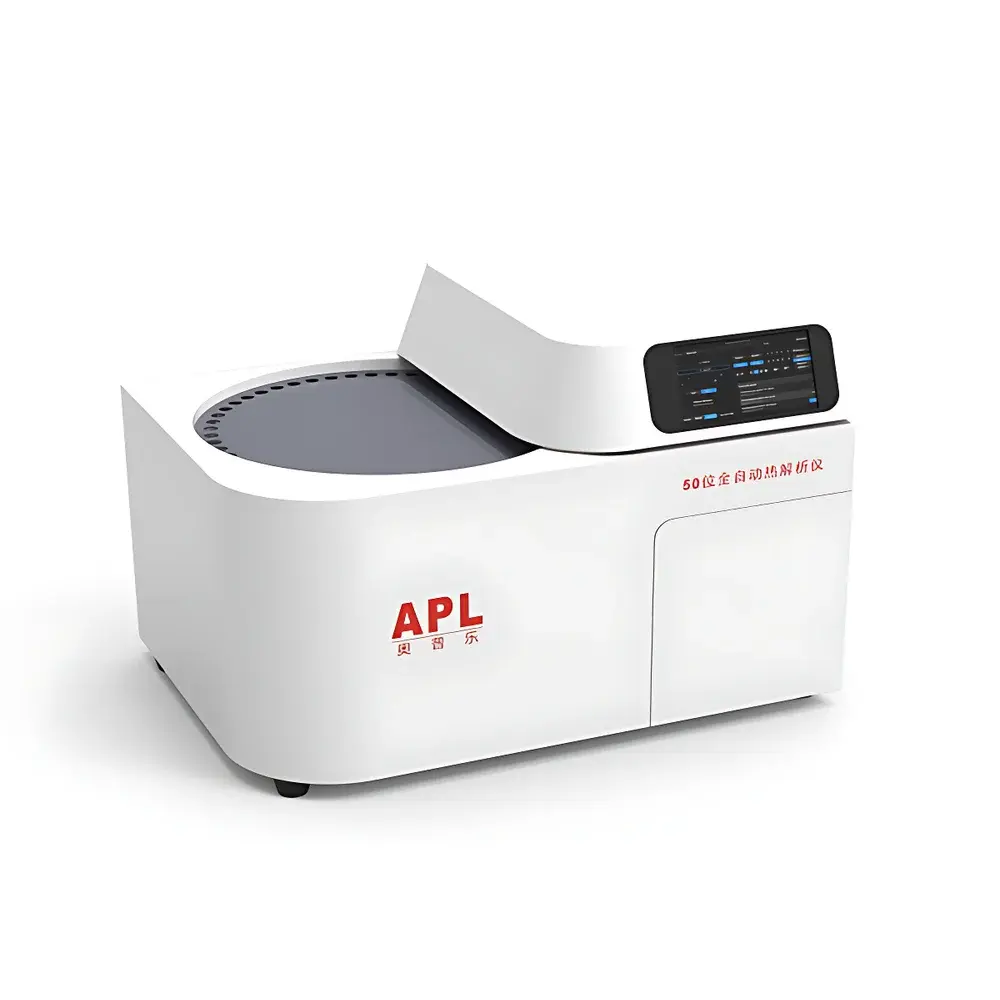
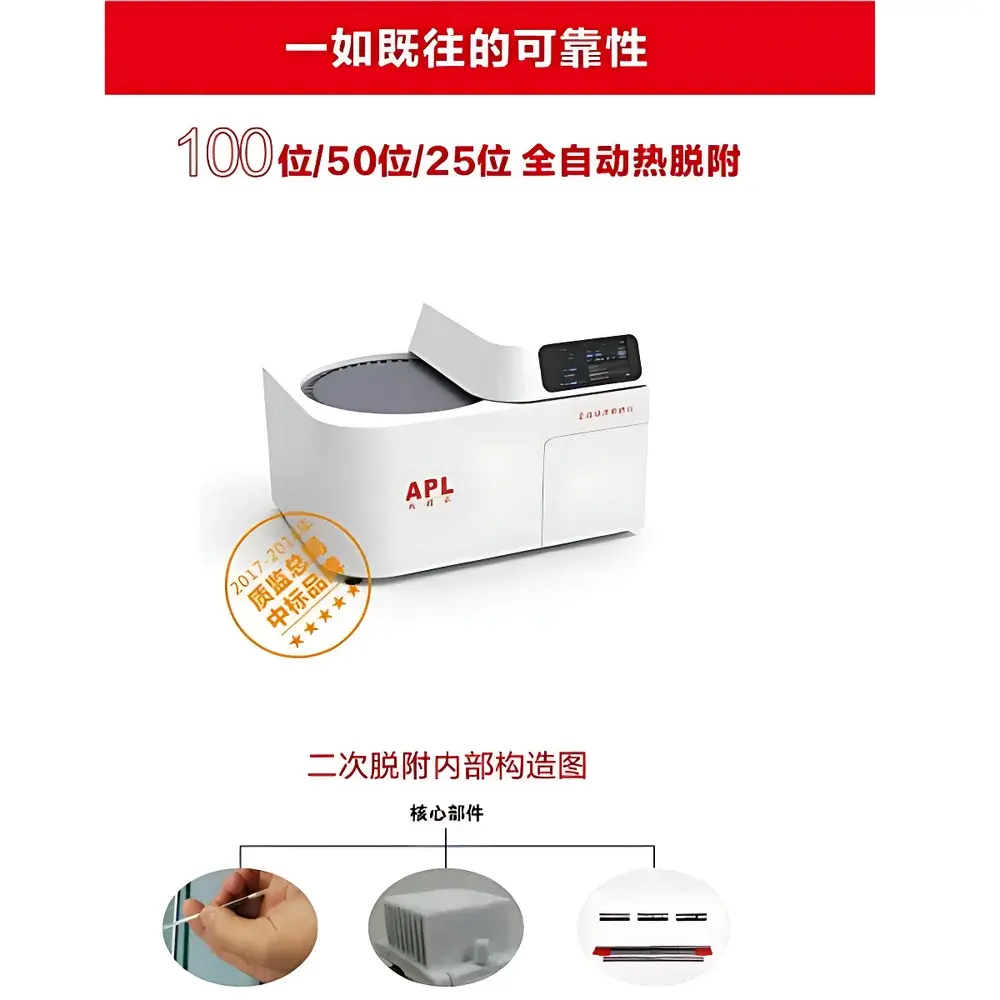
APL APL-TD-50D Fully Automated Two-Stage Thermal Desorber
| Brand | APL |
|---|---|
| Origin | Sichuan, China |
| Manufacturer Type | Direct Manufacturer |
| Product Category | Domestic |
| Model | APL-TD-50D |
| Instrument Type | Two-Stage Thermal Desorber / Thermal Desorption Unit |
| Automation Level | Fully Automated |
| Desorption Temperature Range | –35 °C to 400 °C |
| Valve Injection Zone Temperature Range | Ambient to 300 °C |
| Transfer Line Temperature Range | Ambient to 300 °C |
| Cold Trap Temperature Range | –35 °C |
| Temperature Control Accuracy | ±1 °C |
| Analyte Recovery Rate | >98% |
| Sample Capacity | 50 Adsorption Tubes |
Overview
The APL APL-TD-50D Fully Automated Two-Stage Thermal Desorber is a precision-engineered sample introduction system designed for quantitative analysis of volatile and semi-volatile organic compounds (VOCs and SVOCs) in environmental, occupational health, and indoor air quality applications. It operates on the principle of two-stage thermal desorption: first, analytes are thermally released from sorbent-packed tubes under controlled inert gas flow; second, they are refocused onto a cryogenically cooled trap (–35 °C) prior to rapid thermal desorption and transfer into a gas chromatograph (GC) or GC–MS system. This dual-stage architecture significantly enhances sensitivity, peak shape resolution, and reproducibility—particularly for trace-level compounds such as benzene, toluene, ethylbenzene, xylenes (BTEX), aldehydes, and C2–C12 hydrocarbons. The instrument is purpose-built to meet the rigorous methodological requirements of standardized environmental monitoring protocols, including HJ 644–2013, HJ 583–2010, HJ 734–2014, and GB/T 18883–2002.
Key Features
- Fully automated sequence execution—including tube heating, cold trap focusing, GC injection, and post-run tube reconditioning (bake-out)—via programmable time-based method control.
- Independent temperature zoning for desorption oven (–35 °C to 400 °C), valve manifold (ambient to 300 °C), and transfer line (ambient to 300 °C), ensuring precise thermal management across all critical interfaces.
- Integrated Peltier-based cooling system achieves stable –35 °C cold trap operation without external chillers or liquid nitrogen, reducing operational complexity and long-term cost of ownership.
- Electrically actuated 6-port switching valve combined with solenoid valves enables robust, leak-tight control of carrier gas flow paths for desorption, injection, and back-flush cleaning cycles.
- Simple-Lock™ mechanical coupling system allows tool-free, repeatable adsorption tube insertion and ejection in ≤2 seconds, minimizing handling error and maximizing throughput in high-volume labs.
- Onboard calibration mode supports standard vapor generation directly within the desorber, enabling accurate multi-point calibration curve generation without external spiking apparatus.
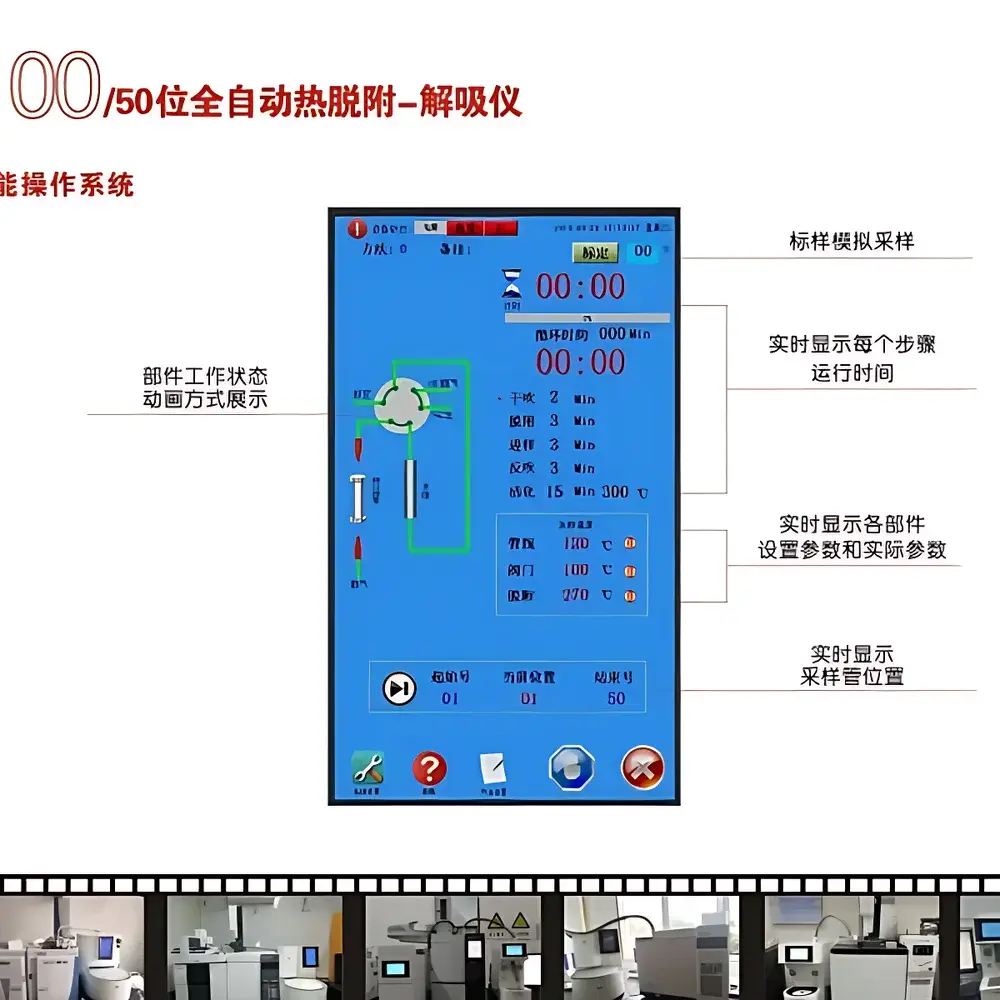
- Touchscreen HMI with intuitive workflow navigation supports method creation, parameter validation, password-protected user access levels, and audit-ready event logging.
Sample Compatibility & Compliance
The APL-TD-50D accepts standard 89 mm × 6.4 mm OD sorbent tubes compliant with ASTM D6196, ISO 16017-1, and US EPA TO-17 specifications. Tubes are rated for continuous use up to 420 °C and sealed with fluoropolymer caps to ensure sample integrity during storage and transport. The system is validated for compliance with multiple Chinese national and environmental standards, including HJ 644–2013 (VOCs in ambient air), HJ 583–2010 (benzene series), HJ 734–2014 (stationary source emissions), and GB 50325–2010 (indoor pollution control). All thermal and pneumatic parameters are traceable to NIST-traceable references, and the instrument supports GLP/GMP-aligned data integrity practices—including electronic signatures, method versioning, and tamper-evident audit trails—when integrated with compliant LIMS or chromatography data systems.
Software & Data Management
The embedded firmware supports full method lifecycle management: creation, validation, export/import (CSV/XML), and revision control. Each run logs timestamped metadata—including actual temperatures, valve timing events, pressure profiles, and recovery check results—for traceability. Exported data files include structured descriptors compatible with third-party GC software (e.g., Agilent OpenLab, Thermo Chromeleon, Shimadzu GC Solutions). Optional API integration enables remote monitoring and scheduling via Ethernet or RS-232. All configuration changes and user actions are recorded in an immutable audit trail meeting FDA 21 CFR Part 11 requirements when deployed with appropriate system controls and role-based authentication.
Applications
- Regulatory monitoring of ambient and indoor air VOCs per HJ/T 400–2007 and GB/T 18883–2002.
- Analysis of vehicle cabin emissions and material off-gassing studies.
- Compliance testing for building materials, adhesives, and coatings under GB 50325–2010.
- Source apportionment and emission characterization from industrial stacks (HJ 734–2014).
- Method development and validation for emerging contaminants including oxygenated VOCs and halogenated compounds.
- High-throughput screening in contract environmental laboratories processing ≥50 samples per shift.
FAQ
Does the APL-TD-50D support direct interfacing with all major GC and GC–MS platforms?
Yes—it features universal pneumatic and electrical interfaces compatible with Agilent, Thermo Fisher, Shimadzu, PerkinElmer, and Waters GC systems, including both split/splitless and PTV inlets.
Is the cold trap temperature independently controllable?
Yes—the Peltier-cooled trap maintains a stable setpoint between –35 °C and room temperature, with real-time feedback control and over-temperature protection.
Can I perform method validation and system suitability testing on this instrument?
Absolutely—the built-in standard vapor generation mode, recovery rate verification protocol (>98%), and temperature uniformity mapping tools support full IQ/OQ/PQ documentation per ISO/IEC 17025.
What maintenance routines are recommended for long-term reliability?
Routine tasks include quarterly valve seal inspection, annual thermocouple calibration verification, and biannual sorbent tube holder cleaning; no consumables beyond standard GC septa and tubing are required.
Is remote diagnostics or software update capability available?
Firmware updates are performed via USB or network connection; remote desktop support is available through authorized APL service channels under signed support agreements.




