
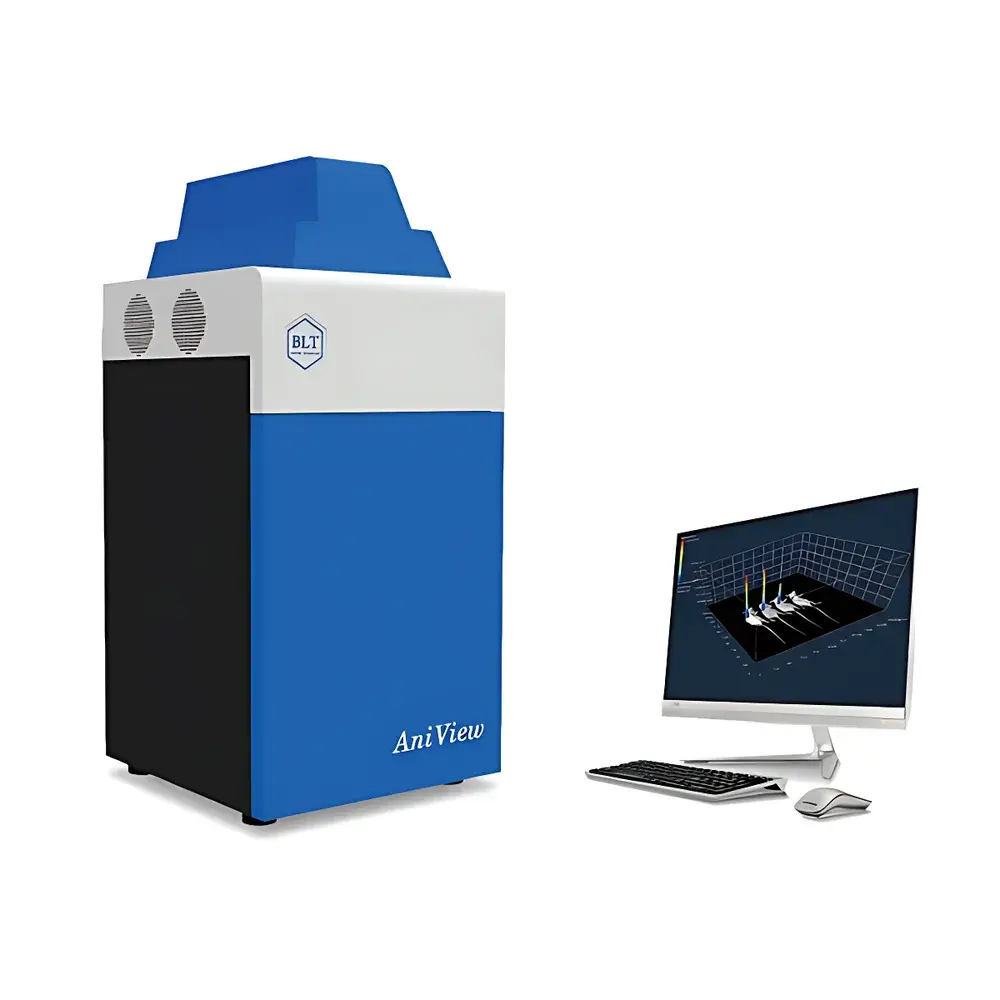
BioLight AniView100 Multimodal Small Animal In Vivo Imaging System
| Brand | BioLight |
|---|---|
| Model | AniView100 |
| Imaging Modality | Optical (Bioluminescence, Fluorescence, Cerenkov, Upconversion Fluorescence), Optional X-ray |
| CCD Sensor | Deep-cooled scientific-grade CCD, -100°C operating temperature |
| Filter Capacity | Up to 20 excitation LEDs + 10 emission filters |
| Software | Quantitative analysis with radiance calibration (p/s/cm²/sr), automated focus & protocol execution |
| Compliance | Designed for GLP-compliant preclinical research environments |
Overview
The BioLight AniView100 is a multimodal small animal in vivo imaging system engineered for quantitative, high-sensitivity optical detection across bioluminescence, fluorescence, Cerenkov luminescence, and upconversion fluorescence modalities. Its core architecture integrates a deep-cooled scientific-grade CCD detector with thermoelectric cooling to −100 °C (absolute), enabling sub-picowatt-level photon capture with exceptionally low dark current and thermal noise. The fully enclosed light-tight chamber—equipped with OD6 optical bandpass filters and real-time background subtraction algorithms—ensures signal fidelity by eliminating ambient light, cosmic ray interference, and stray excitation leakage. Unlike conventional benchtop imagers, the AniView100 employs a physics-based radiometric calibration framework traceable to absolute photon flux units (photons per second per cm² per steradian, p/s/cm²/sr), allowing cross-experiment and cross-laboratory comparability without empirical normalization.
Key Features
- Deep-cooled CCD detection: −100 °C operational temperature achieved via multi-stage thermoelectric cooling, delivering quantum efficiency >95% at 600 nm and dark current <0.001 e⁻/pixel/sec.
- Modular excitation architecture: 20 independently controllable narrowband LED sources (365–780 nm), arranged in uniform annular configuration for homogeneous illumination; compatible with 10-position motorized emission filter wheel.
- Integrated hardware-software synchronization: All imaging parameters—including stage height, temperature control (25–40 °C), LED intensity, exposure time, and filter selection—are programmable via the native acquisition software.
- Intelligent mechanical design: Magnetic latching door with status-indicating LED ring; auto-sensing interlock that halts acquisition upon door opening; redundant thermal and overcurrent protection circuits.
- Modular expansion capability: Field-upgradable modules include X-ray radiography (micro-CT compatible geometry), upconversion fluorescence (980 nm CW laser source), luciferase cell line validation (single-tube and 96-well formats), and ISO-certified isoflurane anesthesia delivery (AA-500 compliant with ASTM F2699-21).
Sample Compatibility & Compliance
The AniView100 supports longitudinal imaging of mice, rats, hamsters, and rabbits (up to 500 g) under controlled physiological conditions. The integrated heating platform maintains core body temperature within ±0.5 °C during extended acquisitions. For regulatory submissions, the system supports audit trails, user access levels, electronic signatures, and data integrity features aligned with FDA 21 CFR Part 11 requirements when configured with optional secure software mode. All optical components meet ISO 10110 surface quality standards; X-ray module (if installed) complies with IEC 62464-1 for low-dose preclinical radiography. The system is routinely validated against NIST-traceable luminance standards for bioluminescent quantification in oncology and immunology models.
Software & Data Management
The AniView Control Suite provides a fully localized English interface with intuitive workflow navigation. Predefined protocols store complete acquisition configurations—including binning, gain, exposure, and region-of-interest definitions—for reproducible experiment replication. Radiance-calibrated image stacks are exported in DICOM 3.0 and TIFF formats with embedded metadata (exposure time, filter ID, LED power, temperature, animal ID). Quantitative analysis includes ROI-based flux integration, kinetic curve generation, co-registration overlays (optical + X-ray), and batch-mode report generation compliant with MIARE (Minimum Information About an Animal Experiment) reporting guidelines. Raw data files are SHA-256 hashed and timestamped to support GLP audit readiness.
Applications
- Oncology: Longitudinal monitoring of orthotopic tumor growth, metastatic burden, and therapeutic response using luciferase-tagged xenografts or fluorescently labeled immune cells.
- Immunology & Infectious Disease: Tracking adoptively transferred T-cells or macrophages in inflammation models; visualizing pathogen load dynamics in viral/bacterial infection studies.
- Stem Cell & Regenerative Medicine: Validating engraftment efficiency and spatial distribution of transplanted stem cells via dual-modality labeling (e.g., GFP + firefly luciferase).
- Drug Development: Pharmacokinetic/pharmacodynamic assessment of novel fluorophore-conjugated therapeutics or radiolabeled tracers via Cerenkov signal detection.
- Vaccinology: Evaluating antigen-specific immune activation through reporter gene expression in dendritic cell populations.
- Gene Therapy & CRISPR Validation: Quantifying promoter activity, splice variant expression, or editing efficiency in live animals using inducible luciferase constructs.
FAQ
Does the AniView100 support spectral unmixing for multiplexed fluorescence imaging?
Yes—the system supports linear unmixing of up to four spectrally distinct fluorophores when paired with appropriate excitation/emission filter combinations and reference spectra acquired under identical optical conditions.
Can raw image data be exported for third-party analysis (e.g., MATLAB, ImageJ)?
All calibrated images are saved as 16-bit TIFF files with full metadata headers; export plugins for Fiji/ImageJ and MATLAB are provided with the software suite.
Is the X-ray module capable of tomographic reconstruction?
No—the optional X-ray module provides planar radiography only; micro-CT functionality requires integration with external dedicated systems.
What anesthesia compatibility does the AA-500 module support?
The AA-500 delivers precise isoflurane vapor concentration (0.5–5.0% v/v) with integrated oxygen flow control (0.2–2.0 L/min); it meets ISO 8535-1 for veterinary anesthesia equipment safety.
How is photobleaching minimized during repeated fluorescence imaging sessions?
The system implements LED duty-cycle modulation, real-time exposure optimization, and automatic gain adjustment to minimize cumulative photon dose while maintaining SNR above 20 dB.





