
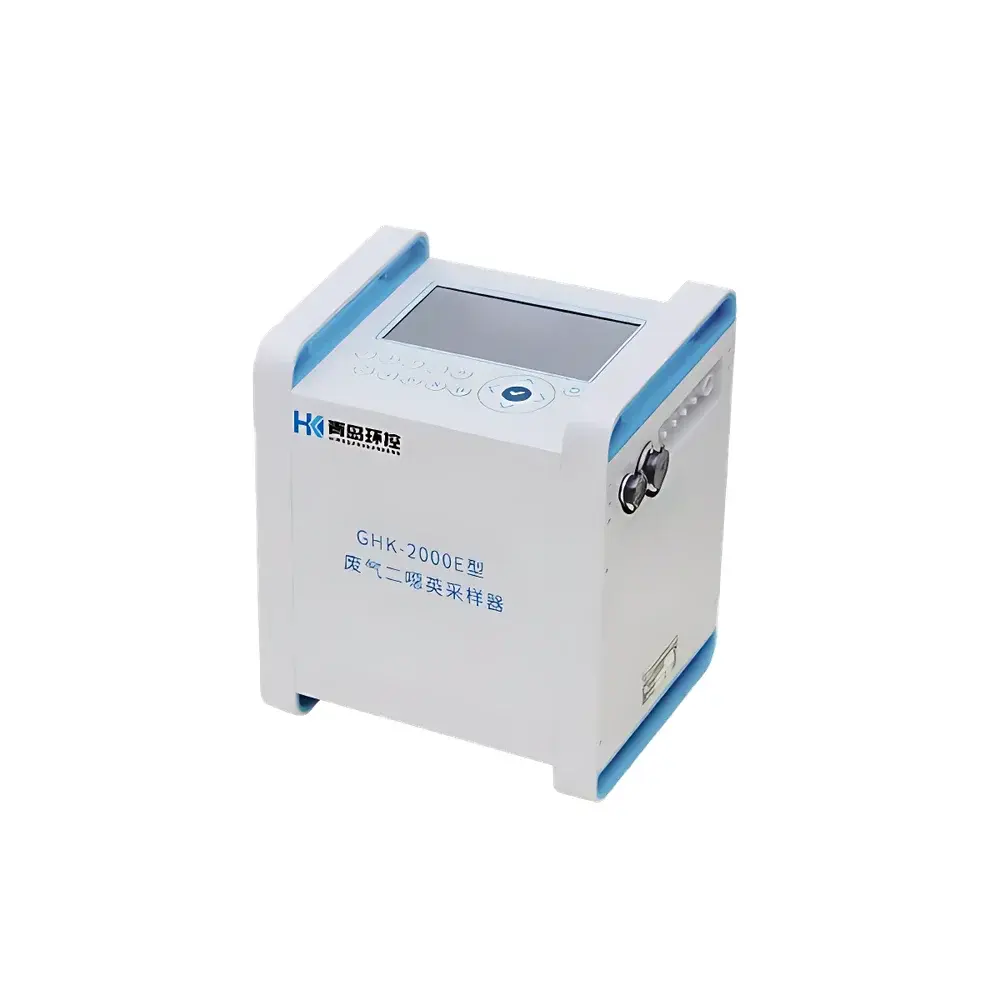
HUANKONG GHK-2000E Dioxin Emission Sampling System
| Brand | HUANKONG |
|---|---|
| Origin | Shandong, China |
| Manufacturer Type | Direct Manufacturer |
| Country of Origin | China |
| Model | GHK-2000E |
| Instrument Category | Flue Gas and Particulate Sampler |
| Sampling Flow Rate | 5–60 L/min |
| Moisture Content Range | 0–60% |
Overview
The HUANKONG GHK-2000E Dioxin Emission Sampling System is a field-deployable, regulatory-compliant flue gas sampling platform engineered for the quantitative collection of dioxin congeners (PCDD/Fs) from industrial exhaust streams. It operates on the principle of isokinetic sampling—using a Pitot tube-based velocity tracking algorithm to maintain dynamic equilibrium between probe inlet velocity and local flue gas velocity—ensuring representative particulate and vapor-phase dioxin capture across heterogeneous flow profiles. Designed specifically for compliance-driven environmental monitoring, the system meets the physical and operational requirements of key Chinese environmental standards including HJ/T 365–2007 (Dioxin Monitoring Technical Specification for Hazardous Waste Incineration Facilities), HJ 77.2–2008 (Determination of Dioxins in Ambient Air and Exhaust Gas by Isotope-Dilution High-Resolution Gas Chromatography/High-Resolution Mass Spectrometry), and GB/T 16157–1996 (Method for Determination of Particulates and Gaseous Pollutants in Stack Emissions). Its architecture supports integrated sampling of both particle-bound and gaseous-phase dioxins via dual-stage filtration (quartz fiber filter + polyurethane foam/XAD-2 resin trap), enabling full congener profile analysis downstream in accredited laboratories.
Key Features
- Modular probe assembly with quick-release titanium sampling tubes and interchangeable titanium nozzles—enabling rapid adaptation to varying duct geometries, temperature regimes, and isokinetic requirements across diverse emission sources.
- Inert sampling train constructed from high-purity titanium and fluoropolymer-lined components to minimize analyte adsorption, particularly critical for low-concentration, semi-volatile dioxin species.
- Real-time isokinetic tracking using integrated Pitot-static pressure sensing and closed-loop flow control; achieves ±5% isokinetic deviation under dynamic flue conditions with response time < 2 s.
- Dual-mode thermal management system: programmable heating (up to 200 °C) of the sampling probe and filter holder, coupled with active thermoelectric cooling of the condensate separator—ensuring consistent moisture removal without thermal degradation of target analytes.
- Automated leak-check protocol prior to sampling initiation, verifying integrity of the entire vacuum path per ISO 5800:2021 recommended practice for stack sampling systems.
- Integrated water removal and anti-backflow protection: heated membrane separator combined with back-pressure-regulated particulate guard prevents liquid ingress and filter clogging during high-moisture sampling (up to 60% v/v).
- Onboard volumetric correction engine applies real-time temperature, pressure, and humidity inputs to convert raw sampled volume to standardized conditions (dry gas at 273.15 K, 101.325 kPa) per EN 13284-1 and EPA Method 23 protocols.
Sample Compatibility & Compliance
The GHK-2000E is validated for use with standard dioxin sampling media compliant with HJ 77.2–2008, including quartz fiber filters (QFF) for particulate-phase capture and polyurethane foam (PUF) or XAD-2 resin cartridges for gaseous-phase adsorption. Its flow control and thermal stability ensure adherence to isokinetic criteria defined in ISO 9096 and ASTM D6784–22 (Standard Test Method for Elemental, Ionic, and Organic Emissions from Stationary Sources). The system’s data logging and calibration traceability support GLP-aligned workflows and audit readiness for regulatory submissions to MEE (Ministry of Ecology and Environment) and third-party verification bodies.
Software & Data Management
Embedded firmware records all critical sampling parameters—including instantaneous flow rate, differential pressure, nozzle velocity, probe temperature, ambient barometric pressure, and cumulative corrected volume—with timestamped resolution of 1 s. Data are stored internally and exportable via USB interface to CSV or XML formats compatible with LIMS integration. Audit trails include operator ID entry, calibration history, and automatic flagging of out-of-spec events (e.g., isokinetic deviation >5%, heater fault, pressure drop anomaly). Firmware complies with basic principles of FDA 21 CFR Part 11 for electronic records where locally required.
Applications
- Regulatory acceptance testing for hazardous waste incinerators, medical waste treatment facilities, and co-processing cement kilns under China’s “Technical Guidelines for Environmental Protection Acceptance of Construction Projects.”
- Routine dioxin emission monitoring at municipal solid waste incineration plants and crematoria, aligned with national emission limits (GB 18485–2014).
- Source apportionment studies requiring speciated PCDD/F data from multiple stack locations within complex industrial clusters.
- Pre-compliance verification prior to formal certification audits under ISO 14001 or IECQ QC 080000 frameworks.
FAQ
What sampling media are compatible with the GHK-2000E?
Quartz fiber filters (QFF), polyurethane foam (PUF), and XAD-2 resin cartridges—configured in series as specified in HJ 77.2–2008.
Does the system support automated isokinetic adjustment during variable-flow conditions?
Yes. The integrated Pitot-static sensor and proportional flow valve enable continuous velocity tracking and real-time nozzle flow adjustment with ≤2-second response latency.
Can the GHK-2000E be used for sampling other semi-volatile organic compounds (SVOCs)?
While optimized for dioxins, its inert train and thermal control make it suitable for PCBs, PBDEs, and other SVOCs covered under analogous Chinese and international methods (e.g., HJ 952–2018).
Is calibration documentation provided with the instrument?
Yes—NIST-traceable calibration certificates for flow meter, pressure transducers, and temperature sensors are included, with recalibration intervals recommended per ISO/IEC 17025 guidelines.
How is moisture handled during high-humidity sampling?
A heated membrane separator maintains dew point suppression upstream of the filter, while the thermoelectric condensate cooler ensures continuous liquid removal without ice formation or analyte loss.
Related Products







