
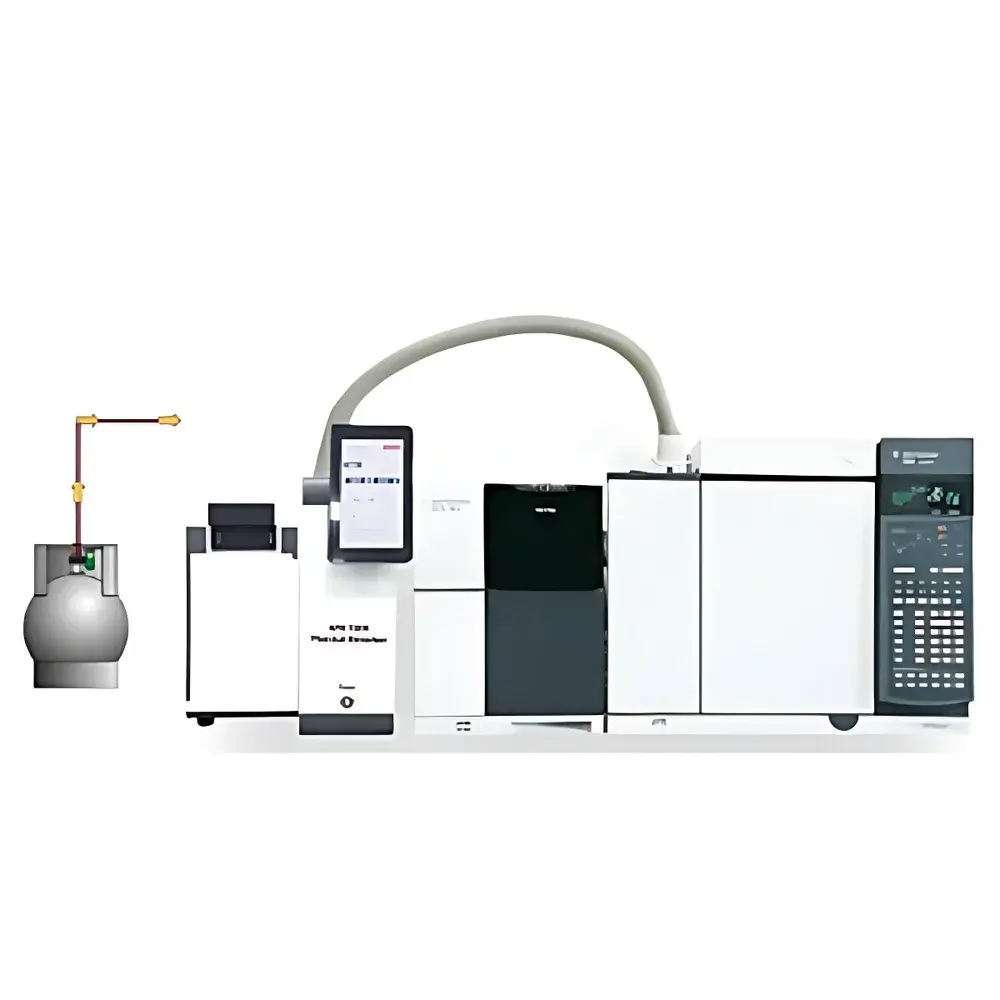
HUANKONG KHK650A Environmental Air VOCs Online Monitoring System
| Brand | HUANKONG |
|---|---|
| Origin | Shandong, China |
| Manufacturer Type | Direct Manufacturer |
| Country of Origin | China |
| Model | KHK650A |
| Detection Principle | Capillary Gas Chromatography (GC) |
| Instrument Type | Online Analytical System |
| Typical Configuration | Multi-Compound VOC Monitor |
| Detection Range | Customizable per application (ppb–ppt range) |
| Resolution | 1 ppb |
| Accuracy | ±1% of reading |
| Response Time | 1–60 min (method-dependent) |
| Compliance Standards | EPA TO-14A, EPA TO-15, EPA TO-17, EPA PAMS |
Overview
The HUANKONG KHK650A Environmental Air VOCs Online Monitoring System is a fully automated, laboratory-grade continuous emission monitoring solution engineered for unattended, real-time quantification of volatile organic compounds (VOCs), sulfur-containing species, and greenhouse gases—including sulfur hexafluoride (SF₆)—in ambient air. It operates on the principle of capillary gas chromatography coupled with selective detection (e.g., FID, PID, or ECD, configurable per user requirements), delivering high-resolution separation and trace-level sensitivity in compliance with U.S. Environmental Protection Agency (EPA) reference methods TO-14A, TO-15, TO-17, and the Photochemical Assessment Monitoring Stations (PAMS) protocol. Designed for fixed-site deployment at regulatory monitoring stations, industrial fenceline locations, and urban air quality networks, the system integrates sample acquisition, cryogenic or thermal desorption preconcentration, GC separation, detection, data processing, and remote telemetry into a single robust architecture. All wetted components—including sampling lines, valves, traps, and transfer tubing—are constructed from SilcoSteel®—a passivated stainless-steel surface treatment proven to minimize adsorption, catalytic degradation, and memory effects for reactive and polar VOCs such as aldehydes, ketones, and sulfur compounds.
Key Features
- Fully automated operation: No manual intervention required for sampling, calibration, analysis, or maintenance scheduling; supports 24/7 unattended monitoring.
- Ultra-low detection capability: Achieves sub-ppb detection limits for over 100 target VOCs, with method-specific sensitivity extending into the low-ppt range for selected compounds.
- Modular detector compatibility: Configurable with flame ionization detection (FID), photoionization detection (PID), electron capture detection (ECD), or mass spectrometry (MS) interfaces to meet compound-class-specific selectivity and regulatory reporting needs.
- Inert flow path: SilcoSteel®-lined sample pathways ensure chemical stability and reproducibility across extended run times—even for highly reactive species including hydrogen sulfide (H₂S), carbonyl sulfide (COS), and mercaptans.
- Integrated calibration management: Built-in multi-point standard gas delivery system with dynamic dilution capabilities; supports automated daily zero/span verification and drift correction per EPA QA/QC protocols.
- Remote diagnostics & control: Web-enabled HMI with secure TLS-encrypted communication; supports SNMP, Modbus TCP, and MQTT for integration into central SCADA or environmental data management platforms.
Sample Compatibility & Compliance
The KHK650A is validated for ambient air matrices meeting ISO 16000-6 and ASTM D5197 requirements for indoor/outdoor VOC sampling. It complies with key regulatory frameworks governing air quality monitoring in North America and the EU, including but not limited to: EPA Method TO-14A (summed hydrocarbons), TO-15 (canister-based VOC analysis), TO-17 (sorbent tube thermal desorption), and PAMS speciation requirements for ozone precursor tracking. The system’s hardware and firmware architecture supports audit-ready data integrity in accordance with 21 CFR Part 11 (electronic records/signatures) when paired with compliant software configurations. All calibration standards, certified reference materials, and operational logs are traceable to NIST-traceable sources. System validation reports include MDL (Method Detection Limit), IDL (Instrument Detection Limit), precision (RSD ≤5% for replicate injections), and recovery (85–115%) across the target analyte list.
Software & Data Management
The embedded analytical software provides full method development, sequence programming, real-time chromatogram visualization, peak integration, library matching, and automated report generation. Raw chromatographic data (including baseline-corrected signals, retention time tables, and spectral snapshots) are stored in vendor-neutral formats (e.g., ANDI/NetCDF) compatible with third-party LIMS and ELN systems. Audit trails record all user actions, parameter changes, calibration events, and instrument status transitions with timestamps and operator IDs. Data export supports CSV, XML, and EPA-compliant AQS-2000 format for direct ingestion into state/federal air quality databases (e.g., AQS, EEA AirBase). Optional cloud-hosted data dashboard enables GIS-mapped concentration overlays, trend analytics, exceedance alerts, and customizable KPI dashboards aligned with WHO and EU Air Quality Directive thresholds.
Applications
- Ambient air quality monitoring networks (urban, rural, background sites)
- Industrial fenceline and community air monitoring programs (CAMPs)
- Landfill and wastewater treatment plant emissions surveillance
- Chemical manufacturing and semiconductor fabrication facility compliance reporting
- Research studies on VOC speciation, ozone formation potential, and secondary organic aerosol (SOA) precursors
- Calibration and validation support for remote sensing instruments (e.g., DOAS, FTIR)
FAQ
What regulatory methods does the KHK650A support?
The system is configured to execute EPA TO-14A, TO-15, TO-17, and PAMS methodologies out-of-the-box, with optional firmware upgrades for ISO 16000-6 and EN 14662 compliance.
Can the KHK650A interface with third-party GC systems?
Yes—the system features standardized analog/digital I/O and Ethernet-based command protocols (SCPI-compatible) to synchronize with external GCs from Agilent, Thermo Fisher, Shimadzu, and other major vendors.
Is the system suitable for unheated outdoor installation?
It is rated for operation in –20 °C to +50 °C ambient environments; optional climate-controlled enclosures with NEMA 4X-rated housings are available for harsh outdoor deployments.
How is data security and integrity ensured?
All data transmissions use TLS 1.2+ encryption; local storage employs write-once-read-many (WORM) partitioning; electronic signatures and audit trails comply with FDA 21 CFR Part 11 and EU Annex 11 requirements when deployed in GLP/GMP-regulated contexts.
What maintenance intervals are recommended?
Preventive maintenance is scheduled every 90 days, including trap regeneration, GC column conditioning, leak checks, and detector performance verification—fully documented in the integrated maintenance log.







