
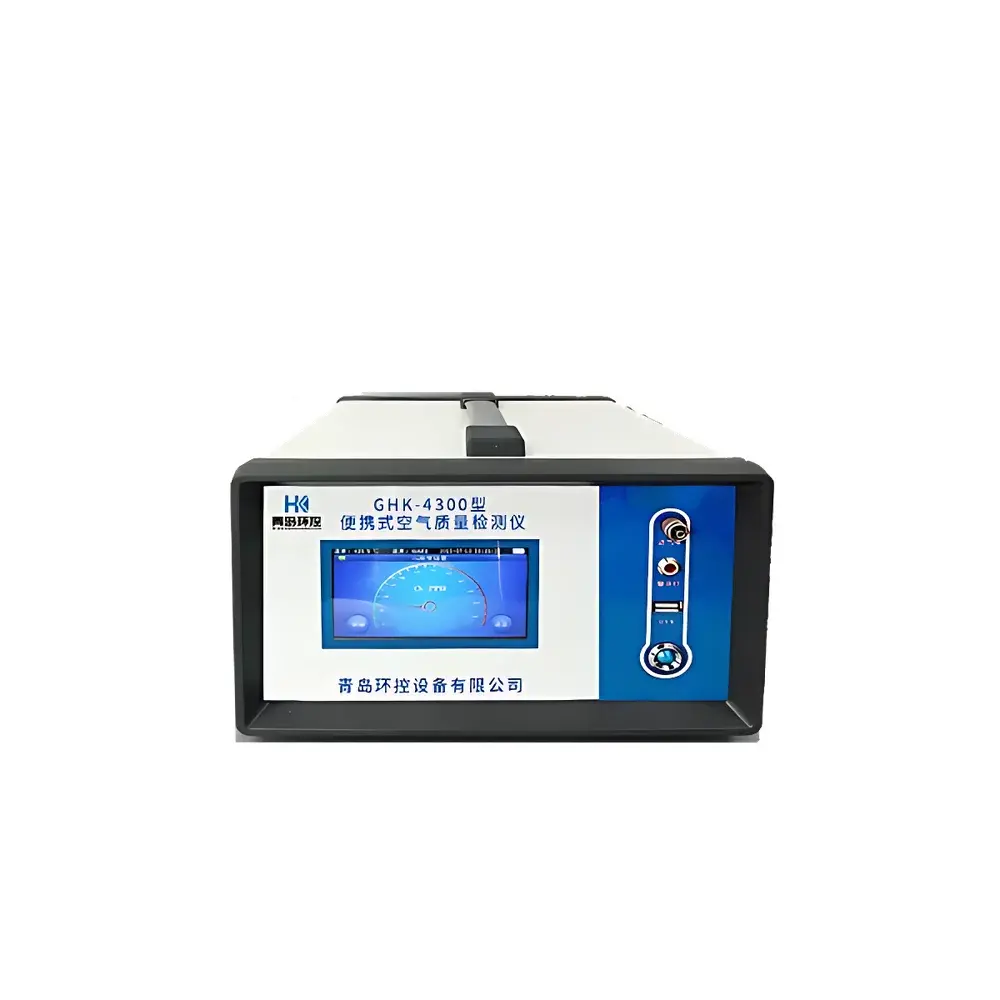
HUANKONG GHK-4300 Portable Air Quality Monitor
| Brand | HUANKONG |
|---|---|
| Model | GHK-4300 |
| Origin | Shandong, China |
| Manufacturer Type | Direct Manufacturer |
| Instrument Type | Portable Multicomponent Gas & Particulate Analyzer |
| Measured Parameters | NO₂, O₃, CO, CO₂, VOCs, PM₁₀, PM₂.₅ |
| Repeatability | ≤±2% FS (typical for electrochemical & NDIR sensors |
| Display | Color TFT Touchscreen |
| Power | Rechargeable Li-ion Battery (≥48 h continuous operation) |
| Data Storage | ≥5,000 measurement records |
| Communication Interfaces | USB 2.0, RS-232, optional Bluetooth 5.0, optional LTE/4G wireless module |
| Environmental Compensation | Integrated temperature & humidity sensing with real-time algorithmic correction |
| Operating Temperature Range | −20 °C to +50 °C (with auto-heating function below −10 °C) |
| Compliance | GB/T 18204.2–2014, GBZ/T 300.37–2017, GB/T 18204.23–2000, GB/T 18204.24–2000, GB/T 18883–2022 |
Overview
The HUANKONG GHK-4300 Portable Air Quality Monitor is an integrated, field-deployable multicomponent analyzer engineered for real-time, on-site assessment of ambient air quality across regulatory, industrial hygiene, and environmental research applications. It employs a hybrid sensor architecture combining electrochemical cells (for NO₂, O₃, CO), non-dispersive infrared (NDIR) detection (for CO₂), photoionization detection (PID) with 10.6 eV lamp (for total VOCs), and laser scattering photometry (per ISO 21501-4 principles) for simultaneous quantification of PM₂.₅ and PM₁₀ mass concentrations. Meteorological parameters—including ambient temperature and relative humidity—are concurrently measured using calibrated digital sensors, enabling dynamic compensation of gas and particulate readings in accordance with thermodynamic and hygroscopic correction models specified in GB/T 18883–2022 and ISO 8573-1. Designed for operational flexibility, the GHK-4300 supports both point-source screening and mobile monitoring via vehicle-mounted deployment (walk-through or drive-by surveys), fulfilling requirements for rapid response in industrial parks, emission hotspots, urban roadside zones, and indoor occupational environments.
Key Features
- Integrated color TFT touchscreen interface with intuitive icon-driven navigation—no external PC required for basic operation or data review
- Field-rugged, all-in-one mechanical design with IP54-rated enclosure for dust and splash resistance during outdoor use
- Onboard rechargeable lithium-ion battery providing ≥48 hours of continuous operation under typical sampling conditions (1-min averaging interval, 25 °C)
- Automatic power-fail recovery: all active measurements and timestamps are preserved in non-volatile memory during unexpected shutdown
- Dual-unit display and conversion: seamless switching between ppm, mg/m³, and µg/m³ for gaseous analytes; µg/m³ for PM fractions
- Real-time environmental compensation: integrated temperature/humidity sensors feed into embedded algorithms that correct sensor drift and optical scattering bias per ISO 17025 traceability guidelines
- Auto-heating function activates below −10 °C to maintain optical path stability and electrochemical cell performance in sub-zero climates
- Comprehensive diagnostics: self-test at startup and continuous health monitoring of all sensor modules with audible/visual fault alerts
- Expandable connectivity: standard USB 2.0 and RS-232 ports for direct PC synchronization; optional Bluetooth 5.0 for wireless data export; optional LTE/4G module for cloud-based telemetry and remote firmware updates
Sample Compatibility & Compliance
The GHK-4300 is validated for direct aspiration of ambient, indoor, and workplace air without pre-concentration or dilution. Its sensor configuration aligns with national Chinese standards for regulatory compliance: GB/T 18204.2–2014 (public health chemical pollutants), GBZ/T 300.37–2017 (occupational CO/CO₂ exposure limits), GB/T 18204.23–2000 and GB/T 18204.24–2000 (CO/CO₂ methodology), and GB/T 18883–2022 (indoor air quality benchmarks). While not certified to EU CE or US EPA equivalency protocols, its measurement ranges and repeatability meet minimum technical thresholds defined in ISO 8573-1 (compressed air purity) and ISO 21501-4 (particle sizing accuracy). Data integrity is maintained through timestamped logging and internal audit trail functionality, supporting GLP-aligned documentation workflows.
Software & Data Management
Data acquisition and post-processing are managed via the proprietary HUANKONG AQ-Link desktop software (Windows 10/11 compatible), which enables calibration curve management, statistical summary generation (min/max/avg/std dev), geotagged reporting, and batch export to CSV or PDF. All stored records include full metadata: date/time stamp, GPS coordinates (when external GNSS module attached), sensor status flags, and environmental correction coefficients. The instrument logs raw sensor outputs alongside compensated values, facilitating retrospective reprocessing if updated calibration parameters become available. For enterprise integration, the RS-232 and optional LTE interfaces support Modbus RTU and HTTP(S) RESTful API protocols, enabling ingestion into SCADA systems, LIMS platforms, or custom dashboards compliant with FDA 21 CFR Part 11 requirements for electronic records.
Applications
- Rapid-response air quality assessment in industrial accident scenarios or fugitive emission investigations
- Mobile monitoring campaigns: vehicle-mounted drive-by mapping of NO₂, PM₂.₅, and VOC gradients across urban corridors
- Workplace exposure evaluation in manufacturing, painting, welding, and solvent-handling facilities per GBZ/T 300 series
- Indoor air quality audits in schools, hospitals, and office buildings against GB/T 18883–2022 thresholds
- Baseline ambient monitoring for environmental impact assessments (EIAs) and permitting applications
- Research-grade field studies requiring synchronized multi-parameter time-series data under variable climatic conditions
FAQ
What calibration standards does the GHK-4300 support?
The instrument accepts zero and span calibration using certified gas cylinders (e.g., 100 ppm CO in N₂) and aerosol generators (e.g., Arizona Test Dust for PM verification). Calibration intervals follow manufacturer-recommended schedules (every 90 days for gases, every 180 days for PM sensors) or site-specific QA/QC protocols.
Is the device suitable for outdoor long-term unattended operation?
While optimized for portable and semi-permanent deployments (e.g., tripod-mounted for 72-hr surveys), it is not rated for fully autonomous, year-round outdoor installation without sheltering or climate-controlled enclosures.
Can measurement data be synchronized with third-party cloud platforms?
Yes—via the optional LTE/4G module, raw data streams can be transmitted to MQTT brokers or HTTPS endpoints using configurable payload schemas, enabling interoperability with AWS IoT Core, Microsoft Azure IoT Hub, or custom middleware.
Does the GHK-4300 provide uncertainty estimates for each parameter?
Uncertainty budgets are provided in the factory calibration certificate and reflect combined standard uncertainties from sensor sensitivity, environmental compensation residuals, and analog-to-digital conversion—typically ±3.5% for CO, ±4.2% for PM₂.₅ (k=2, 95% confidence).
Related Products







