
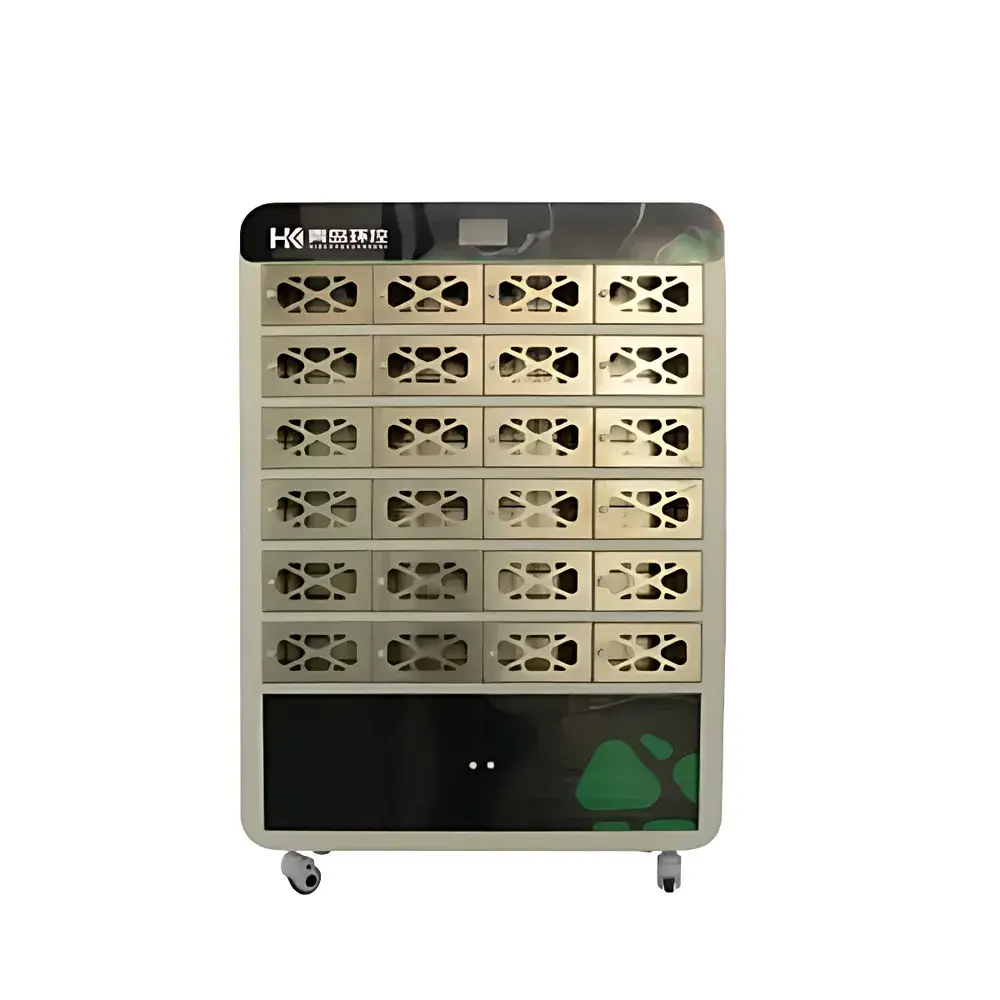
HUANKONG GHD-GZ24 Soil Drying Cabinet
| Brand | HUANKONG |
|---|---|
| Origin | Shandong, China |
| Manufacturer Type | Direct Manufacturer |
| Country of Origin | China |
| Model | GHD-GZ24 |
| Sample Capacity | 12 / 24 / 36 positions (configurable) |
| Operating Environment | 15–35 °C, 20–90% RH |
| Chamber Dimensions (W×D×H) | 200 × 120 × 300 mm |
| Heating & Air Circulation | Dual-mode (chamber heating + conditioned air convection) |
| Humidity & Temperature Control | Independent setpoint control for drying air (temperature and RH) |
| Air Treatment | Integrated desiccant-based dehumidification, HEPA + activated carbon filtration |
| Airflow Design | Dual-path low-velocity air distribution with turbulence modulation |
| Control Interface | Touchscreen HMI with real-time parameter logging |
| Drying Modes | Continuous mode and intelligent adaptive mode (with time-stamped environmental logging) |
| Construction | 304 stainless steel sample compartments |
| Noise Level | <45 dB(A) |
| Compliance | Designed per ISO 11464:2021 (soil sampling and handling), aligned with ASTM D422–20 (particle-size analysis prep), and supports GLP-compliant data integrity requirements |
Overview
The HUANKONG GHD-GZ24 Soil Drying Cabinet is an engineered environmental conditioning system designed specifically for the standardized pre-treatment of soil samples prior to physicochemical analysis. It implements a dual-mode drying principle—combining controlled chamber heating with precisely regulated, filtered, and conditioned airflow—to replicate natural air-drying conditions under reproducible laboratory settings. Unlike conventional ovens or desiccators, the GHD-GZ24 avoids thermal degradation by maintaining sample temperatures within ambient-relevant ranges (typically 20–40 °C), while actively managing relative humidity (RH) of the drying medium between 10% and 70%. This approach ensures minimal alteration of soil structure, organic matter content, moisture-sensitive mineral phases, and trace element speciation—critical for compliance with ISO 11464:2021, which mandates representative sample stabilization without biasing analytical outcomes.
Key Features
- Dual-path air management system: Two independent airflow circuits simulate laminar indoor air movement and gentle convective exchange, minimizing particle resuspension and cross-contamination.
- Real-time environmental monitoring: Integrated sensors continuously log drying air temperature, RH, and elapsed time; data are timestamped and exportable via USB interface.
- Modular sample architecture: Stainless steel (AISI 304) sample compartments—available in 12-, 24-, or 36-position configurations—provide chemical inertness, corrosion resistance, and zero organic adsorption.
- Conditioned air generation: Air passes sequentially through desiccant dehumidification, precision heating elements, and a dual-stage filtration unit (HEPA H13 + granular activated carbon), ensuring particulate-free, VOC-scrubbed drying gas.
- Intelligent drying logic: The “Smart Mode” dynamically adjusts airflow rate and RH setpoints based on real-time chamber feedback, optimizing drying kinetics while preserving sample integrity.
- Low-noise operation: Engineered static-air diffusion design maintains acoustic emissions below 45 dB(A), suitable for shared laboratory environments without acoustic isolation.
Sample Compatibility & Compliance
The GHD-GZ24 accommodates a broad spectrum of soil matrices—including clay-rich, organic, saline, heavy-metal-contaminated, and volatile organic compound (VOC)-bearing samples—without compromising analyte stability. Each compartment operates as a physically isolated microenvironment, eliminating inter-sample vapor-phase migration. The cabinet’s construction and airflow design conform to ISO 11464:2021 requirements for sample homogenization and drying, and its operational parameters support method validation under ASTM D422–20 (grain-size analysis) and EPA Method 5035A (soil VOC preservation). While not a certified GLP instrument per se, its audit-ready data logging (with user ID, timestamps, and parameter history) enables full traceability required for regulatory submissions under US EPA, EU CLP, and national environmental testing accreditation schemes.
Software & Data Management
The embedded touchscreen HMI provides intuitive configuration of drying profiles—including target temperature (±0.5 °C accuracy), RH setpoint (±3% RH), duration, and mode selection (Continuous or Smart). All operational events—including power cycles, setpoint changes, alarm triggers, and sensor readings—are stored locally with ISO 8601 timestamps. Data export is supported in CSV format via USB 2.0 port; no proprietary software or cloud dependency is required. For laboratories operating under 21 CFR Part 11, the system supports manual audit trail documentation—though electronic signature functionality is not integrated. Future firmware updates may introduce optional Ethernet connectivity for centralized lab management systems (LIMS integration via Modbus TCP).
Applications
- Preparation of soil samples for XRF, ICP-MS, and AAS elemental analysis where moisture-induced signal drift must be eliminated.
- Stabilization of field-moist soils prior to sieve analysis, Atterberg limits testing, or compaction studies (ASTM D698/D1557).
- Controlled drying of contaminated soils for TCLP extraction (EPA Method 1311) and leachate characterization.
- Conditioning of reference materials and proficiency test samples under documented, repeatable environmental conditions.
- Research applications requiring comparative drying kinetics across soil types—enabled by synchronized multi-position monitoring and identical boundary conditions.
FAQ
Does the GHD-GZ24 meet ISO or ASTM standards for soil drying?
Yes—the cabinet’s operational envelope and design principles align with ISO 11464:2021 and support sample preparation workflows referenced in ASTM D422–20, D2216, and EPA guidance documents.
Can I dry samples with volatile organic compounds (VOCs) without loss?
The low-velocity, non-turbulent airflow and absence of forced hot-air jets minimize VOC volatilization; however, for EPA Method 5035A compliance, cold trapping or immediate post-drying analysis is recommended.
Is calibration certification available?
NIST-traceable temperature and RH sensor calibration reports can be provided upon request; annual verification is advised per ISO/IEC 17025 laboratory quality requirements.
What maintenance is required?
Desiccant cartridges require replacement every 6–12 months depending on ambient humidity load; HEPA and carbon filters should be inspected quarterly and replaced annually or after 2,000 operating hours.
Can the unit be integrated into a LIMS?
Native LIMS integration is not built-in, but timestamped CSV logs can be parsed programmatically; optional Modbus TCP firmware upgrade enables industrial protocol compatibility.







