
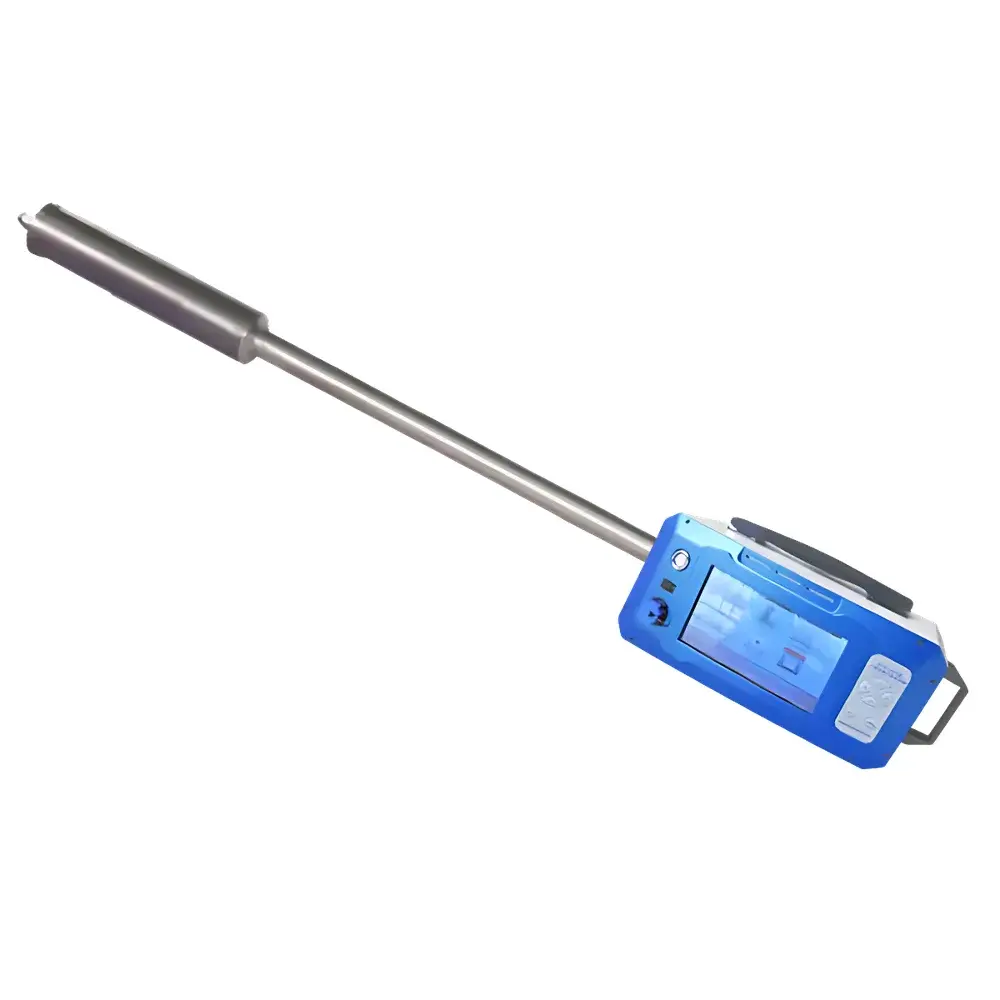
HUANKONG GHK-2000 Integrated Flue Gas Sampler
| Brand | HUANKONG |
|---|---|
| Origin | Shandong, China |
| Manufacturer Type | Manufacturer |
| Country of Origin | Domestic (China) |
| Model | GHK-2000 |
| Instrument Type | Flue Gas Sampler |
| Sample Type | Flue Gas |
| Sampling Flow Rate | 0.1–1.5 L/min |
| Flue Gas Velocity | 1–45 m/s |
| Moisture Content Range | 0–60% |
Overview
The HUANKONG GHK-2000 Integrated Flue Gas Sampler is an engineered field-deployable instrument designed for regulatory-compliant sampling of flue gas emissions from stationary sources. It operates on the principle of isokinetic sampling combined with solution absorption and sorbent tube-based capture—enabling simultaneous collection of gaseous pollutants (e.g., SO₂, NOₓ, HCl) and elemental/oxidized mercury species. The system integrates real-time measurement of critical stack gas parameters—including temperature, static/dynamic pressure, volumetric flow velocity, moisture content (by chilled-mirror dew point method), and oxygen concentration—ensuring accurate normalization of sample volumes to standard conditions (dry, 273.15 K, 101.325 kPa). Its compact, all-in-one architecture eliminates inter-unit cabling and alignment complexity typical of modular sampling systems, significantly reducing setup time and field calibration drift.
Key Features
- Monolithic design integrating sampling probe, conditioning module, dual independent high-vacuum pumps, and control unit—total mass < 8.5 kg, dimensions ≤ 380 × 220 × 180 mm
- Full-length heated sampling probe (up to 200 °C) fabricated from aerospace-grade titanium alloy (Grade 2), resistant to thermal shock, acid corrosion, and particulate abrasion
- Two-stage moisture management: Peltier-cooled condensate trap (−5 °C to +5 °C adjustable) followed by Nafion® membrane dryer, achieving dew point suppression to ≤ −10 °C without desiccant replacement
- Dual-channel sampling capability: Channel A for aqueous absorption (impingers or bubblers), Channel B for thermal-desorption-compatible sorbent tubes (e.g., gold-coated quartz, activated carbon), each with independent flow control and leak-check diagnostics
- Isokinetic flow control algorithm automatically adjusts pump speed based on real-time pitot tube velocity readings to maintain ±5% isokinetic deviation across 1–45 m/s velocity range
- Embedded rechargeable Li-ion battery (≥4.5 h continuous operation at 1.0 L/min, 200 °C probe heat), with AC/DC universal input (100–240 VAC, 50/60 Hz)
- Industrial-grade 7-inch capacitive touchscreen (1000 cd/m² brightness, −20 °C to +60 °C operational range) supporting glove-compatible touch and physical button redundancy
- Automatic pre-sampling purge cycle (configurable duration: 0–120 s) to evacuate dead volume and ensure representative sample acquisition
- Power-fail recovery with non-volatile memory retention—resumes interrupted sampling sequences with timestamp continuity and metadata integrity
Sample Compatibility & Compliance
The GHK-2000 meets the instrumental requirements of multiple internationally referenced methods, including EPA Method 30B (determination of total gaseous mercury using sorbent traps), HJ 917–2017 (mercury analysis via activated carbon adsorption/thermal desorption-AAS), HJ/T 47–1999 (technical specifications for flue gas samplers), GB/T 16157–1996 (particulate and gaseous pollutant sampling in exhaust ducts), and HJ/T 397–2007 (field monitoring protocols for stationary sources). It supports sampling of acidic gases (HCl, HF, SO₂), nitrogen oxides (NO, NO₂), volatile organic compounds (VOCs), and oxidized/elemental mercury species under both dry and high-moisture (≤60% v/v) flue gas conditions. Probe materials and internal wetted surfaces comply with ASTM D6784–22 (Ontario Hydro Method compatibility) and ISO 12141:2021 (sampling system material certification for trace metal analysis).
Software & Data Management
Firmware v3.2 provides embedded data logging with ≥100,000 measurement records stored in encrypted SQLite database (timestamped, GPS-tagged if external module connected). All calibrations (flow, pressure, temperature, O₂ sensor) are traceable to NIST-traceable standards and recorded with audit trail (user ID, action, timestamp, pre/post values). Data export supports CSV and XML formats via USB 2.0 host interface; optional Bluetooth 5.0 enables wireless telemetry to certified laboratory information management systems (LIMS). The system enforces ALCOA+ principles (Attributable, Legible, Contemporaneous, Original, Accurate, Complete, Consistent, Enduring, Available) and supports 21 CFR Part 11-compliant electronic signatures when paired with validated third-party LIMS integration.
Applications
- Regulatory compliance monitoring at coal-fired power plants, waste incinerators, cement kilns, and chemical manufacturing stacks
- Source testing for mercury emissions inventories under national and regional cap-and-trade programs
- Method validation studies comparing sorbent trap vs. continuous emission monitoring system (CEMS) performance
- Stack characterization during boiler tuning, scrubber efficiency assessment, and selective catalytic reduction (SCR) optimization
- Field verification of particulate matter (PM₂.₅/PM₁₀) co-sampling train integrity prior to gravimetric analysis
- Mobile source emissions profiling using portable stack adapters and dilution tunnel interfaces
FAQ
Does the GHK-2000 support isokinetic sampling correction in real time?
Yes—the integrated pitot tube array and differential pressure transducer continuously feed velocity data to the onboard controller, which dynamically modulates pump speed to maintain isokinetic ratio within ±5% tolerance per HJ/T 397–2007.
Can the instrument store calibration certificates and user-defined method templates?
Yes—calibration history, certificate scans (PDF), and customizable sampling protocols (e.g., “EPA 30B Mercury”, “HJ 917–2017 Acid Gases”) are stored in protected firmware partitions with version control.
Is the titanium probe compatible with sulfuric acid-laden flue gas at 180 °C?
Yes—Grade 2 titanium exhibits proven resistance to concentrated H₂SO₄ up to 200 °C under oxidizing conditions, as verified per ASTM G31 immersion testing and field deployments in refinery FCC units.
How is data integrity ensured during extended unattended operation?
All logged parameters include CRC-32 checksums; file system uses journaling FAT32 with wear-leveling algorithms; unexpected power loss triggers immediate write-to-flash commit of last 10 s of buffered data.
Does the system provide traceable flow calibration against primary standards?
Yes—each unit ships with factory calibration report referencing NIST SRM 2197 (critical flow venturi) and ISO 6145–2 (dynamic volumetric calibration), valid for 12 months under normal use.







