
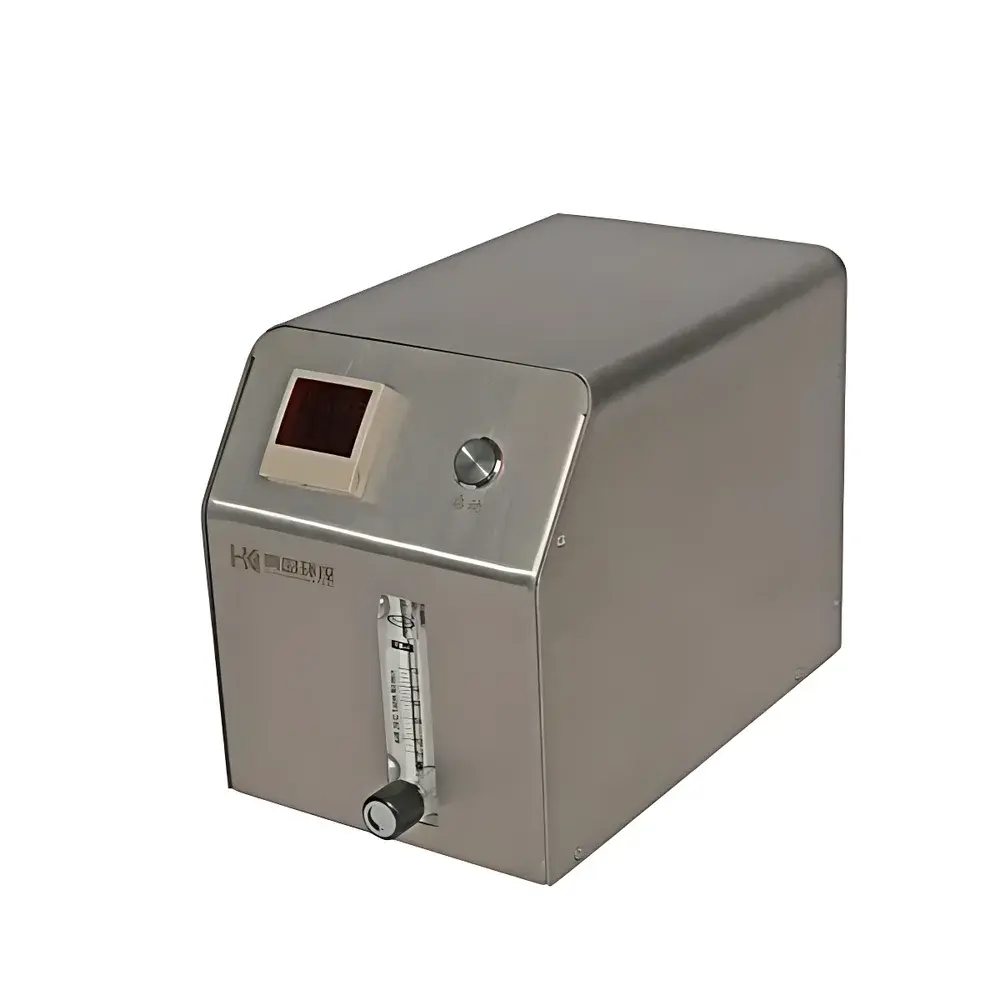
Summa Canister Autosampler GHD-5000
| Brand | HUANKONG |
|---|---|
| Origin | Shandong, China |
| Manufacturer Type | OEM Manufacturer |
| Instrument Type | GC Autosampler for Summa Canisters and Tedlar Bags |
| Model | GHD-5000 |
| Maximum Sample Capacity | Configurable (Standard: 1–12 canisters/bags) |
| Motion Control | Fully Automated Stepper-Motor-Driven Carousel |
| Repeat Injection Capability | Unlimited cycles with programmable sequence logic |
| Filtration Module | Integrated PTFE-membrane particulate filter (0.5 µm) |
| Carrier Gas Flow Range | 10–500 mL/min (N₂ or He, ±2% full-scale accuracy) |
| Sampling Line Material | SilcoNert®-coated stainless steel tubing |
| Backflow Prevention | Dual-stage check valve assembly |
| Housing Material | 316L stainless steel |
| Power Consumption | <45 W |
| Interface | RS-232 + Analog 0–10 V output |
Overview
The Summa Canister Autosampler GHD-5000 is a laboratory-grade, fully automated sampling interface engineered for direct, quantitative transfer of volatile organic compounds (VOCs) from electropolished stainless steel Summa canisters or fluorinated ethylene propylene (FEP) gas bags into gas chromatography (GC) or gas chromatography–mass spectrometry (GC–MS) systems. It operates on a pressure-balanced, constant-flow purge-and-trap principle: sample gas is drawn through a calibrated, inert quantitative loop (standard 10–100 mL volume, user-selectable) using a precision diaphragm pump coupled with a thermally stabilized critical orifice or laminar flow controller. This architecture ensures stoichiometric transfer fidelity—critical for regulatory compliance in ambient air monitoring, industrial hygiene, and EPA Method TO-14A/TO-15 applications. Unlike manual canister purging, the GHD-5000 eliminates operator-induced variability in flow rate, dwell time, and backpressure management, thereby improving inter-laboratory reproducibility and reducing analytical uncertainty in quantitation of C₂–C₁₂ hydrocarbons, halocarbons, and oxygenates.
Key Features
- Fully automated carousel-based handling supporting up to 12 Summa canisters (6-L standard) or FEP gas bags (1–10 L), with programmable injection sequence and delay intervals.
- Inert fluid path constructed from SilcoNert®-treated 316L stainless steel tubing and Swagelok® VCR fittings—validated for <0.1 ng/m³ adsorption loss of benzene, chloroform, and 1,3-butadiene per ASTM D6196 Annex A2.
- Integrated dual-stage non-return valve system prevents reverse diffusion during venting or standby, preserving sample integrity within the canister across repeated use cycles.
- Real-time digital flow control via closed-loop feedback: mass flow sensor (±1% reading, NIST-traceable calibration) modulates pump speed and orifice resistance to maintain setpoint stability within ±2% over ambient temperature range (10–35 °C).
- Front-panel LED display with programmable timer and cycle counter; supports timed injections (1 s–99 min resolution) and multi-step protocols (e.g., pre-purge → fill loop → pressurize → inject → bake-out).
- Low-power design (<45 W nominal) enables field deployment with portable power supplies; no external cooling or compressed air required.
- Modular filtration stage includes a replaceable 0.5 µm PTFE membrane filter upstream of the quantitative loop—removes particulates and aerosols without altering VOC composition.
Sample Compatibility & Compliance
The GHD-5000 is validated for use with EPA-certified Summa canisters (cat. #007241, Restek) and ASTM D6196-compliant FEP gas bags. It meets the mechanical and operational requirements of U.S. EPA Methods TO-14A (Determination of Volatile Organic Compounds [VOCs] in Ambient Air Using Summa Canisters and Gas Chromatography/Mass Spectrometry) and TO-15 (same, with improved sensitivity). All wetted surfaces comply with USP extractables testing criteria for metallic leachables (<0.1 ppm Ni, Cr, Fe). The instrument’s firmware supports audit trail logging per FDA 21 CFR Part 11 when interfaced with compliant LIMS or GC data systems—recording user ID, timestamp, method parameters, and error flags for each injection event.
Software & Data Management
While the GHD-5000 operates as a standalone hardware module, it provides native integration via RS-232 serial protocol and analog 0–10 V output for synchronization with Agilent, Thermo Fisher, Shimadzu, and PerkinElmer GC platforms. Optional PC software (Windows 10/11, .NET 6.0 runtime) enables method storage, batch scheduling, real-time flow monitoring, and CSV export of run logs—including flow deviation alerts, valve actuation timestamps, and filter usage counters. All configuration changes are logged with ISO 8601 timestamps and SHA-256 hashed user credentials to support GLP/GMP audit readiness.
Applications
- Ambient air quality monitoring networks (e.g., EPA Photochemical Assessment Monitoring Stations [PAMS], NCore sites)
- Industrial fence-line VOC emission verification per 40 CFR Part 63 Subpart HHHHH
- Indoor air quality (IAQ) assessments in commercial buildings and cleanrooms
- Method development and validation labs requiring trace-level VOC recovery studies
- Mobile laboratory deployments for emergency response (e.g., chemical release incidents)
- Calibration gas preparation workflows involving dynamic dilution of primary standards
FAQ
Does the GHD-5000 support both positive-pressure and vacuum-driven canister sampling?
Yes—it accommodates both modes: passive venting under atmospheric pressure or active evacuation via integrated pump, configurable per method requirements.
Can the quantitative loop volume be customized beyond factory defaults?
Yes—loop volumes of 5 mL, 25 mL, 50 mL, and 100 mL are available as field-installable kits, each supplied with NIST-traceable volumetric certification.
Is the filtration module replaceable in the lab without tools?
Yes—the PTFE membrane cartridge features a quarter-turn bayonet mount and requires no torque wrench; replacement takes <60 seconds.
How is system leak integrity verified prior to analysis?
Built-in leak-check mode performs automated pressure hold test (5–30 psi, 5-min duration) with automatic pass/fail reporting and delta-P log export.
What maintenance schedule is recommended for long-term reliability?
Valve seals and pump diaphragms require replacement every 12 months or 5,000 cycles (whichever occurs first); all consumables are listed in the service manual with part numbers and shelf-life tracking guidance.





