
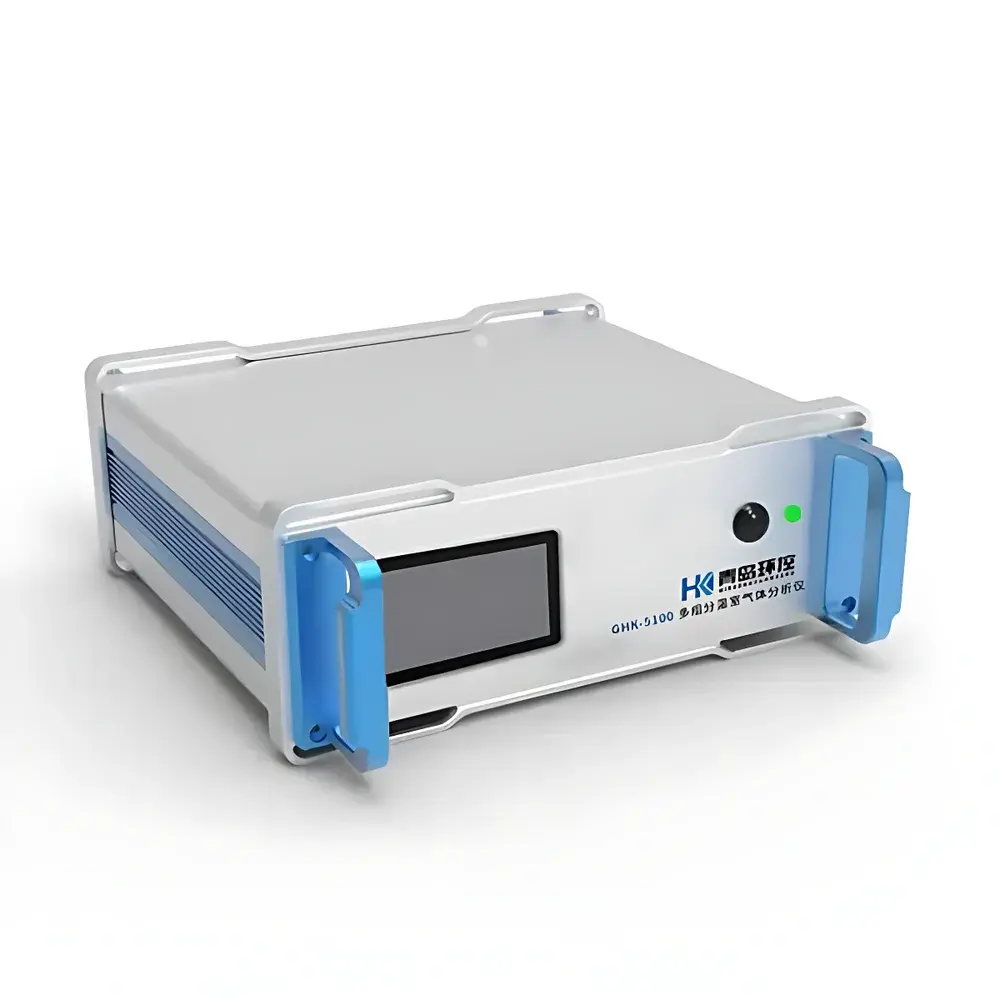
HUANKONG GHK-5100 Multi-Component Greenhouse Gas Analyzer
| Brand | HUANKONG |
|---|---|
| Origin | Shandong, China |
| Manufacturer Type | OEM Manufacturer |
| Country of Origin | China |
| Model | GHK-5100 |
| Price Range | USD 7,000 – 28,000 (FOB) |
| Measurement Principle | Tunable Diode Laser Absorption Spectroscopy (TDLAS) |
| Target Gases | CH₄ (0–100 ppm), CO₂ (0–2000 ppm), H₂O (optional) |
| Detection Limits | CH₄: 0.01 ppm |
| CO₂ | 0.1 ppm |
| Response Time | <3 s |
| Repeatability | ≤±3% FS |
| Accuracy | ±3% of reading |
| Operating Temperature Stability | Active thermal control of laser and absorption cell |
| Pressure Regulation | Integrated pressure stabilization algorithm |
| Sample Flow Control | Built-in diaphragm pump with closed-loop flow regulation |
| Compliance | Designed for field-deployable environmental monitoring per ISO 14064-1, EPA Method TO-15 (adapted), and EU Directive 2009/125/EC energy efficiency guidelines |
Overview
The HUANKONG GHK-5100 Multi-Component Greenhouse Gas Analyzer is a field-deployable, real-time optical gas analyzer engineered for high-sensitivity, selective quantification of methane (CH₄) and carbon dioxide (CO₂) in ambient air, stack emissions, and soil flux studies. It operates on the physical principle of Tunable Diode Laser Absorption Spectroscopy (TDLAS), a mature, physics-based technique that exploits the unique near-infrared (NIR) absorption fingerprints of target molecules. By scanning a narrow-linewidth distributed feedback (DFB) laser across a ro-vibrational transition band—specifically the ν₃ fundamental band of CH₄ at ~1653 nm and the 2ν₁+2ν₂+ν₃ combination band of CO₂ at ~2004 nm—the instrument measures absorbance via Beer–Lambert law inversion. Unlike broadband NDIR or electrochemical sensors, TDLAS provides inherent immunity to cross-interference, zero drift, and long-term stability without frequent calibration. The GHK-5100 integrates all core subsystems—including temperature-stabilized DFB lasers, a 10-cm multi-pass Herriott-type absorption cell, a thermoelectrically cooled InGaAs photodetector, and a real-time digital signal processor—within a compact, ruggedized chassis optimized for unattended operation in outdoor or mobile monitoring environments.
Key Features
- Real-time, continuous measurement with response time <3 seconds (T₉₀), enabling dynamic flux tracking and rapid emission event detection
- Dual-gas capability (CH₄ and CO₂) with independent wavelength tuning; optional third-channel integration for H₂O vapor correction or custom gases (e.g., N₂O, CO) via additional laser modules
- Active thermal and pressure stabilization algorithms maintaining cavity temperature within ±0.05 °C and pressure within ±0.1 kPa—critical for minimizing spectral broadening and baseline drift
- Internal sample handling system featuring a brushless diaphragm pump, mass flow controller (MFC)-regulated inlet, and particulate filter (0.3 µm) to ensure consistent 0.5–1.0 L/min flow across variable backpressure conditions
- Modular architecture supporting OEM integration into UAV payloads, vehicle-mounted mobile labs, or fixed-site fence-line monitoring stations
- Low power consumption (<12 W typical), 12–24 V DC input, and IP54-rated enclosure suitable for industrial and environmental field use
Sample Compatibility & Compliance
The GHK-5100 accepts ambient air, flue gas (after dilution and particulate filtration), biogas (with moisture removal), and headspace samples from static chambers. Its optical path design eliminates catalytic or chemical degradation of analytes, preserving sample integrity. The analyzer meets functional requirements aligned with ISO 14064-1:2018 for greenhouse gas inventory verification, supports data traceability per ISO/IEC 17025:2017 (when operated under accredited lab protocols), and complies with the hardware-level energy efficiency provisions of EU Regulation No. 2009/125/EC. While not certified as a Class I, Division 1 hazardous area device, it includes intrinsic safety considerations such as current-limited laser drivers and spark-free pump electronics. All firmware logs include UTC timestamps, sensor health diagnostics, and raw absorbance spectra—enabling retrospective validation and GLP-compliant audit trails.
Software & Data Management
The GHK-5100 ships with HUANKONG GasView™ v3.2 firmware and PC-based configuration software supporting Windows 10/11 and Linux (Debian 11+). Data output is available via RS-232, RS-485 (Modbus RTU), Ethernet (TCP/IP), and optional 4G LTE modem. Each measurement packet contains CH₄ (ppm), CO₂ (ppm), H₂O (ppm), cell temperature (°C), cell pressure (kPa), laser current (mA), and signal-to-noise ratio (SNR). Raw spectral data (16-bit, 1024-point scans at 10 Hz) can be streamed for advanced spectral fitting using external tools (e.g., HITRAN-based line-by-line modeling). The embedded database retains >30 days of minute-averaged data with automatic rollover; export formats include CSV, NetCDF4, and XML compliant with EPA Air Quality System (AQS) metadata standards. Audit logs record all parameter changes, firmware updates, and calibration events with user ID and timestamp—supporting FDA 21 CFR Part 11 readiness when deployed in regulated carbon accounting workflows.
Applications
- Urban and rural ambient air quality networks for CH₄ hotspot identification and CO₂ background trend analysis
- Landfill and wastewater treatment plant fugitive emission monitoring per EPA Method 21 and ISO 16000-30
- Mobile mapping of pipeline leakage using vehicle-mounted configurations with GPS-synchronized concentration mapping
- Soil-atmosphere exchange studies using automated static chamber coupling and automated valve sequencing
- Verification of carbon capture utilization and storage (CCUS) site integrity through perimeter fence-line monitoring
- Emission factor development for IPCC Tier 2/Tier 3 reporting frameworks in agriculture, energy, and waste sectors
FAQ
What calibration standards are required for routine operation?
Primary calibration uses certified NIST-traceable gas standards (CH₄ in N₂, CO₂ in air) at two points (zero and span). A single-point daily zero check with synthetic air is recommended; full two-point calibration every 7–30 days depending on operating environment.
Can the GHK-5100 operate unattended for extended periods?
Yes—field deployments up to 90 days have been validated with integrated battery backup (optional) and remote firmware update capability via secure SSH tunnel.
Is spectral interference from water vapor corrected in real time?
Yes—H₂O concentration is either measured in parallel (with optional third laser) or estimated from dew point sensor input; its absorption contribution is subtracted during least-squares spectral fitting.
Does the analyzer support compliance with regulatory reporting requirements?
It provides the measurement performance and data integrity features necessary for Tier 2 reporting under ISO 14064 and EPA GHGRP; formal certification depends on site-specific QA/QC protocols and third-party validation.
What maintenance intervals are recommended?
Filter replacement every 3 months; laser alignment verification annually; full optical path inspection and cleaning every 24 months under normal operating conditions.
Related Products







