Lafayette 80600A-CP Five/Nine-Hole Operant Conditioning Chamber for Rats and Mice
| Brand | RWD |
|---|---|
| Origin | Shenzhen, China |
| Manufacturer Type | Original Equipment Manufacturer (OEM) |
| Country of Origin | China |
| Model | 80600A-CP |
| Pricing | Available Upon Request |
Overview
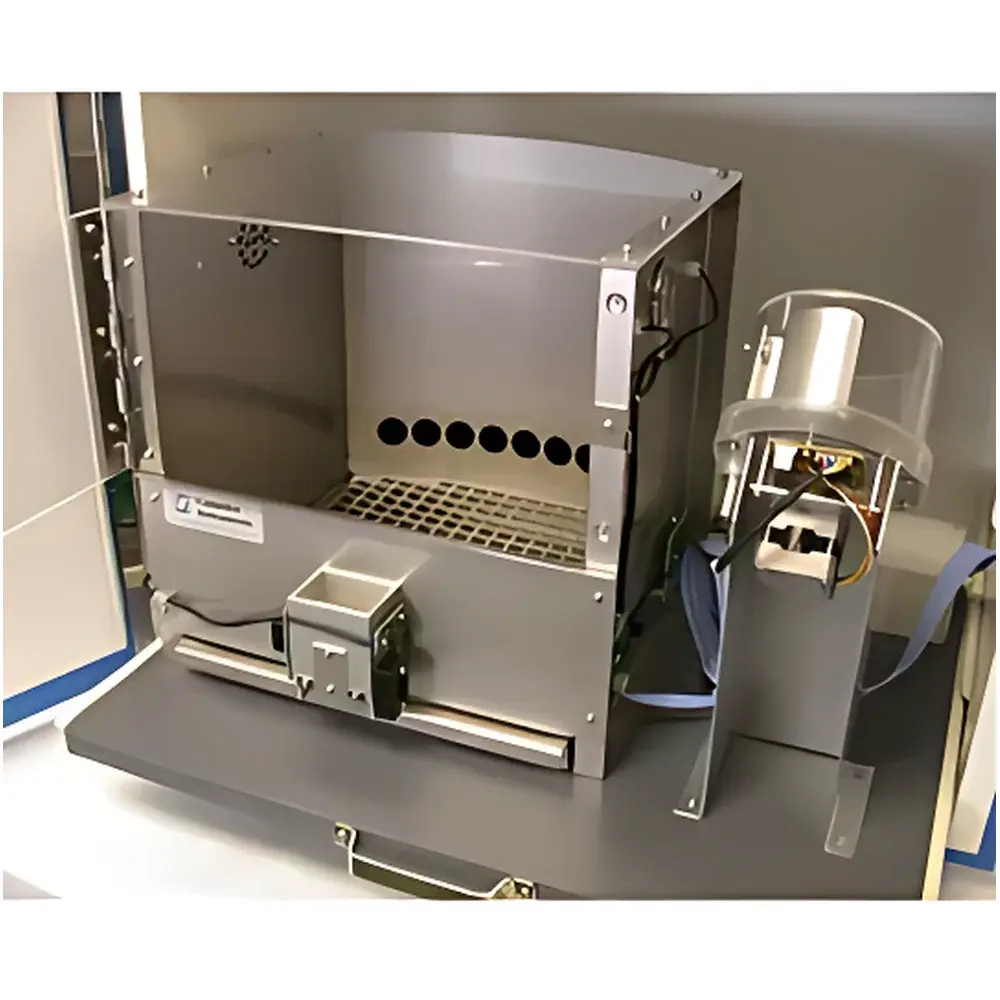
The Lafayette 80600A-CP Five/Nine-Hole Operant Conditioning Chamber is a rigorously engineered behavioral testing apparatus designed for translational neuroscience research in rodent models. Based on the well-established five-choice serial reaction time task (5-CSRTT) paradigm, this chamber implements operant conditioning principles grounded in Skinnerian learning theory—leveraging discrete stimulus presentation, precise response detection, and contingent reinforcement to quantify attentional capacity, response inhibition, impulsivity, and cognitive flexibility. The system operates via infrared nose-poke detection across nine spatially distributed apertures arranged along a curved front panel, each equipped with independently controllable LED visual stimuli and high-sensitivity photobeam interruption sensing. It supports both pellet-based (80600A-CP) and liquid-based (80600A-CL, 80610A-CP) reward delivery, enabling pharmacological, genetic, or lesion-based interrogation of neural circuits involving prefrontal cortex, basal forebrain, cholinergic, serotonergic, noradrenergic, and dopaminergic systems. Integrated white noise generation and programmable dimming provide standardized sensory masking—critical for minimizing external cue interference and ensuring inter-laboratory reproducibility in studies of Alzheimer’s disease, schizophrenia, depression, Huntington’s disease, ADHD, and OCD.
Key Features
- Acoustically insulated and light-isolated chamber housing, constructed from stainless steel and optical-grade polycarbonate for durability, optical clarity, and ease of decontamination
- Curved front panel with nine precisely aligned nose-poke apertures, each fitted with infrared beam sensors and individually addressable LED stimulus lights
- Dual-mode reward delivery: precision pellet dispenser (for rats) or calibrated liquid reward system (for rats or mice), both synchronized with stimulus onset and response window timing
- Integrated ventilation system maintaining stable thermal and CO₂ conditions during extended sessions (typical duration: 30–60 min)
- Removable stainless-steel grid floor and sliding waste collection tray for rapid sanitation between subjects
- Motorized sliding base for effortless chamber extraction and repositioning within sound-attenuating enclosures
- Programmable illumination control (via ABET II 16-bit I/O) and broadband white noise generator (45–75 dB SPL, flat spectral profile) for consistent environmental masking
- 25-pin D-sub interface compatible with ABET II hardware platform; includes 10 m shielded cable for remote operation and data acquisition
- Optional infrared activity monitoring module for concurrent locomotor assessment during attentional tasks
Sample Compatibility & Compliance
The 80600A-CP chamber is validated for use with Sprague-Dawley and Wistar rats (250–500 g) and C57BL/6, BALB/c, and DBA/2 mice (18–35 g). All structural materials comply with ISO 10993-5 (cytotoxicity) and USP Class VI biocompatibility standards. The system architecture supports full audit trail functionality when paired with ABET II Standard Software v3.2+, meeting GLP and preclinical GMP documentation requirements. Experimental protocols—including 5-CSRTT, 9-hole discrimination, and variable delay tasks—are structured to align with NIH Behavioral Core Facility guidelines and published consensus standards from the Cognitive Neuroscience Society and the International Behavioral Neuroscience Society (IBNS).
Software & Data Management
Control and data acquisition are managed through ABET II Standard Software (v89501), a modular, script-driven platform supporting event-based logging with microsecond timestamp resolution. Task parameters—including stimulus duration (10 ms–5 s), inter-trial interval (ITI: 5–30 s), response window (0.5–10 s), and reward contingency rules—are defined via intuitive graphical scripting or Python-based protocol editing. Raw data exports include binary event logs (.evt), CSV-formatted summary metrics (accuracy, omissions, premature responses, correct latency), and session-level metadata compliant with BIDS (Brain Imaging Data Structure) behavioral extension conventions. Software supports 21 CFR Part 11-compliant user authentication, electronic signatures, and immutable audit trails when deployed with NLABET 2G I/O controller (81501-NL) and ABET 2G acquisition card (81504).
Applications
This chamber serves as a core platform for preclinical evaluation of cognitive endophenotypes in neurodegenerative and neuropsychiatric disease models. Validated applications include: quantification of sustained attention deficits following cholinergic depletion or amyloid-beta infusion; assessment of impulsive action in DAT-KO mice; evaluation of executive dysfunction after medial prefrontal cortex lesions; screening of novel pro-cognitive compounds targeting α7-nicotinic or 5-HT6 receptors; and longitudinal tracking of attentional decline in tauopathy models. Its modularity enables integration with optogenetic fiber photometry rigs, EEG telemetry systems, or in vivo microdialysis—facilitating multimodal interrogation of neural dynamics underlying attentional control.
FAQ
What species and strain ranges are supported?
Rats (Sprague-Dawley, Wistar, Long-Evans; 250–500 g) and mice (C57BL/6, BALB/c, DBA/2, FVB/N; 18–35 g). Strain-specific aperture spacing and reward volume calibration are configurable in software.
Is the system compatible with third-party data acquisition platforms?
Yes—via TTL pulse output (25-pin D-sub) and analog voltage outputs for synchronization with electrophysiology, fNIRS, or video tracking systems (e.g., EthoVision XT, Noldus).
Can stimulus parameters be randomized across trials?
Yes—ABET II supports dynamic randomization of stimulus location, ITI, and delay intervals using pseudo-random number generators with seed control for replication.
How is reward delivery calibrated and verified?
Pellet dispensers undergo factory calibration against NIST-traceable mass standards; liquid systems include gravimetric validation reports and real-time flow-rate monitoring via integrated pressure sensors.
Does the chamber meet ISO/IEC 17025 requirements for accredited behavioral testing labs?
When operated under documented SOPs with annual metrological verification of timing accuracy (±1 ms), LED luminance (±5% CV), and acoustic output (calibrated with Type 1 sound level meter), the system satisfies key technical requirements for ISO/IEC 17025 accreditation in behavioral phenotyping.