
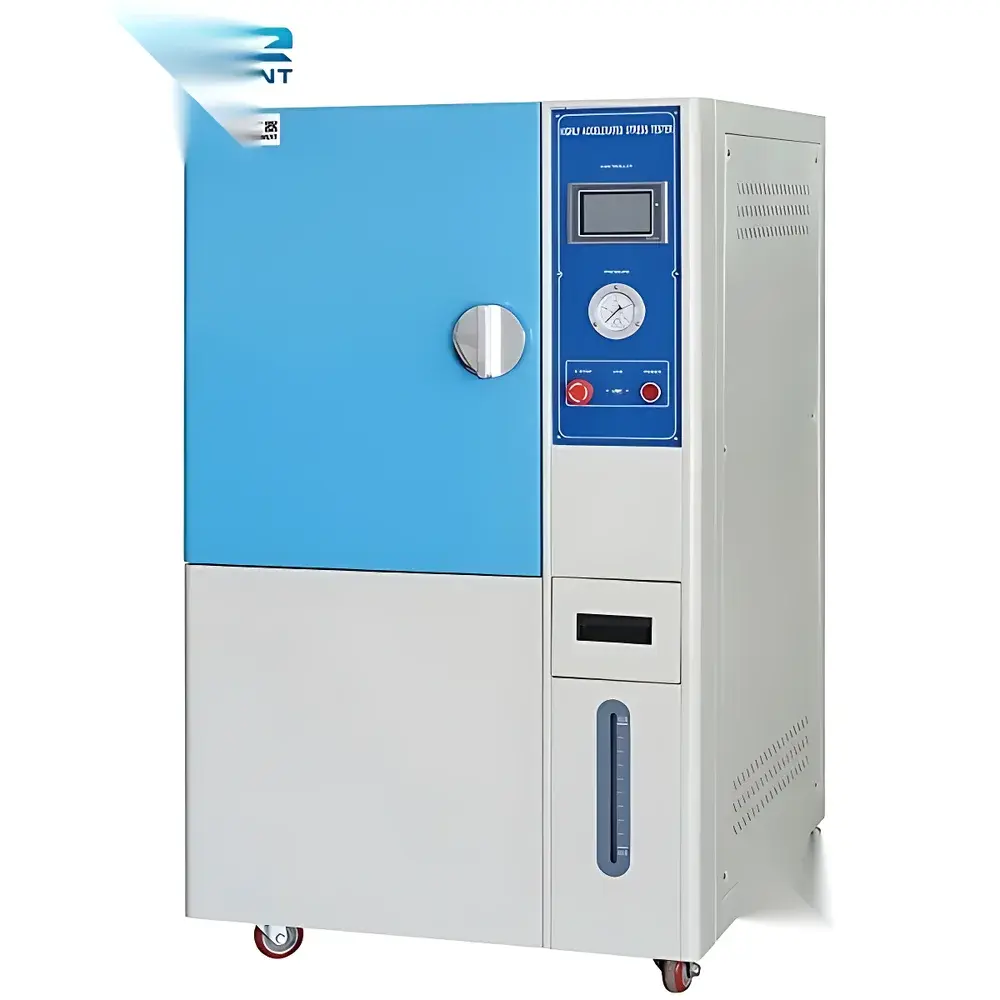
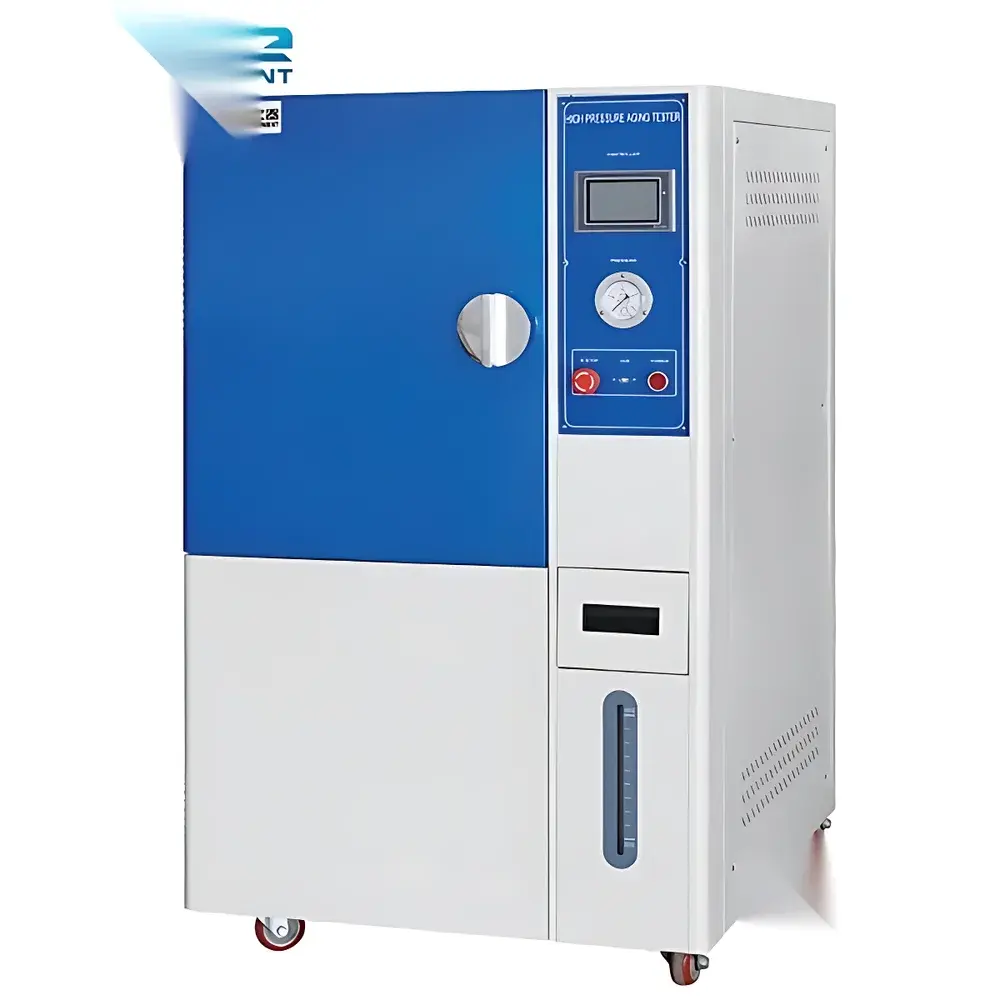
HAST High-Accelerated Stress Test Chamber
| Brand | Other Brands |
|---|---|
| Origin | Imported |
| Manufacturer Type | Authorized Distributor |
| Pressure Range | 0–6 kg/cm² (0–0.6 MPa) |
| Operating Pressure | 2.0 kg/cm² (≈200 kPa gauge) |
| Temperature Range | +100°C to +132°C (saturated steam) |
| Humidity Range | 75–100% RH (saturated vapor) |
| Temperature Control Accuracy | ±0.5°C |
| Time Setting Range | 0.00–999.99 hours |
| Chamber Structure | Horizontal cylindrical test chamber with vacuum-assisted air purge |
| Compliance | ASTM D2244, IEC 60068-2-66, JIS C 60068-2-66, MIL-STD-202, ISO 16750-4, UL 746, NACE TM0177, CNS 12527, BS EN 60068-2-66 |
Overview
The HAST High-Accelerated Stress Test Chamber is an engineered environmental stress screening system designed for rapid reliability evaluation of hermetic and semi-hermetic electronic components, printed circuit boards (PCBs), IC packages, LED assemblies, automotive sensors, and medical-grade plastic enclosures. Unlike conventional temperature-humidity-bias (THB) testing, this chamber operates under elevated temperature, high relative humidity, and controlled overpressure—leveraging the physics of saturated steam diffusion to accelerate moisture ingress through micro-defects in encapsulants, seals, and dielectric layers. By maintaining a precisely regulated saturated vapor environment at pressures up to 2.0 kg/cm² (≈200 kPa gauge), the system achieves acceleration factors of 10× to 30× compared to standard 85°C/85% RH testing—enabling failure mode identification during early design validation and qualification phases per industry-standard accelerated life models (e.g., Peck’s model, Eyring equation). Its operation conforms strictly to the thermodynamic boundary conditions defined in IEC 60068-2-66 and JIS C 60068-2-66 for highly accelerated temperature and humidity stress testing (HAST).
Key Features
- Horizontal cylindrical test chamber geometry minimizes condensate pooling and eliminates direct steam jet impingement on samples—enhancing test repeatability and operator safety.
- PID-controlled pressure regulation system with real-time feedback loop ensures stable overpressure maintenance within ±0.02 kg/cm² tolerance across full operational range (0–6 kg/cm²).
- Microprocessor-based VT-4810 temperature controller with K-type thermocouple input, SSR-driven heating, and dual-display PV/SV interface enables precise setpoint programming and thermal stability of ±0.5°C at saturation temperatures.
- Integrated vacuum purge subsystem evacuates ambient air prior to steam generation, followed by HEPA-filtered nitrogen or clean dry air reintroduction—ensuring oxygen-free, particle-controlled internal atmosphere per MIL-STD-810G Method 500.7 requirements.
- Automated safety interlock architecture: door remains mechanically locked until internal pressure drops below 0.1 kg/cm²; pressure-sensing logic enforces fail-safe venting and vacuum break sequences before access.
- Self-sustaining water supply: integrated reservoir supports continuous operation up to 1000 hours without manual refill; optional fully automatic make-up system available with level sensing and solenoid-controlled deionized water injection.
Sample Compatibility & Compliance
The chamber accommodates standard JEDEC trays, 24×24 mm QFN packages, multi-layer PCBs up to 450 × 450 mm, and sealed plastic housings used in automotive lighting, power electronics, and implantable device enclosures. It meets the mechanical, thermal, and pressure integrity criteria specified in ASTM D2244 (color stability), UL 746E (polymeric material aging), NACE TM0177 (sulfide stress cracking resistance), and ISO 16750-4 (road vehicle environmental conditions). All control firmware and data logging functions comply with GLP/GMP traceability principles—including audit trail capability, user-level access control, and electronic signature support aligned with FDA 21 CFR Part 11 Annex 11 requirements.
Software & Data Management
Equipped with embedded RS-485/Modbus RTU and optional Ethernet TCP/IP interface, the chamber supports integration into centralized MES or LIMS platforms. Real-time monitoring includes simultaneous logging of chamber pressure (kg/cm²), saturated steam temperature (°C), elapsed test time (hh:mm:ss), and internal dew point (°C). Data export formats include CSV and XML with timestamped metadata. Optional PC-based software provides trend analysis, alarm history review, calibration certificate management, and automated report generation compliant with ISO/IEC 17025 documentation standards.
Applications
This HAST chamber is routinely deployed in R&D labs and quality assurance departments for: accelerated moisture sensitivity level (MSL) grading per J-STD-020; solder joint reliability assessment under thermo-hygro-mechanical stress; validation of conformal coating barrier performance; qualification of MEMS package hermeticity; and accelerated corrosion testing of plated contacts and wire bonds. It is especially effective for identifying latent defects such as mold compound delamination, intermetallic growth, and electrochemical migration—prior to high-volume production release.
FAQ
What is the maximum allowable test duration per cycle?
Up to 999.99 hours per programmed sequence—configurable in 0.01-hour increments.
Does the system support ramp-and-soak pressure profiles?
No—this model maintains constant saturated vapor pressure during dwell; programmable ramp profiles require optional upgrade to advanced PID+PLC controller module.
Is deionized water mandatory for operation?
Yes—use of DI water with resistivity ≥1 MΩ·cm prevents mineral deposition on steam generators and pressure transducers, ensuring long-term calibration stability.
Can the chamber be validated per IQ/OQ protocols?
Yes—factory-supplied validation templates (including sensor calibration certificates, leak test records, and temperature/pressure uniformity mapping reports) are provided upon request.
What safety certifications does the unit carry?
CE marking per Machinery Directive 2006/42/EC and Low Voltage Directive 2014/35/EU; electrical safety tested to IEC 61010-1:2010 Ed.3.



