
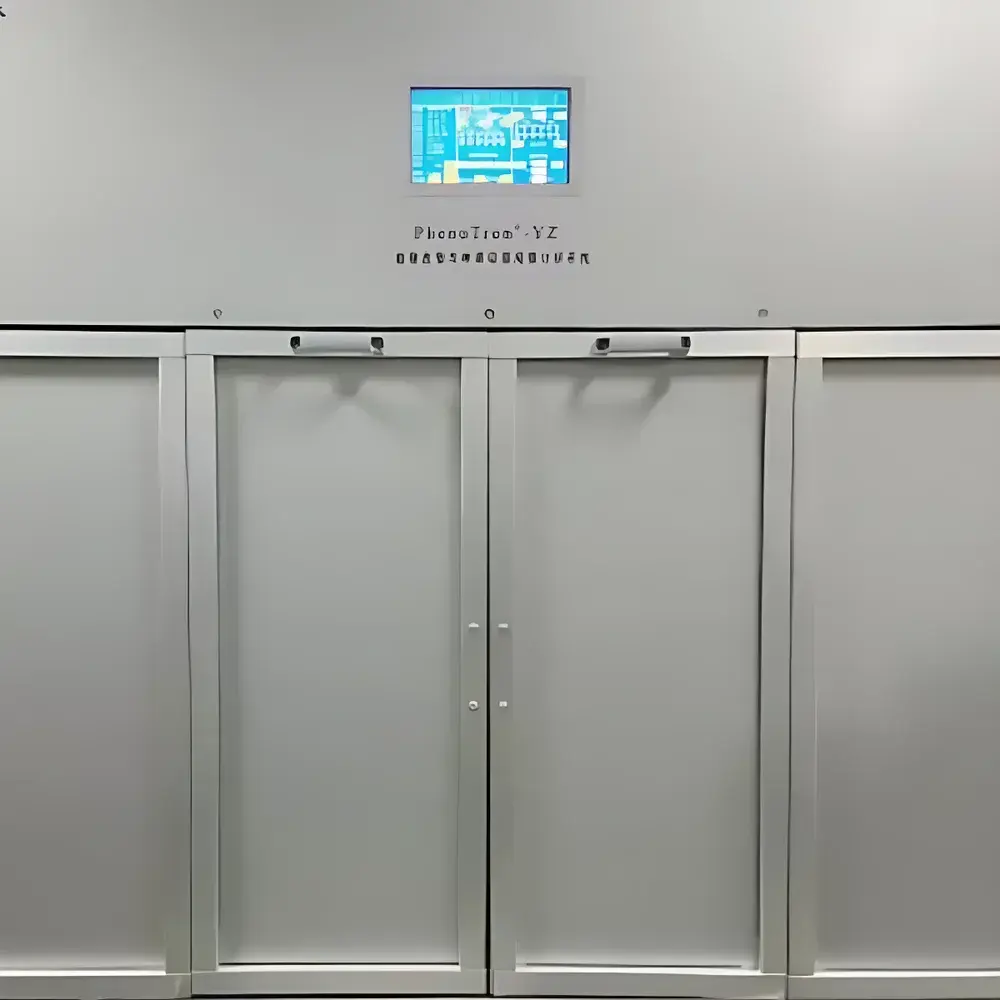
EcoTech PhenoTron-YZ Plant Phenotyping and Germplasm Imaging Analysis System
| Brand | EcoTech |
|---|---|
| Origin | Imported (Non-China) |
| Manufacturer Type | Authorized Distributor |
| Model | PhenoTron-YZ |
| Pricing | Available Upon Request |
| Spectral Range | 400–1000 nm (VNIR), optional 900–1700 nm (SWIR) & 1000–2500 nm |
| Spatial Resolution | 1024 px (VNIR), 640 px (SWIR) |
| Spectral Resolution | FWHM 5.5 nm (VNIR), 8 nm (SWIR) |
| Scan Range | 120 cm × 60 cm (Y-axis), 60 cm Z-axis lift |
| Positioning Accuracy | <5 mm |
| Max Payload | 40 kg |
| Motorized Speed | 1–40 mm/s |
| Thermal Imaging (Optional) | -20°C to 150°C, NETD ≤30 mK @25°C, 640×512 IR resolution |
| Chlorophyll Fluorescence Imaging (Optional) | 5 MP, 70 fps, Fo/Fm/ΔF/Fm'/NPQ/Y(II)/Rfd/Y(NPQ)/Y(NO) quantification |
| Software | Embedded Chinese touchscreen OS + PC-based GUI with remote control, position memory (10 presets), synchronized multi-axis triggering, real-time monitoring, and GLP-compliant data logging |
Overview
The EcoTech PhenoTron-YZ is a modular, laboratory-scale plant phenotyping and germplasm imaging analysis system engineered for high-throughput, non-invasive, multi-modal spectral characterization of seeds, seedlings, rosettes, and intact potted plants. It operates on the principle of spatially resolved spectral reflectance, fluorescence excitation-emission, and thermal emission mapping—integrated via synchronized motorized scanning (Y-axis) and vertical positioning (Z-axis). Designed for controlled-environment laboratories, the system supports quantitative trait locus (QTL) discovery, germplasm screening, abiotic/biotic stress phenotyping (e.g., drought, heat, nutrient deficiency), and pre-breeding evaluation under standardized conditions. Its architecture conforms to ISO/IEC 17025-aligned instrument design principles, emphasizing traceable calibration paths, environmental stability, and reproducible measurement geometry. The core platform integrates hardware synchronization (light source triggering, camera exposure, stage motion), spectral radiometric calibration protocols, and metadata-rich image acquisition—ensuring compliance with FAO’s Crop Ontology and MIAPPE v1.1 metadata standards.
Key Features
- Modular STP (Scanning–Triggering–Processing) architecture enabling flexible sensor integration and future-proof expansion
- Automated Y-axis belt-driven scanning (120 × 60 cm field) with sub-5 mm positional repeatability and programmable velocity (1–40 mm/s)
- Z-axis synchronized lift mechanism (60 cm travel) for multi-angle acquisition and canopy-layer profiling
- VNIR hyperspectral imaging (400–1000 nm, 224 bands, FWHM 5.5 nm) with calibrated reflectance and fluorescence quantification
- Multi-excitation chlorophyll fluorescence imaging: UV-A (365 nm), blue (450 nm), red (660 nm) for Fo, Fm, Fv/Fm, Y(II), NPQ, Rfd, and Kautsky kinetics
- Optional Thermo-RGB fusion: Co-registered visible (5400 × 3600 px) and uncooled microbolometer IR (640 × 512 px) imaging with <30 mK thermal sensitivity
- iPOT digital growth pot integration (optional): Real-time monitoring of substrate weight, volumetric water content (via capacitance probes), soil temperature, leaf temperature (IR), stem flow (sap flux), and gas exchange proxies
- IoT-enabled operation: 5G-compatible remote initiation, live telemetry streaming, and audit-trail-enabled command logging
- Embedded touchscreen HMI with full Chinese localization and PC-based GUI supporting batch processing, ROI scripting, and export to HDF5/NetCDF formats
Sample Compatibility & Compliance
The PhenoTron-YZ accommodates diverse sample formats including Petri dishes (root assays), germination trays (seedling screens), 96-well plates (micro-phenotyping), standard growth pots (up to 40 kg load), and custom mounting fixtures. All optical paths maintain fixed working distances and illumination uniformity (±3% across FOV), satisfying ASTM E2595-22 requirements for spectral imaging reproducibility. Hyperspectral data adhere to NASA’s CEOS Cal/Val framework for radiometric traceability. Optional modules meet ICH Q5C guidelines for biopharmaceutical cell line characterization analogies (e.g., fluorescence-based viability metrics). System firmware and software support 21 CFR Part 11-compliant electronic signatures, audit trails, and role-based access control when deployed in GxP environments.
Software & Data Management
EcoTech’s Phenolyze™ software suite provides end-to-end workflow management—from acquisition protocol definition (e.g., dark adaptation timing, light intensity ramping, fluorescence induction curves) to pixel-level spectral unmixing and trait extraction. Batch processing supports parallel analysis of >1000 images/hour using GPU-accelerated algorithms. All raw data are stored with embedded EXIF-like metadata (timestamp, stage coordinates, lamp voltage, integration time, calibration ID). Export options include CSV (trait tables), GeoTIFF (spatial maps), and Bruker OPUS-compatible binary files for third-party chemometric modeling (e.g., PLSR, PCA). Data integrity is enforced via SHA-256 hashing and automatic versioned backups to NAS or cloud storage (AWS S3, Azure Blob).
Applications
- Germplasm bank phenotyping: Rapid quantification of morphological (leaf area index, convex hull ratio), physiological (Fv/Fm, NPQ), and biochemical (anthocyanin index, carotenoid reflectance ratio) traits across thousands of accessions
- Forward/reverse genetics: High-resolution mapping of fluorescence quenching dynamics in mutant libraries under controlled photoinhibitory regimes
- Drought resilience screening: Combined stomatal conductance proxy (thermal heterogeneity), water use efficiency (δ¹³C surrogate via NIR slope), and photosynthetic capacity (Y(II) kinetics)
- Seed quality assessment: Hyperspectral classification of viability, vigor, and pathogen load using VNIR-SWIR spectral fingerprints
- Controlled-environment agronomy: Longitudinal tracking of canopy development, senescence progression, and nutrient deficiency signatures (e.g., Mg²⁺ chlorosis via 550 nm reflectance dip)
FAQ
Does the PhenoTron-YZ support automated calibration routines for hyperspectral data?
Yes—factory-installed white reference tiles and dark current frames are acquired before each session; optional NIST-traceable spectralon panels enable lab-level radiometric recalibration.
Can fluorescence and thermal imaging be acquired simultaneously?
No—due to spectral interference between IR emission and fluorescence detection windows, Thermo-RGB and chlorophyll fluorescence modules operate sequentially under synchronized trigger logic.
Is raw hyperspectral cube data accessible for custom algorithm development?
Yes—unprocessed .bil/.hdr ENVI format cubes are exported with full wavelength and spatial metadata; Python and MATLAB SDKs are provided.
What safety certifications does the system hold?
CE marked per EN 61000-6-2/6-4 (EMC), EN 61010-1 (electrical safety), and ISO 13857 (mechanical guarding); integrated overcurrent, overload, and undervoltage protection circuits.
How is data provenance maintained during multi-user lab deployments?
Each acquisition logs operator ID, instrument serial number, calibration certificate ID, environmental log (ambient T/RH from onboard sensors), and digital signature—fully compliant with GLP Annex 11 requirements.





