
EcoTech SpectraScan-R Ex-situ Visible-Near Infrared Hyperspectral Root Imaging & Analysis System
| Brand | EcoTech |
|---|---|
| Origin | Beijing, China |
| Model | SpectraScan-R |
| Imaging Modality | VIS-NIR Hyperspectral + High-Resolution RGB Scanning |
| Spectral Range (Standard) | 400–1000 nm |
| Optional Extensions | 900–1700 nm or 1000–2500 nm SWIR |
| Spatial Resolution | 512 × 512 pixels (configurable to 1024 × 1024) |
| Spectral Resolution | 7 nm (204 bands) |
| Field of View | 31° (55 × 55 cm at 1 m) |
| Imaging Distance | 15 cm to infinity |
| Integrated Touchscreen | 4.3″ with 13 physical control keys |
| Data Acquisition Mode | Push-broom with embedded preview camera (5 MPix) |
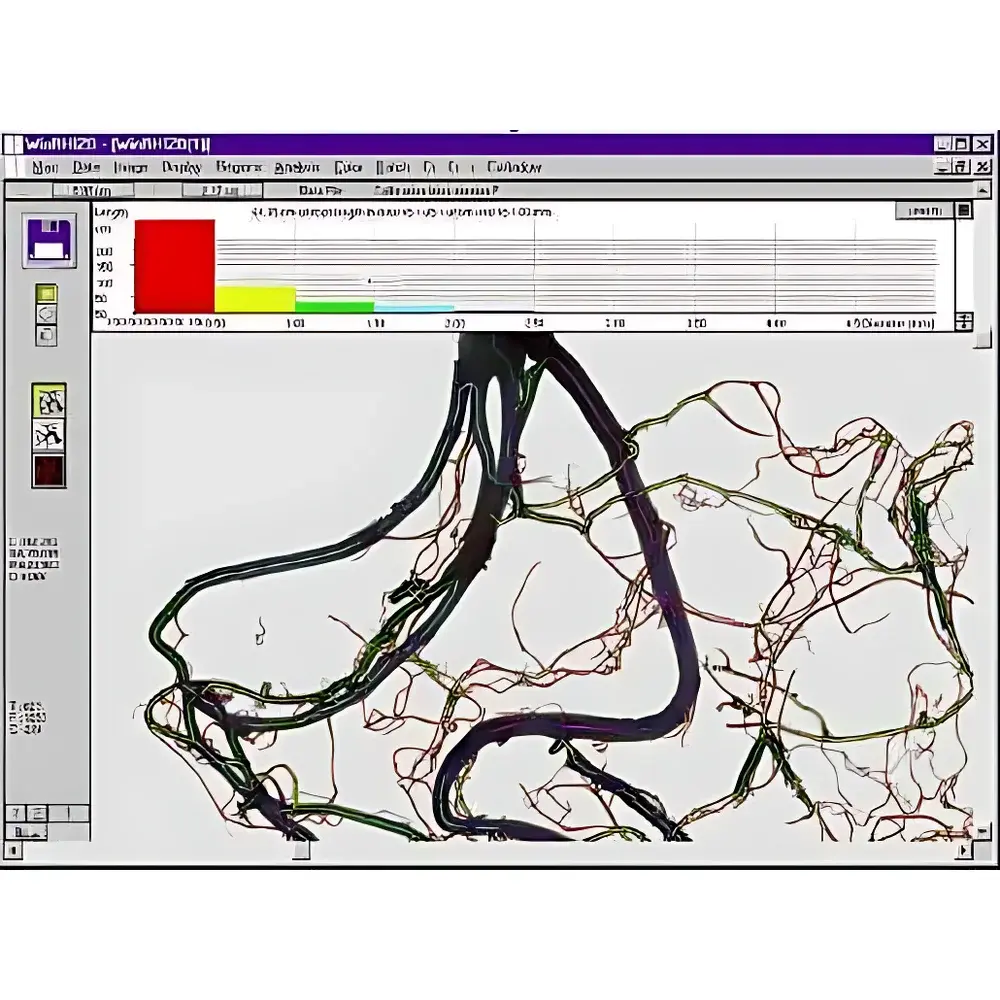
| Software Platform | WinRHIZO Pro (Professional Edition) with Scanner.cal calibration support, SAM classification, Savitzky-Golay spectral smoothing |
| Compliance | Compatible with GLP-compliant data workflows |
Overview
The EcoTech SpectraScan-R is an integrated ex-situ hyperspectral root imaging and morphometric analysis system engineered for quantitative, non-destructive characterization of excised plant root systems under controlled laboratory conditions. It combines high-fidelity visible–near infrared (VIS-NIR: 400–1000 nm) hyperspectral line-scan imaging with synchronized high-resolution RGB scanning to capture both structural morphology and biochemical spatial distribution in a single acquisition workflow. Unlike conventional root scanners relying solely on grayscale or RGB intensity thresholds, the SpectraScan-R leverages spectral unmixing principles—based on endmember extraction and spectral angle mapper (SAM) algorithms—to resolve sub-pixel heterogeneity in root tissue viability, water content, lignin/cellulose gradients, and rhizosphere organic carbon dynamics within soil-root matrices. Its dual-source illumination architecture—comprising calibrated top and bottom LED arrays—eliminates shadow artifacts and ensures radiometric uniformity across transparent root trays, enabling reproducible reflectance-based quantification. Designed for compliance with standardized root phenotyping protocols (e.g., OECD Test Guideline 208, ISO 11269-2), the system delivers traceable, geometry-corrected spectral cubes suitable for longitudinal comparative studies in plant stress physiology, rhizobiome interaction mapping, and phytoremediation monitoring.
Key Features
- Dual-modality acquisition: Simultaneous high-resolution RGB imaging (up to 4800 dpi) and push-broom VIS-NIR hyperspectral scanning (512 × 512 spatial pixels, 204 spectral bands at 7 nm resolution)
- Calibration-integrated hardware: Factory-characterized Scanner.cal file and dual-illumination geometry ensure pixel-level radiometric consistency and eliminate vignetting-induced bias
- Modular spectral flexibility: Standard 400–1000 nm configuration with optional upgrade paths to 900–1700 nm (NIR-II) or 1000–2500 nm (SWIR) modules for enhanced cellulose, starch, and moisture discrimination
- Embedded real-time processing: On-device 4.3″ touchscreen GUI with dedicated function keys enables immediate preview, region-of-interest (ROI) selection, and automated time-lapse acquisition scheduling
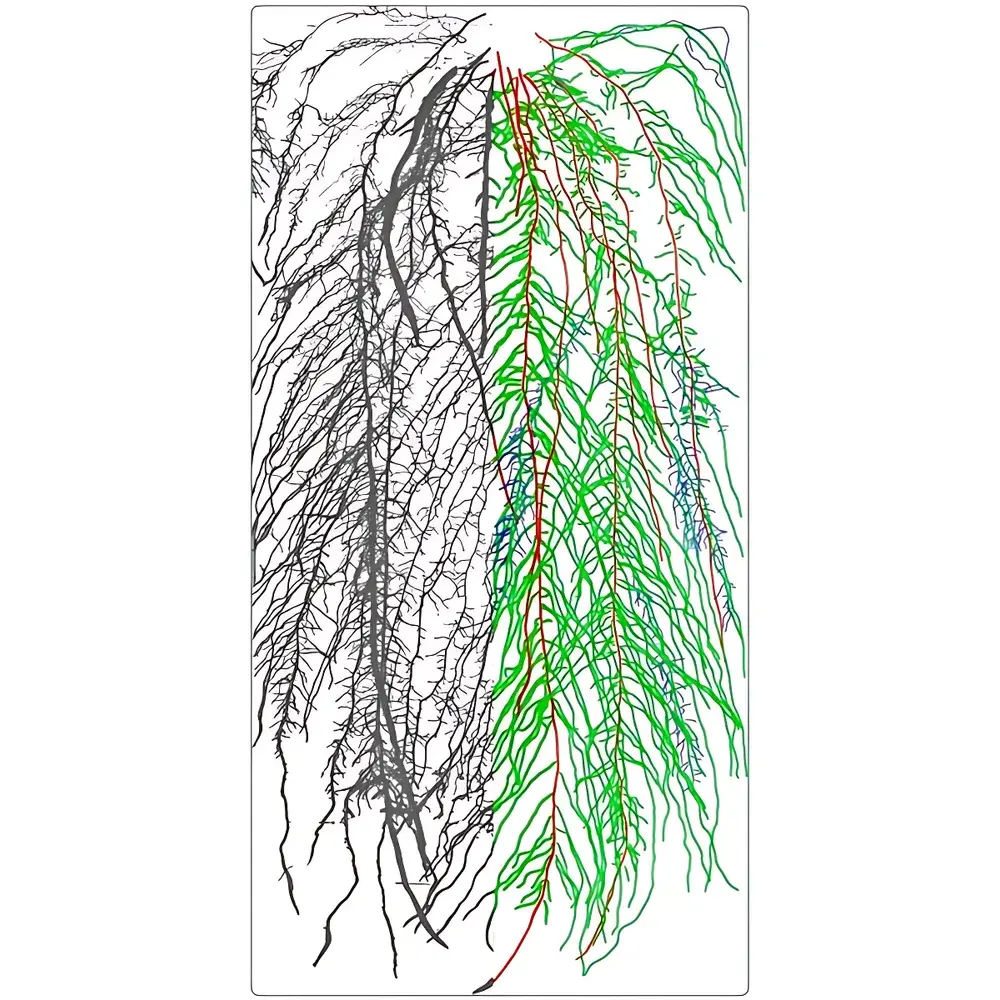
- WinRHIZO Pro software suite: Fully licensed analytical platform supporting morphometric quantification (length, diameter, surface area, volume, tip count), topology modeling (branch order, path length, connectivity), and spectral classification (viable/dead root segmentation, moisture gradient mapping, rhizosphere C-org distribution)
- Non-statistical morphometry engine: Pixel-accurate skeletonization and branch tracing algorithms resolve overlapping root structures without reliance on stochastic thresholding or Monte Carlo assumptions
Sample Compatibility & Compliance
The SpectraScan-R accepts intact, soil-attached or washed root systems mounted on optically transparent acrylic trays (standard dimensions: 30 × 43 cm). Its illumination geometry accommodates heterogeneous sample thicknesses—from fine Arabidopsis lateral roots to coarse maize crown roots—without refocusing. The system complies with widely adopted root phenotyping standards: image metadata embeds EXIF-compatible acquisition parameters (wavelength, integration time, illumination intensity) required for ISO/IEC 17025-accredited laboratories. All spectral data exports adhere to ENVI-compatible BIL/BIP formats, facilitating interoperability with third-party tools such as MATLAB, Python (scikit-learn, spectral), and commercial platforms including ENVI and ArcGIS. For regulated environments, WinRHIZO Pro supports user-defined electronic signatures, session-based audit trails, and immutable project archives aligned with FDA 21 CFR Part 11 expectations for electronic records retention.
Software & Data Management
Data processing centers on WinRHIZO Pro—a rigorously validated, encryption-dongle-protected application designed specifically for root architecture analysis. Calibration is enforced via proprietary Scanner.cal files that correct for sensor non-uniformity, lens distortion, and spectral response drift. Morphometric outputs include total root length (mm), mean diameter (µm), projected surface area (cm²), convex hull volume (cm³), and tip density (tips/cm). Advanced modules enable link analysis (branch angle distribution, connection topology independent of root completeness), topological mapping (root order hierarchy, Strahler numbering), and developmental staging (first-order vs. fifth-order root biomass partitioning). Hyperspectral analysis employs Savitzky-Golay filtering for noise suppression and SAM-based classification to generate binary or multi-class maps—e.g., distinguishing healthy cortical tissue from suberized or necrotic zones based on spectral signature divergence. All results export to CSV, Excel, and HDF5 formats with embedded metadata headers compliant with MIAPPE (Minimum Information About a Plant Phenotyping Experiment) guidelines.
Applications
The SpectraScan-R serves as a core instrumentation platform in academic and industrial plant science laboratories conducting research in root system architecture (RSA) plasticity under abiotic stress (drought, salinity, heavy metal exposure), genotype-by-environment interaction studies, symbiotic colonization kinetics (e.g., mycorrhizal hyphal penetration mapping), and rhizosphere biogeochemical monitoring. Its capacity to quantify root-soil interface properties—including spatially resolved moisture gradients and labile organic carbon distribution—makes it particularly valuable in wetland restoration assessment, biochar amendment efficacy trials, and soil health indicator development. In breeding programs, it enables high-throughput screening of RSA traits correlated with yield stability, while its spectral fingerprinting capability supports early detection of root pathogen infection before macroscopic symptom onset. Published use cases span model species (Arabidopsis, rice, maize) and perennial crops (alfalfa, poplar), with peer-reviewed validation in journals including New Phytologist, Plant and Soil, and Frontiers in Plant Science.
FAQ
Can the SpectraScan-R be used for in situ (in-soil) root imaging?
No—the system is explicitly designed for ex-situ analysis of excavated or hydroponically grown root systems placed on transparent substrates. In-soil imaging requires ground-penetrating modalities (e.g., MRI or minirhizotrons) not supported by this platform.
Is WinRHIZO Pro compatible with macOS or Linux operating systems?
WinRHIZO Pro is a Windows-native application (Windows 10/11, 64-bit) and requires the vendor-provided USB hardware key for license enforcement. Virtual machine or Wine-based emulation is not officially supported or validated.
What spectral preprocessing steps are applied automatically during acquisition?
Raw hyperspectral data undergo real-time dark current subtraction and flat-field correction using factory-measured reference frames. No atmospheric or scattering corrections are applied onboard; these are deferred to post-acquisition workflows in ENVI or custom Python pipelines.
Does the system support batch processing of multiple root images?
Yes—WinRHIZO Pro includes scriptable batch mode with configurable parameter templates, enabling unattended analysis of large experimental sets while preserving per-sample calibration integrity and metadata provenance.
How is measurement uncertainty quantified for morphometric outputs?
Uncertainty derives from scanner optical resolution (≤5 µm pixel size), root alignment repeatability (<±0.3 mm positioning error), and software segmentation tolerance (default 2-pixel edge blur threshold). Full uncertainty budgets are documented in the system’s IQ/OQ/PQ validation package per ISO/IEC 17025 Annex A.3 requirements.
Related Products




