EcoTech PTM-NG26 Distributed Photosynthetic Phenotyping Monitoring System
| Brand | EcoTech |
|---|---|
| Origin | Europe |
| Model | PTM-NG26 |
| Sensor Type | Distributed PLS-10R Intelligent Leaf Sensors |
| Measurement Principle | Open-system gas exchange with integrated microclimate sensing |
| Deployment Range | Up to 30 m per sensor node |
| Data Output | Net CO₂ assimilation rate (A<sub>net</sub>, µmol CO₂·m⁻²·s⁻¹), Transpiration rate (E, mmol H₂O·m⁻²·s⁻¹), Stomatal conductance (g<sub>s</sub>, mol H₂O·m⁻²·s⁻¹), Intercellular CO₂ concentration (C<sub>i</sub>, µmol·mol⁻¹), Leaf temperature (T<sub>L</sub>, °C), Leaf–air temperature differential (ΔT, °C), Photosynthetically Active Radiation (PAR, µmol·m⁻²·s⁻¹), Ambient air temperature & relative humidity, Atmospheric CO₂ concentration (µmol·mol⁻¹), Barometric pressure (kPa), Vapor Pressure Deficit (VPD, kPa) |
| Data Storage | Local SD card + cloud synchronization via secure HTTPS API |
| Compliance | Designed for GLP-aligned experimental workflows |
Overview
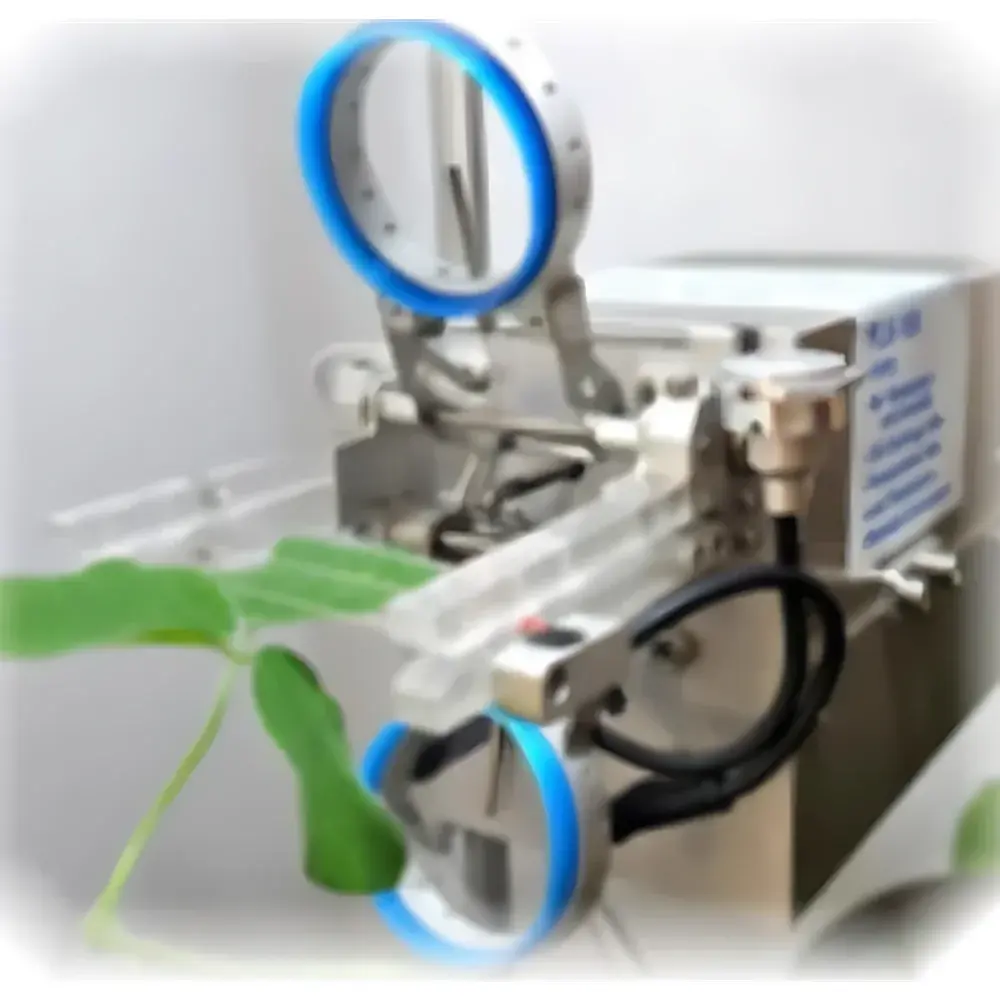
The EcoTech PTM-NG26 Distributed Photosynthetic Phenotyping Monitoring System is an advanced, modular open-system gas exchange platform engineered for high-temporal-resolution, non-invasive monitoring of leaf-level physiological function across spatially distributed plant populations. Unlike conventional single-leaf cuvette systems, the PTM-NG26 implements a true distributed architecture—each PLS-10R intelligent sensor functions as an autonomous measurement node, integrating infrared gas analyzers (IRGA), precision thermistors, quantum sensors, and environmental microsensors within a compact, leaf-clamping design. The system operates on the principle of steady-state open-path gas exchange, calculating net CO₂ assimilation and transpiration based on real-time differential CO₂ and H₂O vapor concentration measurements between inlet and outlet airstreams, corrected for leaf area, boundary layer conductance, and ambient microclimate variables. Its deployment flexibility—supporting up to 30 meters of cable length per sensor without signal degradation—enables robust replication in greenhouse compartments, field mesocosms, or controlled-environment chambers, making it particularly suited for genotype × environment interaction studies and longitudinal phenotyping trials.
Key Features
- Distributed multi-node architecture: Simultaneous, synchronized monitoring of ≥16 independent leaves (scalable via hub configuration), eliminating serial measurement bottlenecks inherent in centralized systems.
- Integrated microclimate quantification: Co-located measurement of leaf temperature (±0.1°C), PAR (400–700 nm, ±5% calibration traceability to NIST standards), air temperature/humidity (Vaisala HUMICAP®), atmospheric CO₂ (NDIR, 0–2000 ppm), barometric pressure, and derived VPD—all time-synchronized at 1 Hz sampling resolution.
- No pneumatic tubing required: Each PLS-10R sensor contains its own miniature axial-flow pump and dual-channel IRGA, removing reliance on centralized air handling units and minimizing flow path artifacts.
- Modular expandability: Seamless integration with optional modules including FluorTron-ROBOT for automated chlorophyll fluorescence imaging, PhenoTron-iPOT for spectral light treatment experiments, and EMS-ET for whole-plant transpiration and stem flow correlation.
- Secure, audit-ready data infrastructure: Local storage on industrial-grade SD cards (encrypted FAT32) plus encrypted TLS 1.2 cloud upload; metadata tagging supports ISO/IEC 17025-compliant experiment logging and versioned dataset archiving.
Sample Compatibility & Compliance
The PTM-NG26 accommodates broad leaf morphologies—including broadleaf dicots (e.g., Arabidopsis thaliana, tomato, soybean), monocots (e.g., maize, wheat, rice), and woody species—via adjustable PLS-10R clamps with compliant silicone gaskets ensuring consistent seal integrity across 2–12 cm² leaf areas. All sensors are CE-marked and comply with IEC 61326-1:2013 (EMC for laboratory equipment). The system’s data structure and timestamping protocol meet minimum requirements for GLP and GCP adherence, supporting traceable calibration logs (CO₂ span gas certificates, PAR sensor NIST-traceable calibrations), user-defined audit trails, and export formats compatible with R, Python (Pandas), and MATLAB for downstream statistical modeling (e.g., mixed-effects ANOVA, PCA, time-series clustering).
Software & Data Management
EcoTech’s Phenosoft v4.2 software provides real-time visualization, batch processing, and QC flagging (e.g., dew-point violation, flow-rate deviation >5%, CO₂ drift >20 ppm/10 min). Raw data exports adhere to MIAPPE 1.1 (Minimum Information About a Plant Phenotyping Experiment) metadata standards. Cloud-based dashboards support role-based access control (RBAC), enabling collaborative analysis across geographically dispersed research teams. All data transmissions conform to GDPR and HIPAA-equivalent encryption protocols; local installations may be configured to operate in air-gapped environments upon request. Audit logs record every parameter change, user login, calibration event, and data export—fully compliant with FDA 21 CFR Part 11 requirements for electronic records and signatures when deployed in regulated agricultural biotechnology settings.
Applications
- High-throughput phenotyping of photosynthetic efficiency under abiotic stress gradients (drought, heat, salinity, elevated CO₂).
- Quantifying stomatal limitation vs. biochemical limitation of photosynthesis using A/Ci response curves and Farquhar-von Caemmerer-Berry model fitting.
- Evaluating cultivar-specific responses to dynamic light regimes (e.g., canopy light flecks, LED spectral treatments) in conjunction with PhenoTron-iPOT.
- Validating remote sensing indices (e.g., PRI, NDVI) against ground-truthed gas exchange metrics across growth stages.
- Supporting breeding programs through early-stage selection for water-use efficiency (WUE = Anet/E) and intrinsic WUE (iWUE = Anet/gs).
- Long-term ecophysiological monitoring in FACE (Free-Air CO₂ Enrichment) or warming chamber experiments requiring spatial replication and minimal observer interference.
FAQ
What is the maximum number of PLS-10R sensors supported by a single PTM-NG26 master unit?
Up to 16 sensors can be daisy-chained via RS-485 bus; additional hubs enable expansion to 64+ nodes in large-scale deployments.
Does the system support automated diurnal cycle measurements without manual intervention?
Yes—Phenosoft v4.2 includes programmable measurement schedules (e.g., 5-min intervals from 06:00–20:00), automatic dark adaptation triggers, and fail-safe recovery after power interruption.
How is leaf area measured and incorporated into flux calculations?
Users input leaf area manually during setup or integrate digital caliper-derived measurements; optional LeafAreaScan module enables automated image-based area estimation calibrated against gravimetric standards.
Can PTM-NG26 data be imported directly into CropSyst, APSIM, or DSSAT crop modeling platforms?
Yes—CSV exports include standardized column headers (e.g., “A_net_umol_m2_s”, “VPD_kPa”, “PAR_umol_m2_s”) and UTC timestamps, fully compatible with model forcing file requirements.
Is firmware update capability available over-the-air (OTA)?
Firmware updates are delivered via secure HTTPS push through the cloud portal or offline SD card injection, with rollback support and SHA-256 signature verification.