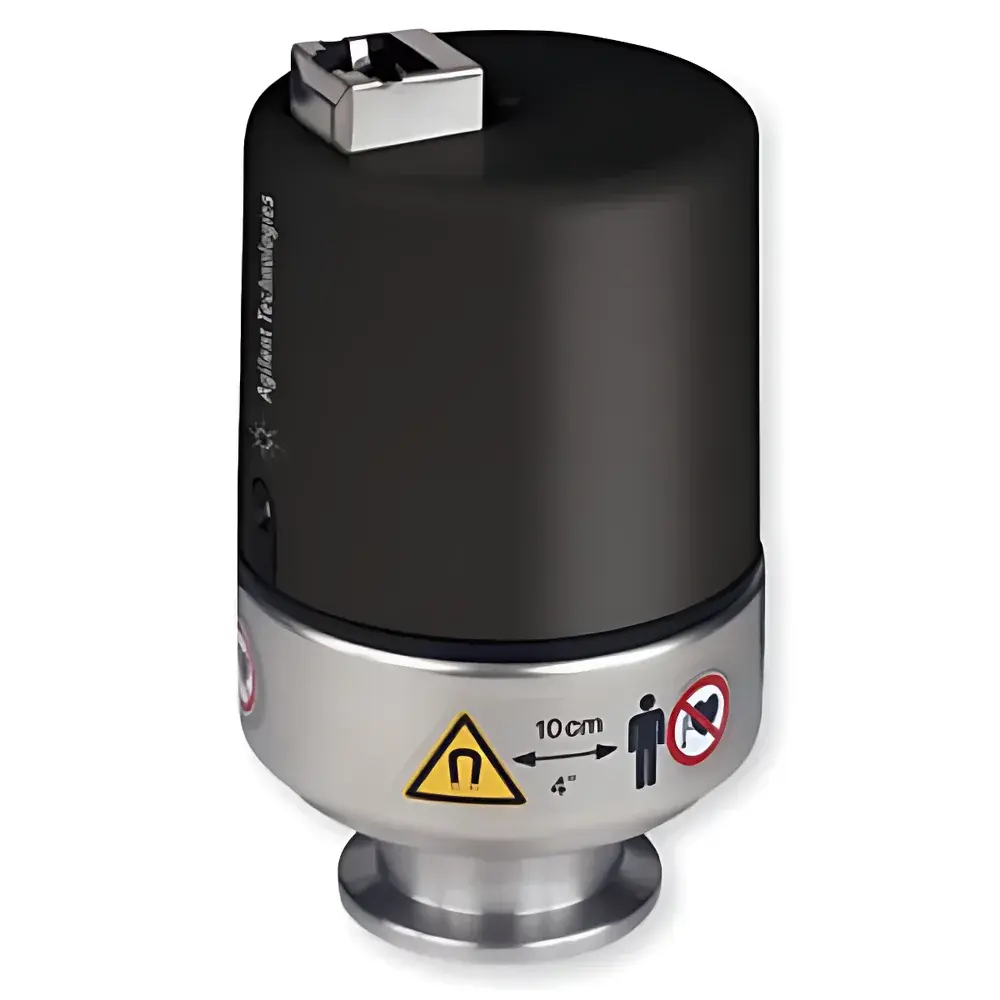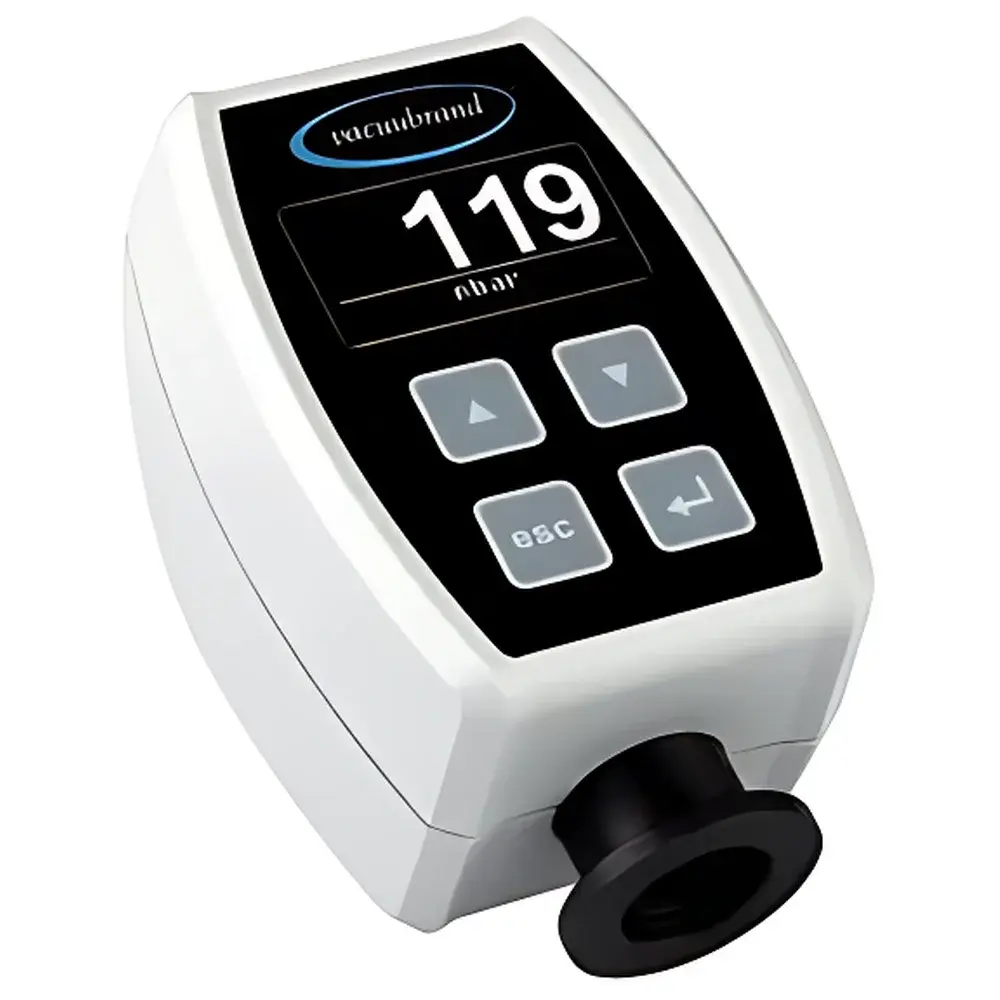
VACUUBRAND VACUU·VIEW® Integrated Ceramic Capacitance Vacuum Gauge
| Brand | VACUUBRAND® |
|---|---|
| Origin | Germany |
| Model | VACUU·VIEW® |
| Measurement Range (Standard) | 1000 to 0.1 mbar |
| Measurement Range (Extended) | 1000 to 1×10⁻³ mbar |
| Sensor Type | Chemically Resistant Ceramic Capacitance Manometer |
| Accuracy | High repeatability and long-term stability across full range |
| Display | Backlit LCD, menu-driven interface |
| Units | mbar, hPa, Torr, psi (user-selectable) |
| Construction | All-in-one compact housing with integrated sensor |
| Compliance | Designed for laboratory and industrial vacuum process monitoring under ISO/IEC 17025-aligned operation |
Overview
The VACUUBRAND VACUU·VIEW® is an integrated, chemically resistant ceramic capacitance vacuum gauge engineered for precise, stable, and gas-independent pressure measurement in the rough and low-vacuum ranges. Unlike thermal conductivity or Pirani-based gauges, the VACUU·VIEW® employs a robust ceramic diaphragm sensor coupled with high-fidelity capacitive transduction—ensuring linear, repeatable output unaffected by gas composition (e.g., N₂, O₂, Ar, HCl, Cl₂, or organic vapors). Its operating principle relies on detecting minute deflections of a hermetically sealed, corrosion-resistant ceramic membrane under differential pressure, converted into digital pressure values via precision analog-to-digital conversion. This architecture delivers inherent immunity to chemical attack, zero drift minimization, and metrological reliability essential for GLP-compliant vacuum process validation, reaction vessel monitoring, rotary evaporation control, and solvent recovery systems.
Key Features
- Integrated all-in-one design: Compact housing with built-in ceramic capacitance sensor eliminates external cabling, mounting adapters, and calibration drift from hose effects.
- Chemical resistance: Sensor diaphragm fabricated from alumina-based ceramic (Al₂O₃), rated for continuous exposure to aggressive media including halogenated solvents, mineral acids, and caustic vapors—validated per DIN EN 60068-2-52 salt mist and ISO 9223 corrosion class C5-M.
- Gas-independent measurement: Capacitance-based readout ensures consistent accuracy regardless of gas type—critical for mixed-gas processes or solvent-laden vacuum streams where thermal gauges exhibit significant error.
- High long-term stability: Typical zero drift < ±0.1 % FS/year; calibrated sensitivity shift < ±0.2 % FS/year—enabling extended recalibration intervals in accordance with ISO/IEC 17025 clause 6.6.
- Intuitive local interface: Backlit monochrome LCD with multilevel menu navigation supports unit selection (mbar, hPa, Torr, psi), damping adjustment, zero offset, and alarm threshold configuration without PC dependency.
- Ruggedized mechanical construction: IP65-rated enclosure with stainless steel process connection (G¼” internal thread) and reinforced cable gland for vibration-prone industrial environments.
Sample Compatibility & Compliance
The VACUU·VIEW® is compatible with standard vacuum tubing (KF16, NW25, G¼”), glass-jacketed reactors, distillation manifolds, freeze dryers, and glovebox transfer lines. Its ceramic sensor withstands condensable vapors and non-reactive particulates without coating-induced hysteresis. The device complies with electromagnetic compatibility requirements per EN 61326-1 (industrial environment) and meets CE marking directives for measurement instrumentation. While not certified for ATEX/IECEx Zone 1 use, its intrinsic safety profile supports deployment in Class I, Division 2 areas when installed per NEC Article 500. Data integrity aligns with ALCOA+ principles: measurements are timestamped, non-erasable, and support audit-ready export via optional RS485/Modbus RTU interface (firmware v2.3+).
Software & Data Management
Although fully functional as a standalone instrument, the VACUU·VIEW® supports digital integration via optional communication modules. When equipped with the VACUU·VIEW® Link adapter (sold separately), it interfaces with VACUUBRAND’s VACUU·CONTROL software for real-time logging, multi-channel trending, CSV export, and automated report generation. All logged data includes metadata (sensor ID, firmware version, UTC timestamp, user-defined tag), satisfying FDA 21 CFR Part 11 requirements for electronic records when deployed with appropriate system validation protocols. No proprietary cloud service is required; local storage and export maintain full data sovereignty.
Applications
- Monitoring vacuum integrity during solvent removal in rotary evaporators and short-path distillation units.
- Controlling pressure setpoints in chemical synthesis reactors exposed to HCl, SO₂, or HF vapors.
- Verifying vacuum levels prior to electron microscopy sample loading or thin-film deposition chamber evacuation.
- Validating performance of oil-free vacuum pumps (e.g., diaphragm, scroll, or dry screw) in pharmaceutical cleanrooms.
- Long-term trending of vacuum system leakage rates in HVAC commissioning or semiconductor tool maintenance logs.
FAQ
Does the VACUU·VIEW® require periodic zero calibration in the field?
Yes—though highly stable, a manual zero procedure is recommended after installation or following exposure to atmospheric pressure surges. This is performed locally via the display menu and takes <10 seconds.
Can it measure absolute pressure in corrosive gas mixtures such as chlorine + moisture?
The ceramic sensor is resistant to dry Cl₂; however, wet chlorine or hypochlorous acid formation may accelerate surface degradation. For such applications, consult VACUUBRAND’s chemical compatibility matrix (Ref. Doc. VC-CCM-2023) and consider protective purge gas interlocks.
Is firmware upgradable, and how is it performed?
Firmware updates are delivered via USB-to-serial adapter and VACUU·CONTROL software. Updates preserve user-configured settings and require no hardware modification.
What is the maximum allowable temperature of the process connection?
The sensor housing is rated for continuous operation at ≤60 °C ambient; direct process temperature at the G¼” port must remain below 80 °C to prevent thermal stress on the ceramic diaphragm bond.
Does it support Modbus TCP or only Modbus RTU?
Only RS485-based Modbus RTU is supported natively. Modbus TCP requires an external protocol converter.