
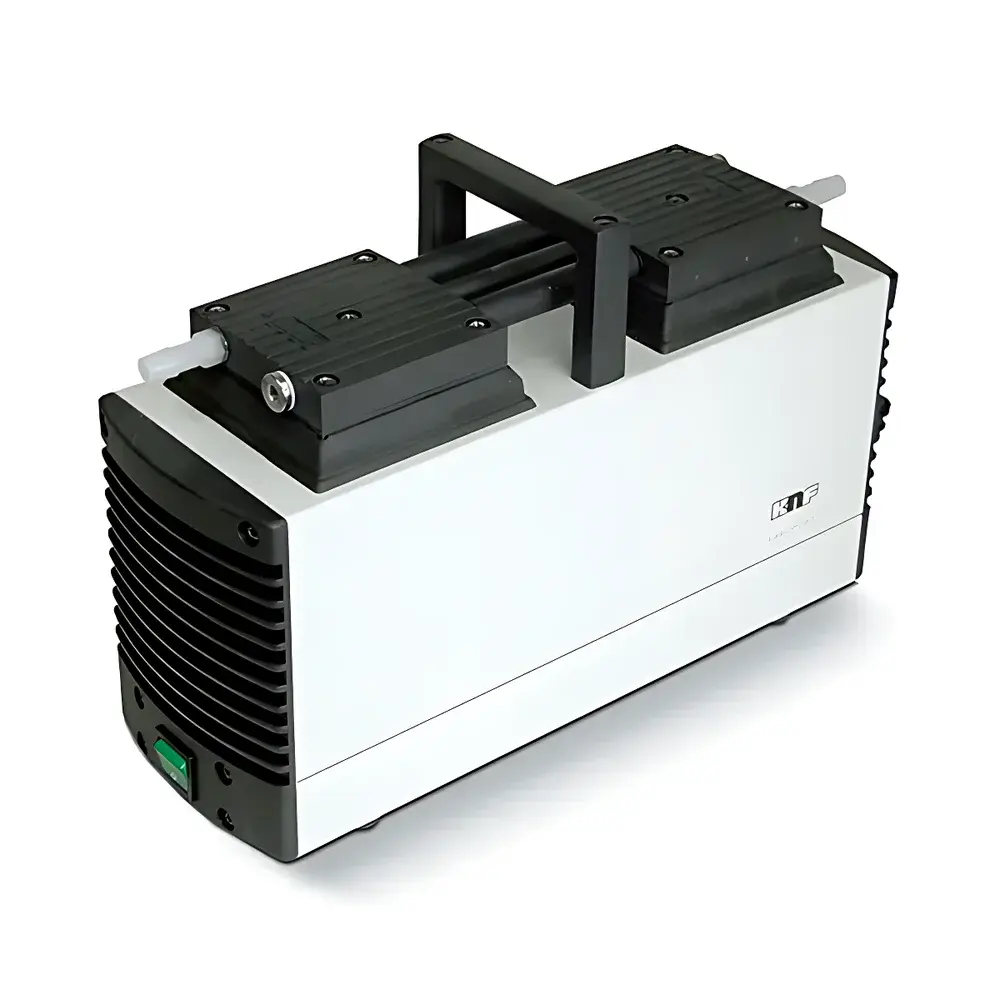
KNF N938.50KT.18 Chemically Resistant Diaphragm Vacuum Pump
| Brand | KNF |
|---|---|
| Origin | Germany |
| Model | N938.50KT.18 |
| Pump Type | Oil-Free Diaphragm Pump |
| Ultimate Vacuum | 15 mbar (abs.) |
| Suction Rate | 30 L/min |
| Maximum Pressure | 0.5 bar (g) |
| Inlet/Outlet Port ID | 10 mm |
| Pump Head Material | Polyphenylsulfone (PPS) |
| Diaphragm Material | PTFE-Coated |
| Valve Material | Perfluoroelastomer (FFKM/FFPM) |
| Dimensions (W×D×H) | 110 × 212 × 317 mm |
| Weight | 6.8 kg |
| Motor Power | 110 W |
Overview
The KNF N938.50KT.18 is a chemically resistant, oil-free diaphragm vacuum pump engineered for reliable and maintenance-free operation in demanding laboratory environments. Based on KNF’s proven dual-head diaphragm architecture, it employs a precision-machined PPS (polyphenylsulfone) pump head and PTFE-coated diaphragms to ensure long-term stability when handling aggressive vapors—including organic solvents, acidic fumes, and alkaline gases. Its ultimate vacuum performance of 15 mbar (abs.) and nominal suction rate of 30 L/min at atmospheric pressure make it especially suitable for applications requiring moderate vacuum levels with high chemical compatibility and low vibration. Designed for continuous 24/7 operation, the N938.50KT.18 eliminates oil contamination risks, avoids routine lubrication, and delivers consistent vacuum output across variable load conditions—critical for reproducible results in analytical and preparative workflows.
Key Features
- Chemical resistance certified via material selection: PPS housing, PTFE-coated elastomeric diaphragms, and FFPM (FFKM) valve components withstand exposure to common laboratory solvents (e.g., acetone, methanol, dichloromethane), dilute acids (e.g., HCl, HNO₃), and bases (e.g., NaOH).
- Oil-free operation ensures zero hydrocarbon backstreaming—essential for GC sample introduction, mass spectrometry interface support, and solvent-sensitive processes such as lyophilization or thin-film deposition.
- Compact footprint (110 × 212 × 317 mm) and lightweight design (6.8 kg) facilitate benchtop integration, mobile cart mounting, or placement beneath fume hoods without compromising accessibility.
- Integrated thermal cut-off switch and line-rated fuse provide overtemperature and overcurrent protection, supporting compliance with IEC 61000-6-3 (EMC) and IEC 61010-1 (safety for laboratory equipment).
- Low acoustic emission (<52 dB(A) at 1 m) and minimal mechanical vibration enable stable operation adjacent to sensitive instrumentation—including analytical balances, optical microscopes, and interferometric systems.
Sample Compatibility & Compliance
The N938.50KT.18 is validated for use with corrosive and condensable process streams typical in chemistry, pharmaceutical, and materials science labs. Its construction meets requirements for ISO 8573-1 Class 0 compressed air purity (when used in reverse as a pressure source) and conforms to RoHS 2011/65/EU and REACH SVHC regulations. While not intrinsically safe, its non-sparking motor and sealed drive train allow deployment in non-hazardous area classifications per ATEX Directive 2014/34/EU Category 3G. For GxP-regulated environments, the pump supports traceable operation when paired with external data loggers recording runtime, temperature, and power draw—enabling alignment with GLP documentation standards and FDA 21 CFR Part 11 audit trail requirements where electronic records are maintained.
Software & Data Management
As a standalone analog pump, the N938.50KT.18 does not include embedded firmware or digital interfaces. However, its robust analog control architecture ensures seamless integration with third-party vacuum controllers (e.g., Vacuubrand VACUU·SELECT, Agilent 7890B vacuum module) and programmable logic controllers (PLCs) via 0–10 V or 4–20 mA analog I/O. When deployed in automated systems—such as rotary evaporator clusters or parallel synthesis platforms—the pump’s consistent performance enables repeatable vacuum ramp profiles and endpoint detection based on pressure stabilization thresholds. Users may implement custom logging using USB-connected pressure transducers (e.g., MKS Baratron series) and LabVIEW or Python-based acquisition scripts—facilitating raw data archiving compliant with ALCOA+ principles (Attributable, Legible, Contemporaneous, Original, Accurate, Complete, Consistent, Enduring, Available).
Applications
- Rotary evaporation under controlled vacuum (especially with heat-labile or low-boiling solvents)
- Reduced-pressure distillation and fractional crystallization
- Solvent recovery from reaction mixtures and extraction residues
- Vacuum-assisted degassing of polymer precursors, resins, and coating formulations
- Desiccation and vacuum drying of hygroscopic compounds and biological samples
- Support vacuum for filtration manifolds, Schlenk lines, and glovebox antechambers
- Backing pump for turbomolecular or diffusion pumps in medium-vacuum hybrid systems
FAQ
Is the N938.50KT.18 suitable for pumping halogenated solvents such as chloroform or carbon tetrachloride?
Yes—its FFPM valve material and PTFE-coated diaphragm provide exceptional resistance to halogenated organics; however, prolonged exposure to saturated vapor concentrations may accelerate diaphragm fatigue. Use cold traps or condensers upstream to minimize condensate ingress.
Can this pump be operated vertically or inverted?
No—it must be installed in the orientation specified in the KNF installation manual (base-down, port-facing forward) to ensure proper diaphragm actuation geometry and thermal dissipation. Deviation may cause premature wear or seal failure.
Does KNF provide calibration certificates or factory verification reports for this model?
Standard units ship with a Declaration of Conformity (DoC) per EU Machinery Directive 2006/42/EC. Optional factory performance verification (including vacuum curve testing at 23°C ±2°C) is available upon request with traceable NIST-traceable pressure standards.
What is the expected service life under continuous duty at 80% of maximum suction capacity?
Based on KNF’s accelerated lifetime testing (IEC 60068-2-64), the diaphragm assembly maintains >95% volumetric efficiency after 15,000 hours of operation under representative chemical load conditions—equivalent to ~1.7 years of uninterrupted use.



