
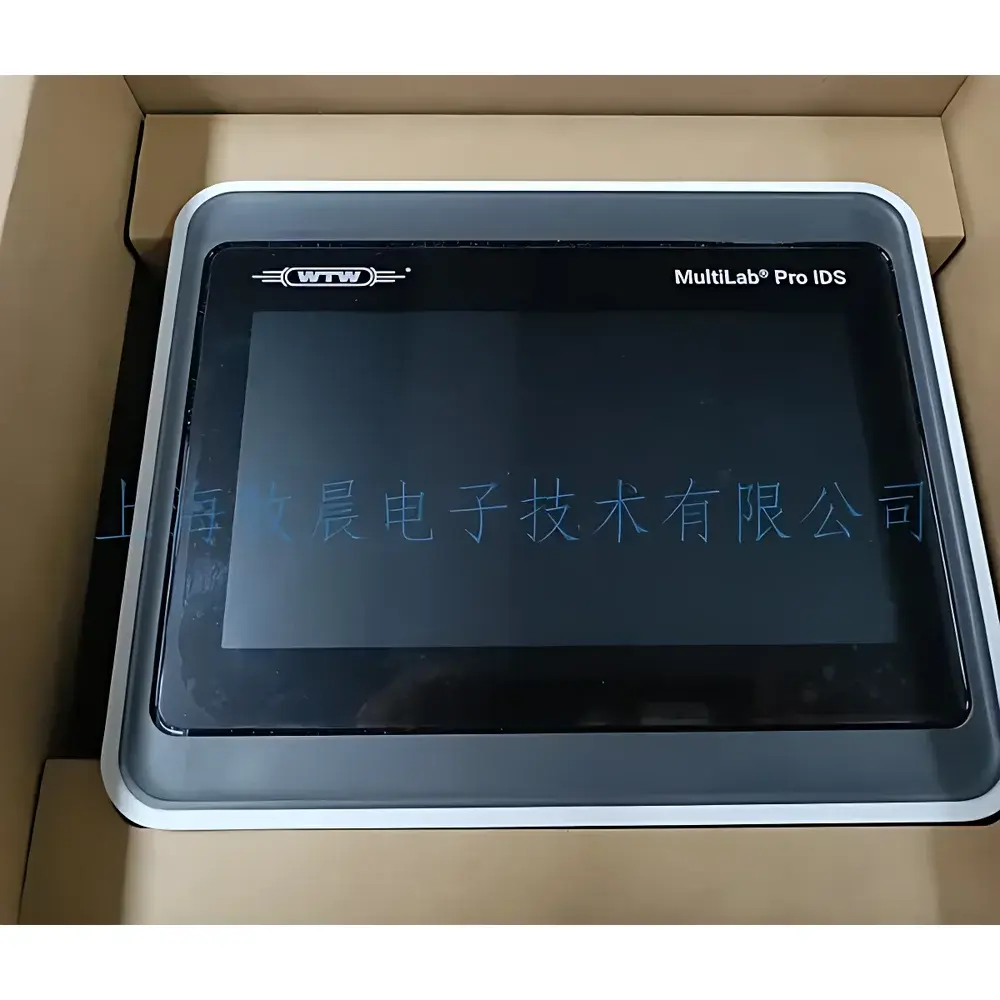
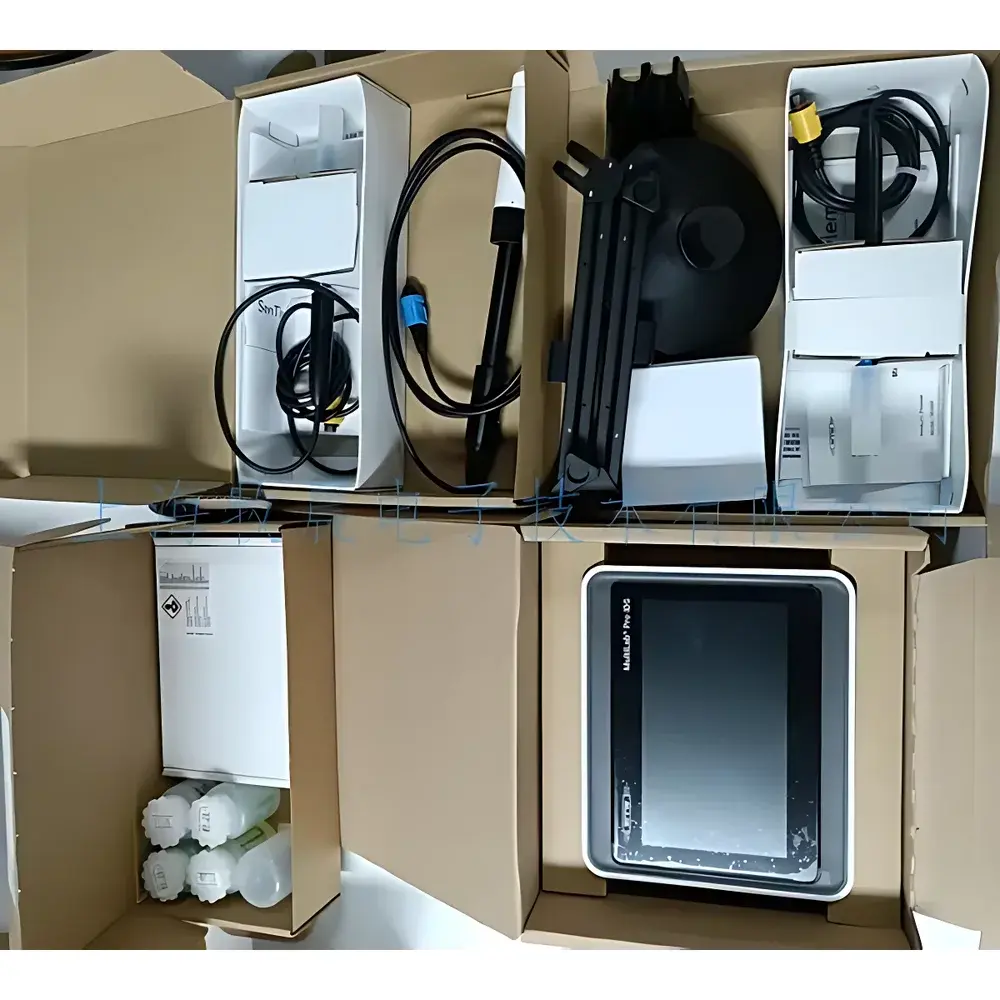
WTW MultiLab Pro40 IDS Laboratory Multiparameter Water Quality Analyzer
| Brand | WTW |
|---|---|
| Origin | Germany |
| Model | Pro40 |
| Instrument Type | Laboratory Water Quality Analyzer |
| Measurement Principle | Electrochemical Sensing (pH, ORP, Conductivity, Dissolved Oxygen) + Optical Turbidimetry |
| Measurable Parameters | pH, ORP, mV, Conductivity, Dissolved Oxygen (DO), Turbidity, ISE (upcoming) |
| Channels | 4 Electrically Isolated Input Channels |
| Display | 7-inch High-Brightness Capacitive Touchscreen with Sanitary Glass Overlay |
| Sensor Interface | IDS Digital Smart Sensor Protocol |
| Wireless Capability | Compatible with IDS Wireless Module (optional) |
| Compliance | Designed for GxP environments |
| Data Export Formats | PDF/A, JSON, CSV |
| Operating Modes | Standard Mode & GxP Mode (with configurable trial period) |
| Environmental Rating | IP65-rated enclosure (front panel) |
| Certifications | CE, RoHS, ISO/IEC 17025–supportive calibration traceability |
Overview
The WTW MultiLab Pro40 IDS is a high-precision, modular laboratory multiparameter water quality analyzer engineered for regulatory-compliant environmental, pharmaceutical, and industrial water testing. Built on WTW’s proprietary IDS (Intelligent Digital Sensor) platform, it employs electrochemical transduction principles for pH, ORP, conductivity, and dissolved oxygen measurement—each channel operating with galvanic isolation to eliminate cross-talk and ensure signal integrity across mixed-parameter workflows. Turbidity is measured via 90° scattered light detection (ISO 7027-compliant optical path), while upcoming ISE support will extend capability to ammonium, nitrate, fluoride, and other ion-specific determinations using solid-state or membrane-based potentiometric sensors. The instrument’s architecture supports up to four simultaneous, independent measurements—whether identical parameters (e.g., dual-pH verification) or heterogeneous combinations (e.g., pH + DO + conductivity + turbidity)—enabling comprehensive water matrix characterization in a single acquisition cycle.
Key Features
- Four electrically isolated analog input channels—eliminating ground-loop interference and enabling concurrent measurement of diverse electrochemical and optical parameters
- 7-inch capacitive touchscreen with chemically tempered sanitary glass—resistant to ethanol, isopropanol, and common disinfectants; operable with nitrile or latex gloves per ISO 13485 cleanroom requirements
- Full IDS digital sensor integration—automatic sensor recognition, embedded calibration history, real-time diagnostics, and firmware-upgradable transducers
- GxP-compliant operation mode—enforcing 21 CFR Part 11 requirements including user-level access control, immutable audit trail (timestamped, operator-annotated), electronic signature capture, and irreversible data lock upon finalization
- AutoRead dynamic endpoint detection—algorithmically determines measurement stability per parameter (e.g., ±0.01 pH units over 5 sec; ±0.1 mg/L DO over 10 sec), reducing subjectivity in endpoint judgment
- QSC (Quality Sensor Control) functionality—validates sensor health pre-measurement by checking reference junction potential, membrane impedance, and temperature response consistency
- Flexible method management—preconfigured templates for ASTM D1293 (pH), ISO 5814 (DO), ISO 7888 (conductivity), and USP (turbidity), plus user-defined protocols with configurable tolerances and pass/fail logic
Sample Compatibility & Compliance
The MultiLab Pro40 IDS accommodates standard 12-mm and 14-mm diameter IDS electrodes—including pH, ORP, conductivity cells (K = 0.01–10 cm⁻¹), luminescent DO probes (e.g., VisiSens™-compatible), and turbidity cuvettes (10-mm pathlength, Formazin or StablCal standards). It supports both aqueous matrices (drinking water, wastewater effluent, process water) and low-ionic-strength samples (e.g., ultrapure water, pharmaceutical rinse solutions) through adaptive conductivity cell constant compensation and low-conductivity pH electrode optimization. Regulatory alignment includes full traceability to NIST-traceable reference materials, documented uncertainty budgets per ISO/IEC 17025, and built-in compliance checks for EPA Method 150.1 (conductivity), EPA Method 365.3 (phosphate—via ISE extension), and EU Directive 2000/60/EC (Water Framework Directive) reporting structures.
Software & Data Management
Data acquisition, visualization, and export are managed via the integrated LabX®-compatible firmware (v3.2+), supporting direct LIMS integration through ASTM E1384-compliant HL7 messaging or ODBC connectivity. All measurements are timestamped with microsecond precision and stored in an encrypted SQLite database with SHA-256 hashing. Export options include PDF/A-1b (for archival), JSON (for API-driven lab informatics systems), and CSV (for statistical analysis in R or Python). Audit trails record every action—including calibration events, parameter changes, user logins, and GxP mode activation—with cryptographic integrity verification. Optional PC software (MultiLab Connect) enables remote configuration, batch report generation, and trend analysis across multi-instrument deployments.
Applications
- Environmental monitoring labs performing routine compliance testing per ISO 5667 series and national discharge permits
- Pharmaceutical QC laboratories validating purified water (PW) and water-for-injection (WFI) per USP , EP 2.2.42, and JP 2.05
- Food & beverage R&D facilities assessing process water stability, cleaning-in-place (CIP) rinse efficacy, and microbial growth risk indicators
- Academic research groups conducting limnological studies requiring synchronized pH–DO–conductivity–turbidity profiling
- Contract testing organizations (CTOs) maintaining ISO/IEC 17025 accreditation with demonstrable metrological traceability and method validation records
FAQ
Does the Pro40 IDS support wireless sensor connectivity out of the box?
No—the IDS Wireless Module (Art. No. 200200) is an optional accessory. When installed, it enables Bluetooth 5.0 communication with IDS-enabled probes, allowing measurements inside fume hoods or biosafety cabinets without cable routing.
Can I import custom calibration buffers or create multi-point calibration curves?
Yes—users may define up to 20 custom buffer sets (e.g., non-standard pH buffers, proprietary conductivity standards) and assign them to specific methods. Linear, polynomial, and segmented calibration models are supported for ISE and DO sensors.
Is the audit trail exportable for external review during regulatory inspections?
Yes—audit logs are exportable as signed PDF/A files containing all metadata (user ID, timestamp, action type, before/after values) and digitally sealed with the instrument’s embedded certificate authority.
What happens if power fails during a GxP-mode measurement?
All unsaved data is retained in non-volatile memory; upon reboot, the system resumes in GxP mode with no loss of audit integrity or calibration state—no manual recovery required.
Are firmware updates validated per IEC 62304 for medical device software lifecycle compliance?
Yes—WTW provides update release notes, regression test reports, and version-controlled firmware binaries certified under IEC 62304 Class B software safety classification, applicable when used in regulated healthcare water systems.







