
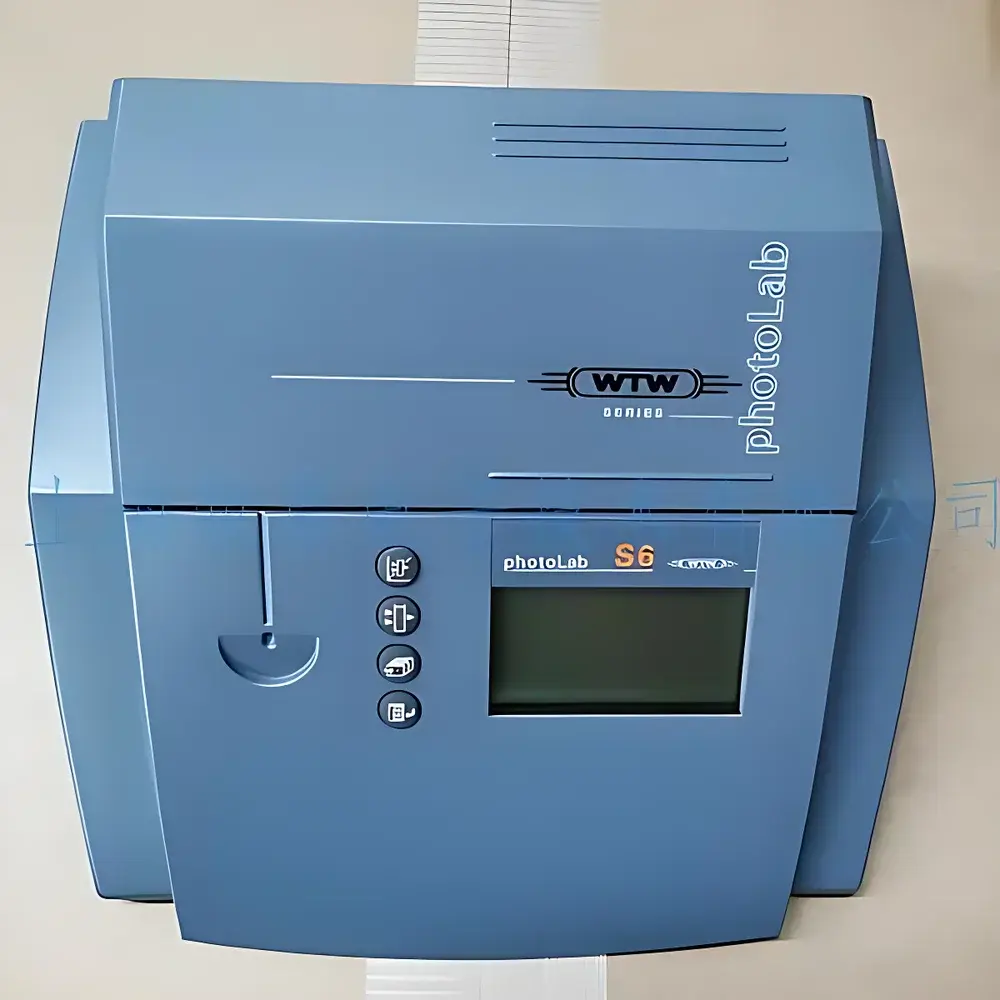
WTW photoLab S6 UV-Vis Spectrophotometer
| Brand | WTW |
|---|---|
| Origin | Germany |
| Model | photoLab S6 |
| Optical Design | Pseudo-Double-Beam |
| Wavelength Range | 340–690 nm (6 fixed interference filters) |
| Cuvette Compatibility | 16 mm and 28 mm round cuvettes |
| Auto-Method Selection | Yes (AutoSelect) |
| MemoChip Support | Yes |
| Compliance | Designed for ISO/IEC 17025-aligned routine analysis, supports GLP data integrity requirements |
| Software Interface | Standalone operation with on-device method execution and result display |
Overview
The WTW photoLab S6 UV-Vis Spectrophotometer is a robust, benchtop analytical instrument engineered for high-reliability routine water quality analysis in industrial process control, municipal wastewater treatment plants, and drinking water laboratories. It operates on the principle of absorbance photometry using a pseudo-double-beam optical architecture—where a single light source is split via time-multiplexed detection between sample and reference paths—to minimize drift and enhance measurement stability without mechanical beam choppers or moving optical components. This solid-state optical path design eliminates wear-prone mechanisms, significantly improving long-term repeatability and reducing maintenance intervals. The instrument features an integrated electronic self-check system that initiates automatically upon lid opening: it verifies lamp intensity, detector response, and optical alignment prior to measurement, ensuring traceable instrument readiness before each analysis. Its ergonomic lid doubles as both protective cover and quick-reference operational guide, printed with standardized icons and step-by-step prompts for common test sequences.
Key Features
- Pseudo-double-beam optical system with six fixed-wavelength interference filters (340, 445, 525, 550, 605, and 690 nm), optimized for EPA, ISO, and DIN-standard water parameter assays including COD, nitrate, phosphate, ammonia, and total chlorine.
- AutoSelect functionality: inserts pre-filled reagent tubes trigger automatic wavelength selection, method identification, and calibration curve application—eliminating manual method selection errors and reducing operator training burden.
- Dual-cuvette compatibility: precision-engineered adapter accommodates both 16 mm and 28 mm round glass or plastic cuvettes, supporting widely available standard reagent kits from Hach, Merck, and WTW’s own SpectroQuant line.
- MemoChip upgrade interface: field-upgradable via removable memory chip; new test methods—including updated regulatory protocols or custom user-defined calibrations—are loaded directly into onboard firmware without EPROM replacement or service technician intervention.
- Intuitive 128×64 pixel LCD display with context-sensitive on-screen guidance; all menus, status indicators, and real-time measurement feedback are presented in English with logical hierarchical navigation.
- Automatic power-on and optical diagnostics: lid actuation initiates full system check—lamp warm-up, dark current measurement, and photodiode baseline verification—ensuring metrological consistency across shifts and operators.
Sample Compatibility & Compliance
The photoLab S6 is validated for use with certified reagent systems compliant with ISO 8466-1 (calibration curve validation), ISO 7027 (turbidity), and EN ISO 15923-1 (ammonia). Its optical configuration meets the performance criteria specified in ASTM D1253 (residual chlorine) and DIN 38405-26 (phosphate). While not intended for GMP-regulated pharmaceutical release testing, its audit-ready operation—including timestamped results, method version tracking via MemoChip ID, and non-erasable measurement logs—supports GLP-compliant environmental monitoring programs. All firmware and method updates adhere to IEC 62304 software lifecycle standards. The instrument is CE-marked and conforms to EN 61326-1 (EMC) and EN 61010-1 (safety).
Software & Data Management
The photoLab S6 operates as a fully autonomous standalone platform—no PC connection required for routine measurements. All method logic, calibration data, and result storage reside in non-volatile memory. Each measurement record includes: date/time stamp, selected method name and version, cuvette type identifier, raw absorbance value, calculated concentration, and pass/fail flag against defined acceptance criteria. Up to 500 results can be stored onboard with automatic overwrite protection for flagged outliers. Data export is supported via optional RS232 serial interface (compatible with WTW LabStation software v4.x) for CSV-formatted batch transfer to LIMS or Excel. Audit trail functionality records all critical events—including MemoChip insertion, method activation, and calibration updates—with immutable timestamps.
Applications
The photoLab S6 is routinely deployed for compliance-driven analysis across three primary domains: (1) Wastewater treatment—monitoring influent/effluent parameters such as NO₃⁻-N, PO₄³⁻-P, NH₄⁺-N, and chemical oxygen demand (COD) using closed-reflux dichromate digestion; (2) Drinking water distribution—verifying disinfectant residuals (free/total chlorine), nitrite, and fluoride at sub-mg/L levels per WHO and EU Directive 98/83/EC; (3) Industrial process water—controlling boiler feedwater hardness, cooling tower biocide concentration, and rinse bath pH indicators via colorimetric endpoints. Its fixed-filter design ensures optimal signal-to-noise ratio for targeted analytes, delivering sub-2% RSD precision under ISO 5725-2 repeatability conditions.
FAQ
Does the photoLab S6 support user-defined calibration curves?
Yes—custom calibration tables can be programmed via MemoChip or LabStation software and stored alongside factory-certified methods.
Is the instrument compatible with square cuvettes?
No—the S6 accepts only round cuvettes (16 mm and 28 mm diameters); square cuvette support (10/20/50 mm) is exclusive to the photoLab S12 model.
Can measurement data be exported in CSV format?
Yes—via RS232 connection using WTW LabStation software; no proprietary drivers or cloud services are required.
What is the typical warm-up time before first measurement?
Less than 60 seconds after lid opening; full optical stabilization occurs within 90 seconds under ambient lab conditions (20–25 °C).
Does the photoLab S6 comply with FDA 21 CFR Part 11 requirements?
It does not include electronic signature or role-based access control features; however, its immutable timestamped logs and method versioning support Part 11-aligned data integrity practices when integrated into validated workflows.
Related Products





