
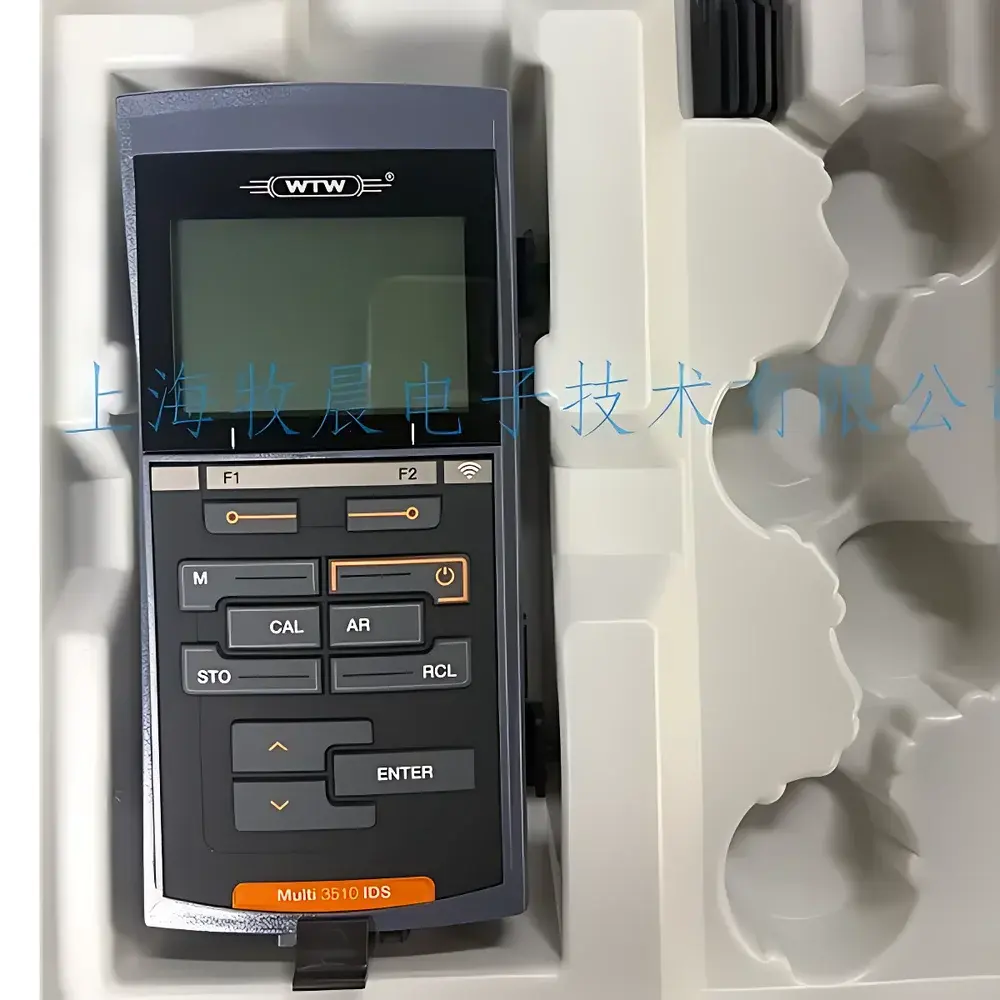
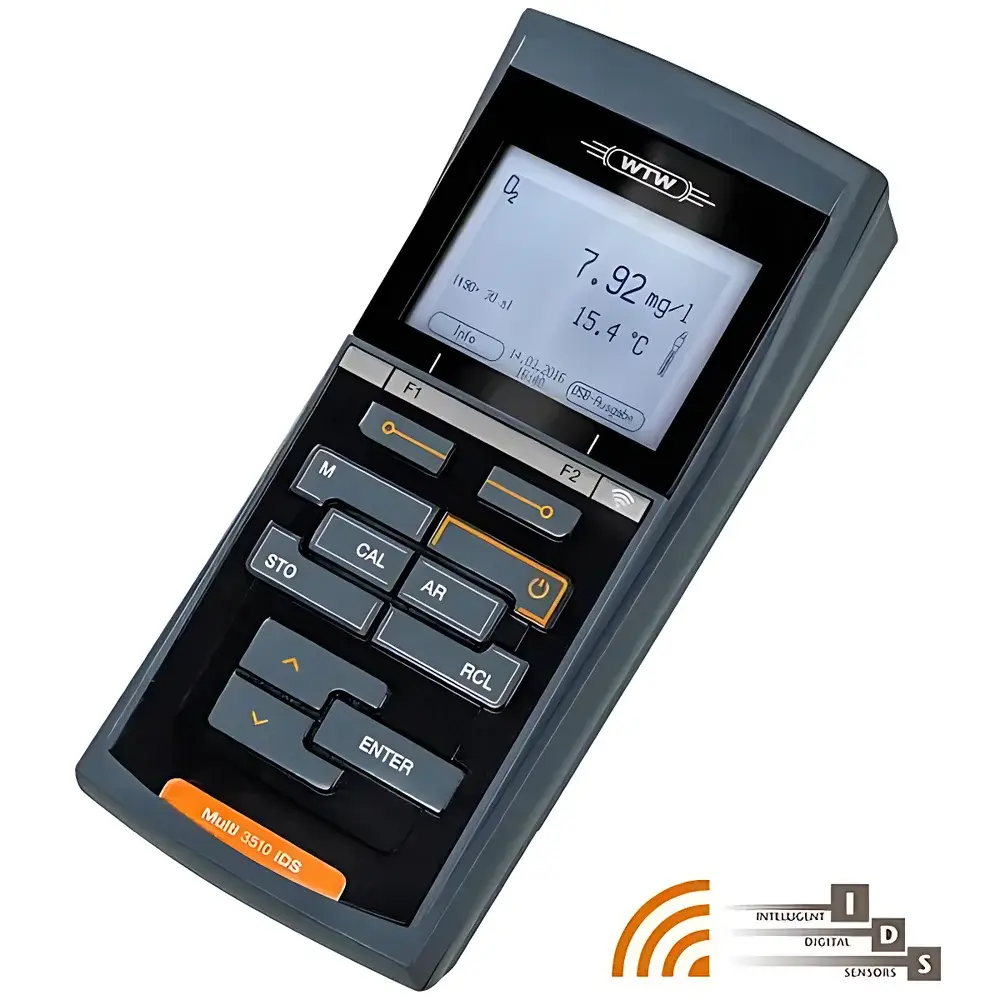
WTW Multi 3510 2FD353 Portable Multiparameter Water Quality Analyzer
| Brand | WTW |
|---|---|
| Origin | Germany |
| Model | Multi 3510 2FD353 |
| Instrument Type | Portable/HANDHELD Water Quality Analyzer |
| Detection Principle | Electrochemical Method |
| Measured Parameters | Dissolved Oxygen, pH, ORP, Conductivity, Turbidity |
| Repeatability | <1% |
| Display | LCD with Graphical Interface |
| Data Storage | Up to 10,000 Sets (Manual & Time-Controlled) |
| Connectivity | Micro-USB-B, Optional Wireless Module |
| Protection Rating | IP67 |
| Power Supply | 4 × AA Alkaline or 4 × 1.2 V NiMH Rechargeable Batteries / USB Bus Power |
| Probe Interface | Digital IDS (Intelligent Digital Sensor) Technology |
| Auto-Sensor Recognition | Yes |
| Calibration Data Storage | Embedded in IDS Probes |
| Electrical Isolation | Yes (Signal Integrity Preservation) |
Overview
The WTW Multi 3510 2FD353 is a high-precision, portable multiparameter water quality analyzer engineered for field-deployable environmental monitoring and routine laboratory verification. Built upon WTW’s Intelligent Digital Sensor (IDS) platform, the instrument employs electrochemical sensing principles—including potentiometric (pH/ORP), amperometric (dissolved oxygen), conductometric (conductivity/resistivity/salinity/TDS), and nephelometric (turbidity) measurement modalities—to deliver traceable, reproducible results across diverse aquatic matrices. Its modular architecture supports plug-and-play integration of certified IDS probes—such as the SenTix 940 pH electrode, TetraCon 925 conductivity sensor, FDO 925 optical dissolved oxygen probe, and VisoTurb 900-P turbidity sensor—enabling simultaneous, multi-parameter acquisition without cross-sensitivity artifacts. Designed for compliance-critical workflows, the device meets CE marking requirements and incorporates hardware-level electrical isolation to eliminate ground-loop interference during in-situ measurements in industrial effluents, surface waters, groundwater, and wastewater treatment streams.
Key Features
- Digital IDS interface with automatic probe recognition and embedded calibration memory—eliminates manual parameter entry and ensures metrological traceability per probe
- Graphical LCD display supporting real-time trend visualization, multi-parameter overlays, and intuitive menu navigation
- IP67-rated enclosure rated for dust-tight operation and temporary submersion—validated for use in rain, mud, and splash-prone environments
- Rechargeable NiMH battery system with USB bus-power capability and low-power sleep mode extending operational runtime beyond 100 hours per charge cycle
- Onboard data logger storing up to 10,000 measurement sets (manual or time-triggered at user-defined intervals from 1 s to 24 h)
- Micro-USB-B port compliant with standard mass-storage class protocols—enables direct file export to Windows/macOS/Linux without proprietary drivers
- Optional wireless module (sold separately) enabling Bluetooth® 4.2 LE communication with iOS/Android tablets for remote probe deployment and live dashboarding
- Built-in temperature compensation algorithms per parameter (e.g., linear/nonlinear NIST-based conductivity correction, auto-compensated DO solubility modeling)
Sample Compatibility & Compliance
The Multi 3510 2FD353 is validated for use with natural waters (freshwater, estuarine, seawater), treated drinking water, municipal and industrial wastewater, leachate, and process streams. Its IDS probe ecosystem conforms to ISO 7888 (conductivity), ISO 5814 (electrochemical DO), ISO 7027 (turbidity), and ASTM D1293 (pH of water). The instrument’s firmware supports GLP-compliant operation: all measurements are timestamped, tagged with operator ID (configurable), and retain full audit trails of calibration events—including date, standard values, slope/offset, and probe serial numbers. While not pre-certified for FDA 21 CFR Part 11, its data export structure (CSV/Excel-compatible) and immutable logging architecture facilitate validation under GMP/GLP quality systems when deployed with documented SOPs.
Software & Data Management
Raw data export occurs via standard USB mass storage mode—no proprietary software required. Files are saved as UTF-8 encoded CSV with headers including UTC timestamp, parameter name, measured value, unit, probe ID, temperature, and QC flags (e.g., “CAL_EXPIRED”, “SENSOR_OFFLINE”). Optional WTW LabX® Light software (Windows only) provides advanced features: automated report generation (PDF/DOCX), statistical process control charts (X-bar/R), outlier detection using Grubbs’ test, and batch calibration management. All calibration records are digitally signed and exportable in PDF/A-1a format for regulatory submission. Firmware updates are delivered via signed .hex files verified through SHA-256 hash integrity checks.
Applications
- Field-based ambient water quality surveys (EPA Region 10, EU WFD monitoring programs)
- Wastewater treatment plant influent/effluent compliance reporting (BOD/COD surrogate monitoring via DO/conductivity trends)
- Drinking water distribution system integrity assessment (chloride breakthrough detection via conductivity spikes)
- Aquaculture pond health management (real-time DO/pH/turbidity correlation for feeding optimization)
- Environmental impact assessments (baseline characterization of construction site runoff, landfill leachate plumes)
- Educational laboratories requiring NIST-traceable, student-safe instrumentation with minimal consumables
FAQ
Does the Multi 3510 2FD353 support GLP-compliant data handling?
Yes—the instrument logs operator ID, calibration history, timestamps, and probe metadata automatically. Exported CSV files contain all fields required for audit-ready documentation.
Can IDS probes be calibrated independently of the meter?
Yes—calibration coefficients and offset values are stored directly in each probe’s internal EEPROM. A calibrated probe retains its settings when connected to any compatible IDS host (e.g., Multi 3630, pH 3310).
Is temperature compensation applied automatically during conductivity measurement?
Yes—temperature is measured continuously by the IDS conductivity probe itself; the instrument applies either linear (α = 2.0 %/°C) or non-linear (ISO 7888) compensation based on user selection.
What is the maximum cable length supported for IDS probes?
Standard IDS cables are 1.5 m; extension cables up to 10 m are available (part no. 201920) with verified signal integrity up to 200 kS/s sampling rate.
How is electrical isolation implemented in the IDS interface?
Each IDS port includes galvanic isolation rated to 1 kV DC between probe electronics and the main unit—preventing ground loops and ensuring stable readings in high-noise industrial sites.







