
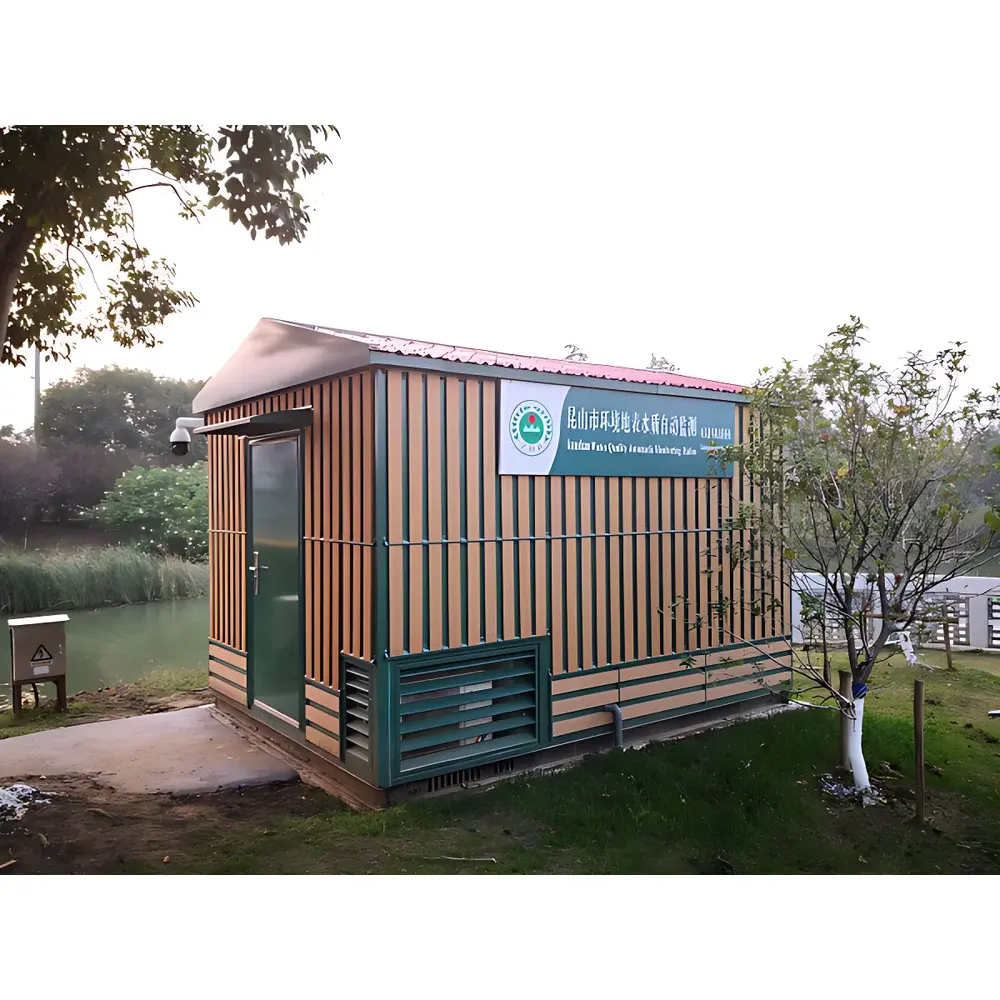
Zming Environmental Technology ZM-AMWS Compact Online Water Quality Monitoring Station
| Brand | Zming Environmental Technology Co., Ltd. |
|---|---|
| Origin | Shanghai, China |
| Manufacturer Type | Authorized Distributor |
| Country of Origin | China |
| Model | ZM-AMWS Analysis Shelter |
| Pricing | Available Upon Request |
Overview
The Zming Environmental Technology ZM-AMWS Compact Online Water Quality Monitoring Station is a fully integrated, shelter-based environmental monitoring system engineered for continuous, unattended operation at surface water monitoring sites—including regulatory compliance sections, ecological compensation points, and watershed boundary stations. It operates on a modular architecture centered around certified online analyzers, combining electrochemical, optical, and physical sensing principles with industrial-grade automation and telemetry. Core measurement methodologies comply with national standard methods (e.g., GB/T 5750, HJ series standards), ensuring traceable data generation aligned with China’s Environmental Monitoring Technical Specifications. The station supports simultaneous real-time acquisition of physicochemical, biological, and hydrological parameters—enabling longitudinal trend analysis, early warning of pollution events, and long-term water quality assessment under varying flow and seasonal conditions.
Key Features
- Multi-parameter modularity: Pre-integrated sensor modules for temperature, pH/ORP, conductivity, dissolved oxygen (optical or electrochemical), turbidity (nephelometric, 90° scattering), permanganate index (KMnO₄ titrimetric method), ammonia nitrogen (colorimetric indophenol blue), total phosphorus (persulfate digestion + molybdenum blue), and total nitrogen (alkaline potassium persulfate digestion + UV spectrophotometry).
- Expandable analytical capability: Optional add-on modules for fluoride (ion-selective electrode), heavy metals (anodic stripping voltammetry or ICP-OES-ready sample preconcentration), chlorophyll-a (in vivo fluorescence), and phycocyanin (for cyanobacterial biomass estimation).
- Hydrological integration: Ultrasonic or pressure-based level sensors; electromagnetic or Doppler-based flow/velocity transducers—all calibrated per ISO 748 and ISO 4359 requirements.
- Autonomous operation: Programmable sampling intervals (15 min to 24 h), automatic calibration verification cycles, and scheduled cleaning protocols reduce manual intervention to ≤1 visit per quarter.
- Intelligent event response: Onboard logic triggers sample preservation (4°C refrigerated auto-sampler) upon exceedance of user-defined thresholds; all triggered events are time-stamped and logged with raw sensor outputs.
- Robust enclosure design: IP65-rated climate-controlled analysis shelter (standard ZM-AMWS model), equipped with surge protection, uninterruptible power supply (UPS) interface, and anti-fouling sensor housings suitable for low-to-moderate biofouling environments.
Sample Compatibility & Compliance
The ZM-AMWS is validated for use with natural freshwater systems—including rivers, lakes, reservoirs, and canals—with suspended solids < 100 mg/L and salinity < 5 ppt. All onboard analyzers undergo factory calibration against NIST-traceable reference materials. Data integrity adheres to China’s HJ 353–2019 (Technical Specifications for Online Monitoring Systems of Pollutant Sources) and HJ 354–2019 (Acceptance Criteria for Online Monitoring Systems). System-level audit trails, electronic signatures, and data encryption support GLP-aligned operational practices. While not FDA 21 CFR Part 11-certified out-of-the-box, the platform’s software architecture permits configuration for electronic record retention compliant with ISO/IEC 17025:2017 Clause 7.5 requirements.
Software & Data Management
The station interfaces with Zming’s proprietary ZM-DataLink SCADA platform via RS-485, Modbus TCP, or 4G LTE (with optional NB-IoT fallback). Real-time data streams are structured in JSON format with ISO 8601 timestamps and embedded metadata (sensor ID, calibration status, QC flag). Local edge storage retains ≥30 days of high-frequency data; cloud synchronization occurs hourly with TLS 1.2 encryption. The web-based dashboard supports customizable alarm rules (SMS/email push), automated PDF report generation (daily/weekly/monthly), and export to CSV, Excel, or EPA-compatible WQX format. Role-based access control (RBAC) enables multi-agency collaboration while maintaining data sovereignty.
Applications
- Regulatory compliance monitoring at national and provincial surface water quality assessment sections (e.g., “National Surface Water Quality Monitoring Network” nodes).
- Ecological compensation verification—quantifying nutrient load reductions across administrative boundaries.
- Early detection of algal bloom precursors via synchronized chlorophyll-a, phycocyanin, and nutrient dynamics.
- Wastewater discharge impact assessment near effluent mixing zones using gradient-based spatial profiling.
- Hydrological–water quality coupling studies supporting SWAT or QUAL2K model calibration.
- Long-term trend analysis for SDG Indicator 6.3.2 (proportion of bodies of water with good ambient water quality).
FAQ
Does the ZM-AMWS support remote firmware updates and diagnostic logging?
Yes—secure OTA (Over-The-Air) updates are supported via authenticated HTTPS channels; diagnostic logs include sensor health metrics, power consumption history, and communication latency statistics.
Can third-party sensors be integrated into the ZM-AMWS platform?
Yes—Modbus RTU/ASCII and analog (4–20 mA / 0–5 V) inputs are provided; custom driver development is available under NDA for OEM sensor partnerships.
What is the recommended maintenance schedule for field deployment?
Bi-weekly visual inspection; quarterly sensor cleaning and calibration verification; annual full-system functional test per HJ 355–2019 guidelines.
Is the system capable of operating in freezing ambient conditions?
Standard ZM-AMWS shelters operate from −10 °C to +50 °C; optional heated enclosure kits extend functionality to −30 °C for northern deployments.
How is data security ensured during wireless transmission?
All cellular communications use SIM-locking, APN isolation, and end-to-end AES-256 encryption; TLS 1.2 handshake is mandatory for cloud API endpoints.
Related Products







